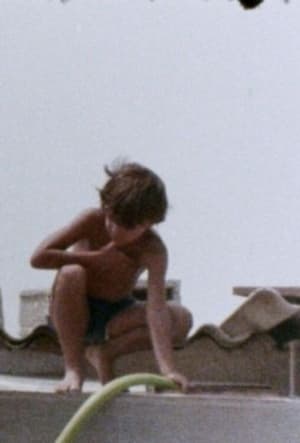
“Sardar Gurcharan Singh was the father of studio pottery in India. "Daddyji" as most called him lovingly was very close to my father. I often tagged along to visit his home studio where pottery wheels were lined up under the big neem trees in his old brick house. My father wanted me to make a film on Daddyji, who was then 95. He was afraid that Daddyji's wonderful story would be left untold. He not only introduced studio pottery in India but due to his longevity, mentored many potters. So despite not knowing anything about films, I made the documentary, Imprint in Clay with a classmate of mine, which was mostly funded by my father.”
This half-hour documentary by acclaimed director Jonathan Demme ("The Silence of the Lambs") captures singer-songwriter Neil Young and his hard-rocking backing band Crazy Horse "live" in the studio playing a set of four songs. These sessions took place at the Complex Recording Studios in Los Angeles on October 3, 1994, just one day after Young's critically-lauded Bridge School Benefit concert. Earlier that year, Young and his band had recorded the studio album "Sleeps with Angels" at the Complex studios and came back to film a series of music videos. Jonathan Demme was there to document the recording session, which began at 6:30 pm on a Monday evening and concluded at 4:30 am the next day. "The Complex Sessions" is the result of these sessions. Set List: 1. My Heart (3:08), 2. Prime of Life (4:44), 3. Change Your Mind (14:56), 4. Piece of Crap (3:08).
Jean-Luc Godard visits NYU in order to discuss his latest feature "La chinoise" with graduate students on filmmaking and politics.
Naomi Kawase observes people in the city of Shibuya with curiosity and openness, drawing parallels between life and filmmaking and discovering her abilities as a filmmaker.
Ken Blanchard describes six keys to successful teamwork, all found in a Hollywood movie classic.
An experimental cut-up portrait of Maggie Chung made by Olivier Assayas for the Foundation of Contemporary Art.
This documentary is an informal portrait of the great modern composer Igor Stravinsky. Proudly American, though still very much an Old World figure with a long and alert memory for people and events in music, literature and art, Stravinsky is depicted here conducting the CBC Symphony Orchestra in a recording of his Symphony of Psalms.
A new film compiled from the BFI National Archive's unparalleled holdings of early films of China, features films from 1900-48 filmed across China. The cinematic journey of Around China with a Movie Camera contains many films which may never have been seen in China, or at the very least not for over 70 years. These travelogues, newsreels and home movies were made by a diverse group of British and French filmmakers, some professionals, but mainly enthusiastic amateurs, including intrepid tourists, colonial-era expatriates and Christian missionaries.
A set of seven portraits consisting of personal accounts from the lives of gays and lesbians. The narration includes stories about coming out, bashing, cross-dressing and AIDS.
Second part of a three-part documentary series on the making of Once Upon a Time in the West, Italian filmmaker Sergio Leone's masterpiece, released in 1968. (Preceded by An Opera of Violence; followed by Something to Do With Death.)
Third part of a three-part documentary series on the making of Once Upon a Time in the West, Italian filmmaker Sergio Leone's masterpiece, released in 1968. (Preceded by The Wages of Sin.)
Educational film about solar energy, told with striking imagery and animation.
This short documentary features a portrait of Ottawa in the mid-20th century, as the nascent Canadian capital grew with force but without direction. Street congestion, air pollution, and rail traffic were all the negative results of a city that had grown without being properly planned. French architect and urban designer Jacques Gréber stepped in to create a far-sighted plan for the future development of Ottawa. With tracks moved, factories relocated, and neighbourhoods redesigned as separate communities, Ottawa became the capital city of true beauty and dignity we know today.
Zdenek Pešánek created the first public kinetic sculpture, for the power station in Prague. This short experimental film focuses on a kinetic sculpture by Zdenek Pešánek. For a period of eight years it issued beams of light from the outside wall of a transformer station at Prague’s power utility before its destruction in 1939. Though genuine, these shots seem abstract to us. They are a rhythmically assembled ode to the light-creating devices and phenomena of electricity. Light arcs, coils, bulbs and various luminous elements support the alternation of positive and negative film images, creating an impressive universe of light and shade. In the 1920s, Pešánek had obtained financial support for his work with electric kinetic light art. In the 1930s, he was the first sculptor to use neon lights. He built several kinetic light pianos, and published a book titled “Kinetismus” in 1941. —http://www.centerforvisualmusic.org
Down the gangway, photographers leave the deck of a riverboat in large numbers.
Lively holiday in Blackpool, with jazz accompaniment.
A retrospective documentary of the cult classic movie The Goonies. Including interviews with the cast, exploration of the film's locations and unique stories you wont hear anywhere else.
An animated film about the British engineer Isambard Kingdom Brunel, who spearheaded numerous engineering marvels of the early 19th century - including the Thames Tunnel, the Great Western Railway, and the Great Eastern steamship (for 40 years the world's largest steamship). Various styles of animation are used to depict events in his colorful life.
Retrospective documentary on the making of the cult classic "Willy Wonka & the Chocolate Factory."
Long treated with indifference by critics and historians, British silent cinema has only recently undergone the reevaluation it has long deserved, revealing it to be far richer than previously acknowledged. This documentary, featuring clips from a remarkable range of films, celebrates the early years of British filmmaking and spans from such pioneers as George Albert Smith and Cecil Hepworth to such later figures as Anthony Asquith, Maurice Elvey and, of course, Alfred Hitchcock.