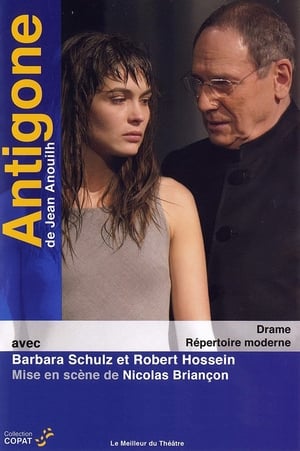
Having defied the ban on Creon and offered a burial to Polynice, her treacherous homeland brother, Antigone is condemned to a slow death in a stone tomb, despite the interposition of Hémon, her fiance, the son of Creon . Nevertheless, Creon ends up following the advice of his diviner Tiresias and, fearing the wrath of the gods, buries Polynices with dignity. When he is about to free Antigone, the young woman had already hanged herself. Mad with pain, Hémon commits suicide by his side.
July 1944: at a fascist front school in occupied Greece, Captain Weirauch, a civilian professor of classical Greek studies, gives a lecture on guilt and atonement in Sophocles' tragedy Oedipus the King.
Oedipus's wanderings come to an end when he finds his final resting place, as foretold by the gods. But his brother-in-law and his son each try to take him away.
In a final battle for the control of Thebes, Oedipus's two sons kill each other. Creon issues an order that no one is to bury Polynices upon pain of death. But Antigone is determined that her brother's body will have the proper rites of burial.
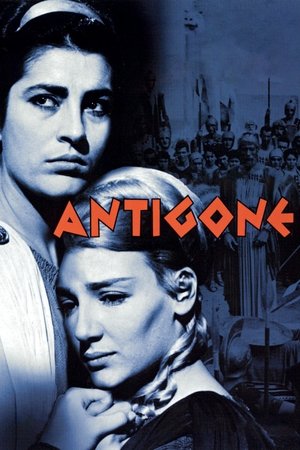
In Thebes in ancient Greece, King Oedipus kills his father and marries his mother Jocasta, having two sons - Eteocles and Polyneices - and two daughters - Ismene and Antigone. King Oedipus dies a beggar in the exile after gouging out his own eye, and Eteocle agrees to reign in Thebes in alternating years with Polynices. However, he refuses to resign after the first year and Polynieces raises an army and attacks Thebes, and they kill each other. The ruler of Thebes Creon decrees that Eleocles should have an honorable burial while the body of the traitor Polyneices should be left on the battlefield to be eaten by the jackals and vultures. However, Antigone, who was betrothed to Creon's surviving son Haemon, defies Creon's orders and buries her brother. When Creon is reported of the attitude of Antigone, he sentences her to be placed in a tomb alive. Antigone hangs herself in the tomb and Haemon tries to kill his father first and then he kills himself with his sword...
Two sisters reunite on the anniversary of the death of their father. Their uncle has remodelled their family home, in an attempt at a fresh start. But one sister's sudden reappearance threatens to shatter this fragile idyll as she demands justice for the pain she carries. Amid the debris and the new extension, guilt, grief and greed battle it out in the family's competing dreams of their future. When we are faced with the suffering of others, even those closest to us, can we look away?
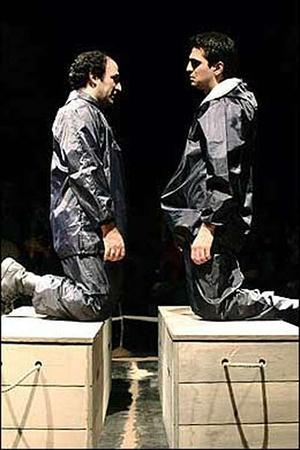
In a Nazi concentration camp, Karl, a German political prisoner, and David, a Jewish watchmaker, are confined in a small enclosure from which only one of them will be able to go out alive.
The story is about a drug ring and the finally successful efforts of the Paris police to break it up. A young detective goes into a den in Paris' Chinatown, following a clue, and that is the last seen of him until his body is found floating in the Seine several days later. The only clue is a woman's glove. The dead man's friends on the force vow to avenge him, and receive information leading them to suspect one Sandra, a beautiful foreigner, played by the stunning Marcelle Chantal.
This Punjabi Movie, Dukh Bhanjan Tera Naam is a Punjabi movie about Sikhism. It was a great success. It portrays the people's belief in the almighty god who is one and how life teaches a lesson to those who does not believe so.
After librarian Isolde attempts suicide, she leaves her politician husband for a younger student with a dark past. Isolde's former husband, however, has something else in mind for the young man.
Twelve Angry Men is a 1954 teleplay by Reginald Rose for the Studio One anthology television series. Initially staged as a CBS live production on 20 September 1954, the drama was later rewritten for the stage in 1955 under the same title and again for a feature film, 12 Angry Men (1957). The episode garnered three Emmy Awards for writer Rose, director Franklin Schaffner and Robert Cummings as Best Actor.
On his 21st birthday, Davy wanders into a gay bar and meets the man of his dreams.
AMG auteur Richard Fontaine started making short, silent posing-pouch snapshot films in the mid-1950s and moved on to sound titles like In the Days of Greek Gods (1958) and Muscles from Outer Space (1962), which featured narratives as well as nudity. Fontaine's films are among the first gay-campaigning documents in American cinema--he often managed to include references to the lowly status of the homosexual. His first feature-length erotic film, In Love Again, is more like propaganda than porn. (from: http://www.glbtq.com/arts/film,3.html)
A teenage hypochondriac and his equally peculiar mother, father and adolescent sister set out on a tumultuous road trip from Amsterdam to Spain when a family member falls severely ill.
In a fancy restaurant, Ben plans to propose to his long time girlfriend only to find out that his ring was mistakenly sent to the wrong table.
A wandering pilgrim encounters a stranger while searching for a fabled monastery.
Following a terrible accident at home, Elia loses his memory. His wife tries to help him through a long conversation to piece together their life and perhaps give him a chance to reinvent himself.
When the Vichy authorities close the Elna Maternity Hospital, which welcomes pregnant women from the concentration camps, its director, Elisabeth, and Victoria, will sacrifice themselves to save it. Television film written by Margarita Melgar and directed by Sílvia Quer (' 'Velvet' ', (' 'Gran Hotel' '), set in northern Catalonia during the summer of 1942. The film is based on real events and narrates the prowess of Elisabeth Eidenbenz, founder of Elna's Maternity, which along with her collaborators restored dignity to pregnant women in the Argelers and Ribesaltes internment camps in Vichy France Motherhood welcomed hundreds of women and saved 597 babies from certain death.
A family believes they are aliens from other planets and tries to save Earth from impending calamity.