In 1879, Kenshin and his allies face their strongest enemy yet: his former brother-in-law Enishi Yukishiro and his minions, who've vowed their revenge.
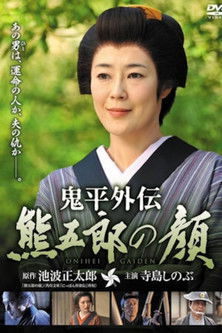
A successful textile industrialist from the provinces, who is beloved by his employees for his kindness, cannot find a wife because of a disfiguring birthmark on his face. Even the courtesans in Yoshiwara refuse to entertain him, until an indentured peasant prostitute, Tamarazu, takes the unsavoury assignment and treats him with brash tenderness.
It's a rare occasion when a noted filmmaker like Yamauchi Tetsuya gets to re-visit a previous film, and in this re-make of NINJA GARI, he not only does that, but has created an even better piece. While the original from 1964 starred the great old-time actor Konoe Jushiro, this version is perfectly cast with his son Matsukata Hiroki in the lead as Wadakuro, one of four ronin hired to fight against the Shogunate's plot to abolish the Gamo Clan, who are struggling to reinstate their young heir Tanemaru as their Lord. Facing the threat of the Koga Ninja, Wadakuro shows his own cruelty while on a personal vendetta. This is a very brutal film, with lots of realistic ninja action, violent deaths, a dark story line and is completely without any light-hearted 'humor' elements that Toei used to incorperate back in the golden era. And with Matsukata Hiroki's outstanding martial skills, the swordplay is even better in this one. This is definitely one of the best ninja movies ever made!
After being betrayed by his peers and lost both his father and his right arm, legendary craftsman "Jingoro Hidari" is on a journey of revenge with his partner "Sleeping Cat" and his mechanical prosthetic arm. Finally, Jingoro faces one of his adversaries "Inumaru" in a fight to the death...
A sage travels to the past and collects a set of eight legendary swords, which bring to life a gang of talented but dysfunctional young warriors. The warriors know that Nobunaga Oda was supposed to die at the Honno-ji incident in 1582, but in this timeline he didn’t. To revert back to the original history, the warriors must travel back in time to assassinate Nobunaga Oda.
During Japan's Warring States period three young Tokugawa vassals head their separate ways after Takeda Shingen's forces overran their castle. When they next meet they have all joined opposing sides.
The Go-Ongers intercept the Recycle Barbaric Machine Beast Army in their Engines, managing to scrap the 13. However, trio of mysterious warriors appear and their actions result in the Go-Ongers losing the primary Engine Casts while being sucked into the Braneworld known as Samurai World, a dimension similar to Edo Japan where power is essential.
In July of 1864, in an incident at the Ikedaya Inn in Kyoto, thirty Shinsengumi suppressed a cell of twenty Choshu revolutionaries, possibly preventing the burning of Kyoto. The incident made the squad more famous and led to soldiers enlisting in the squad. The leader is Hijikata Toshizo, who is said to have been a spoiled brat in his childhood. One day, Toshizo discovers a woman thief with a stolen purse. In the purse, a note mentioning the name of Ito Kashitaro is found detailing illegal operations. Toshizo fears will become true. There is a rift in Shinsengumi.
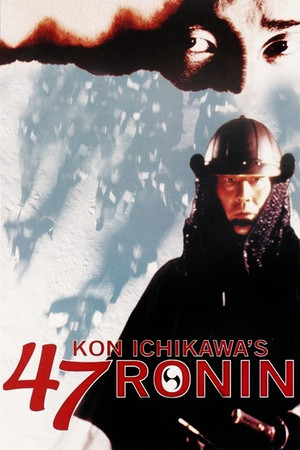
While the story of the Ako Clan's vendetta has been told countless times, never before has there been an array of major motion picture stars to bring new life to this timeless tale. Starting with the corrupt practices of Lord Kira and Yanagi-sawa, the Shogun's Secretary, which in essence led to the incident of Lord Asano's attacking Kira in the Pine Corridor of the Shogun's Palace, this is the definitive version. Asano Takumi no kami was a young lord with high scruples, who refused to join in the general corruption and bribery which ran rampant in the capital at that time. By not giving bribes, he angered Kira Kozuke no suke the elder lord in charge of protocol at the Palace. Refusing to teach the younger man, and giving him false instructions was only the beginning. Insults followed, and a man of honor had no choice but to draw his sword in anger. Forty seven masterless samurai are willing to give their lives to avenge their lord.
Araki Mataemon was a very strong warrior, and his feud against the samurai Kawai Matagorō is one of the most famous in Japan. Matagoro killed Gendayu, the little brother of Mataemon's brother in law, Watanabe Kazuma. Becoming a murderer out of jealousy for a childhood friend, Matagoro fled in another domain, using friends of his father and his lineage linked to Tokugawa Ieyasu. It was somehow a complicated matter, as it seems at that time, a law from Toyotomi Hideyoshi allowed a little brother taking revenge for his elder brother, but not the reverse. After some years, the lord of Kazuma and Mataemon found a way, and they were allowed to take revenge for the murder. They fought and killed Matagoro and just one other samurai who was helping the culprit. It seems at that time, Kazuma was Mataemon's only assistant.
In the midst of an industrial revolution, the people of Hinomoto fight hordes of undead creatures, known as Kabane, using powerful armored trains. Half a year after the events of the original TV series, the heroes of the Iron Fortress attempt to take back Unato Castle.
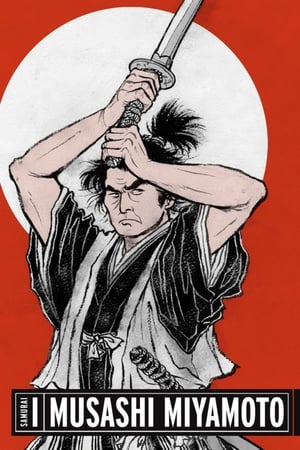
The first film in the 1953 trilogy based on the long novel series The Great Bodhisattva Pass.
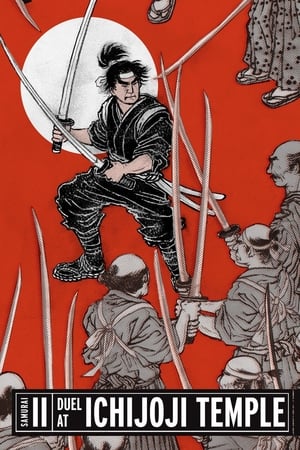
The second film in the 1953 trilogy based on the long novel series The Great Bodhisattva Pass.
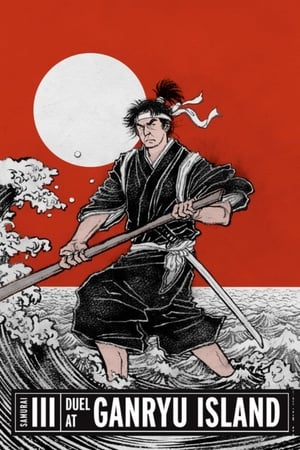
The final film in the 1953 trilogy based on the long novel series The Great Bodhisattva Pass.
Bored Hatamoto film #20
Chuji Kunisada returns to his home village to find that Jubei Matsui, the corrupt magistrate, has been responsible for virtually destroying Kunisada's family. A final tragedy leads Kunisada to join with a band of rogues living in the forest in robbing from the rich and giving to the poor, always with an eye toward avenging himself on Magistrate Matsui.
When feudal lord Itakura Katsuakira decides to prepare his samurai troops for the onslaught of modernization by having them compete in a marathon, his independent-minded daughter Yuki secretly joins the race.
The film is inspired by Miyamoto Musashi who was one of the most famous Japanese ronin and warrior philosophers. This very alternate and visual interpretation of the fate of Miyamoto is brought into a mixture of contemporary Yakuza underworld and a hypnotic Samurai after-life. We flow seamlessly between through life, death, rebirth and the afterlife and challenge our traditional definition of the past, present and future. The film explores the agonizing and painful processes that go through the shattered mind of Miyamoto, as he desperately tries to hold on to the only thing he has left - The rapidly fading memories of his undying love for a woman named, Otsu. A love that for a Yakuza-Samurai is strictly forbidden and which will prove to have catastrophic consequences.
Heizo's cousin Senemon Misawa and his son Katsuzo visited Heizo's home. Heizo learns that Senemon has fallen in love with Katsutoshi, a woman who works at the Yamabukiya Tea House, and has asked her to marry him. Heizo decided to visit Yamabukiya, saying "I will try to find out if this woman is a bodhisattva or a demon." After meeting Katsutoshi Heizo, felt embarrassed and ordered Gorozo to inquire about her just in case. Gorozo, in turn, sends secret detective Rihachi to Yamabukiya with the task of keeping an eye on Katsutoshi...
Heizo "The Demon" investigates the shop of Toshimaya the swordsmith, where 280 ryo was stolen and twelve people murdered. This particular group of theives are most dangerous because of the willingness to kill for money, but what about this mysterious unibrow, who is he? What is he up to?