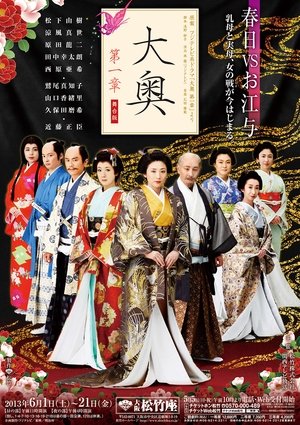
大奥 第一章
Shadow Warriors is a Japanese television jidaigeki show featuring Sonny Chiba that ran for four seasons in the early 1980s. Chiba played different ninja characters in each series. In the first series he played Hattori Hanzō III, in second one he played Tsuge Shinpachi, in the third one he played Tarao Hanzō, in the fourth series and in Bakumatsu Hen, he played Hattori Hanzō XV. In the 2003 direct-to-DVD series Shin Kage no Gundan he played Hattori Hanzō I.
At the end of Edo period, Shoji Rui hands over her birthright to her relatives with the death of her father and begins running an inn "Kawasemi" in Ōkawabata. And she settles the matters in their daily lives with her lover Kamibayashi Tōgo, doshin (a sort of constable) Une Genzaburō, physician Amanō Sotarō, and O-Kichi.
Orphaned when he was not yet ten, Musashi grows up skilled in the martial arts. During the Battle of Sekigahara, he fights on the side of the losing Toyotomi forces, but eludes the enemy as they hunt down the vanquished soldiers. He then spends years wandering the countryside mastering the sword. As his fame spreads throughout the nation, men seek him out to test their skills against him--most notably Sasaki Kojiro who faces Musashi in the ultimate duel at Ganryujima.
The 38th NHK Taiga Drama is Genroku Ryoran. The "Forty-seven Loyal Samurai" is one of the most enduring and best loved stories of Japan's history. Generations have grown up hearing the stirring tale of Oishi Kuranosuke, chief councillor of the Ako clan who leads his men through suffering and hardship to ultimately avenge their lord after he is unjustly forced to commit harakiri. NHK's 38th Taiga Drama "Genroku Ryoran" is the ambitious remake of this classic epic and boasts a cast that reads like a Who's Who in Japanese entertainment.
The 36th NHK Taiga Drama is Mori Motonari. This series chronicles the life of Mori Motonari, a warlord of the early 1500s who stood at the vanguard of the Warring States era. All Japanese school textbooks contain the Mitsuya no kyokun, Mori's famous lesson to his three sons that teaches that while one arrow is easily broken, three arrows together cannot be broken. In 1997, 500 years after his birth, NHK dramatizes Motonari's rise from a chief of the region of Aki (now Hiroshima) to a daimyo who rules over ten provinces of the Chugoku region. Motonari was 64 years old and already the patriarch of a powerful dynasty about the time Oda Nobunaga and Takeda Shingen appeared on the scene. And even after his death, the Mori family figured prominently in Japanese history. His grandson Terumoto became a loyal Toyotomi vassal. Defeated at the Battle of Sekigahara, Ieyasu confiscated most of his lands, leaving him only with Suwo and Nagato, later known as Choshu. But 260 years later, the Mori got their ultimate revenge, leading the imperial forces against the Tokugawa in the Meiji Restoration.
A young Tokugawa Mitsukuni (Yamamoto Koji) meets a homeless orphan Ryosuke (Kurokawa Souya). Surprised by his deadly skills with a wooden sword, Mitsukuni invites him to the covert organisation known as Juninshu. The members of Juninshu are orphans with outstanding skills. They conduct intelligence work using their special abilities and help to capture criminals. With the help of Juninshu, Mitsukuni discovers that Nishiki Hyonosuke (Kato Shigeaki) is the leader of the gang of arsonists that caused the Great Fire of Meireki. Hyonosuke is the son of Unkei (Ishizaka Koji), a sculptor specialising in Buddha statues whom Mitsukuni admires. Unkei has lived to bring Hyonosuke, who has gone off the right path, to justice with his own hands. Hyonosuke aims to overthrow the Tokugawas and a fierce battle is imminent. Worried for Mitsukuni, his wife Yasu (Matsumoto Honoka) seeks the help of the great swordsman Yagyu Gisen (Tachi Hiroshi).
It is 1845. Toyama Kinshiro is a town magistrate who roams Edo in guise of Kinsan the playboy. In his efforts to keep Edo crime-free, he allies himself with Onna Nezumi, a female Robin Hood. Watch Kinsan unveil his cherry blossom tattoo and bring criminals to justice.
The 8th Tokugawa shogun, Yoshimune, sets up a suggestion box to hear the complaints of the common people. However, not all the complaints were addressed. Kuroda Gunbei, a vassal of the senior councilor Okubo Kaga-no-kami, took it upon himself to pick up unresolved cases. Along with his subordinates, he worked to rectify wrongdoings and bring about resolutions.
Osaka Castle was erected as a result of Hideyoshi Hashiba's (portrayed by Shindo Eitaro) solicitation from Kyogoku Tatsuko to become his consort. During more than 30 years, until the devastation of the castle caused by the Summer Siege of Osaka, a series of tragedies unfold, affecting various women who found themselves at the mercy of fate..
Set in the Edo period, a story revolves around Kiyo, a woman who strives to overcome status differences of those days. When she pledges to live for love, a knife attack occurs at Edo castle. And as a 48th loyal retainer, her fate changes after a raid on Kira: she is determined to serve at the inner palace of Edo Castle called "Ooku".
ぼんくら
Saigo Takamori, the hero of the Meiji Restoration, was born to a poor, low-ranking samurai family in the Satsuma domain (present day Kagoshima Prefecture). His simple honesty caught the attention of its charismatic feudal lord of Satsuma, Shimazu Nariakira. Nariakira’s assertion that the love of people is what will enrich and strengthen the nation captivated Saigo who took on Nariakira’s secret mission and eventually became a key person for Satsuma. Not a portrait of him survives today and much of his life is a mystery. He is a man who was twice exiled and thrice married. He overthrew the Tokugawa Shogunate with exceptional bravery and action. Although he accomplished the restoration, he lost his life in a fight with the new Meiji government.
Set in the 18th century, the show follows the Shogun Yoshimune, who likes to disguise himself as a low-ranking samurai and go into his capital of Edo to see the life of the common man, as well as to seek out and punish evildoers who would hurt his citizens. He is aided by Magistrate Oo'oka and a vivacious fireman, Tatsugoro, as well as a rotating cast of other recurring characters. Along with Zenigata Heiji and Mito Kōmon, it ranks among the longest-running series in the jidaigeki genre. Like so many other jidaigeki, it falls in the category of kanzen-chōaku, loosely, "rewarding good and punishing evil."
Yae no Sakura is a 2013 Japanese television series. It is the 52nd NHK taiga drama. The story focuses on Niijima Yae, who is portrayed by Haruka Ayase.
Byakkotai was part of Aizu's four-unit military, set up in the domain's drive to finalize its military modernization, in the wake of the Battle of Toba-Fushimi. The other three units were Genbutai, Seiryūtai, and Suzakutai. Each of the four was named after the protecting gods of compass directions. Byakkotai was meant to be a reserve unit, as it was composed of the young teenage 16 to 17 year old sons of Aizu samurai in a group around 350, who fought in the Boshin War (1868–1869)
It has been twelve years since the Battle of Sekigahara. The Toyotomi family was sealed in Osaka Castle with a huge amount of gold by Tokugawa Ieyasu. The calm before the storm, there were behind-the-scenes secret spying activities between the Tokugawa and Toyotomi. At that time, Iga Ninja leader, Kirigakure Saizo, was attacked by someone by mistake. The vortex of the times captures those that began to seek the truth. A group of Koga led by Sarutobi Sasuke pledges loyalty to Sanada Yukimura. Saizo puts his life on the line in a ninjutsu battle with the legendary Fuma (Kotaro) Clan who freely use mysterious techniques. Eventually, these actions lead to the demise of the Warring States period.
Izumo no Okuni was born about 1571. This time period in Japanese history was fraught with struggle. It was known as the Period of Warring States, that is, the land barrons (daimyo) fought against one another for power. Her father was a blacksmith for the Izumo Grand Shrine and, consequently, the family served as well. It was a custom to send priests and young women, such as Buddhist nuns, among others to solicit contributions. Izumo was sent to Kyoto to perform sacred dances and songs. Her Okuni Kabuki was known and applauded throughout the land. After 25 years she retired.
吉原裏同心
Tange Tenzen is made a vassal to the shogun. He is a master of the single long sword fighting style. But in order to defend the honour of his wife, Nagao Chiharu, he loses an arm and his family is also wiped out.