A Victorian surgeon rescues a heavily disfigured man being mistreated by his "owner" as a side-show freak. Behind his monstrous façade, there is revealed a person of great intelligence and sensitivity. Based on the true story of Joseph Merrick (called John Merrick in the film), a severely deformed man in 19th century London.
Alexander, the King of Macedonia, leads his legions against the giant Persian Empire. After defeating the Persians, he leads his army across the then known world, venturing farther than any westerner had ever gone, all the way to India.
The story is set at the beginning of the 20th century in Sicily. Salvatore, a very poor farmer, and a widower, decides to emigrate to the US with all his family, including his old mother. Before they embark, they meet Lucy. She is supposed to be a British lady and wants to come back to the States. Lucy, or Luce as Salvatore calls her, for unknown reasons wants to marry someone before to arrive to Ellis Island in New York. Salvatore accepts the proposal. Once they arrive in Ellis Island they spend the quarantine period trying to pass the examinations to be admitted to the States. Tests are not so simple for poor farmers coming from Sicily. Their destiny is in the hands of the custom officers.
Developments in the Canadian forestry industry during the 1970s are shown being carried out both as lab experiments and in the field to protect and conserve the country's vast forests. These include turning a Newfoundland bog into woodland, fostering British Columbia seedlings that withstand mechanical planting, inoculating Ontario elms against the bark beetle, devising ways of controlling fire, and more.
For the first time one of Hollywood's greatest stars tells his own story, in his own words. From a childhood of poverty to global fame, Cary Grant, the ultimate self-made star, explores his own screen image and what it took to create it.
What would your family reminiscences about dad sound like if he had been an early supporter of Hitler’s, a leader of the notorious SA and the Third Reich’s minister in charge of Slovakia, including its Final Solution? Executed as a war criminal in 1947, Hanns Ludin left behind a grieving widow and six young children, the youngest of whom became a filmmaker. It's a fascinating, maddening, sometimes even humorous look at what the director calls "a typical German story." (Film Forum)
In 1943, as Hitler continues to wage war across Europe, a group of college students mount an underground resistance movement in Munich. Dedicated expressly to the downfall of the monolithic Third Reich war machine, they call themselves the White Rose. One of its few female members, Sophie Scholl is captured during a dangerous mission to distribute pamphlets on campus with her brother Hans. Unwavering in her convictions and loyalty to the White Rose, her cross-examination by the Gestapo quickly escalates into a searing test of wills as Scholl delivers a passionate call to freedom and personal responsibility.
A documentary portrait of a legendary Czech jockey, Josef Vána, reveals his inner world of thoughts. His unique way of life can't be described in words, and this is a first, really original view into his daily life around horses, terrifying accidents, and also stories about his family.
How do you become Peter Brötzmann? How do you become what you are: a painter, a musician, an absolute artist? Europe was nothing but a ruin and shame possessed the heart of the young Germans. They needed to invent, scream, regain a lost brotherhood. Overcome this silence! That’s how some young German, British, Dutch, Belgian… musicians made Europe exist long before Maastrich and have kept on cherishing, imperturbably, their freedom! They are no longer twenty-year-olds, but others have followed. They set themselves one constraint: reinvent everything every time. A way to take the very instant into account, to let the unexpected in, to match to the world.
A portrait of the British writer Thomas Hardy (1840-1928), who, although he had radical instincts, hated hypocrisy, was of great poetic brilliance, had a tragic perception of life and a calm outward appearance, was at heart a man of seething and somber darkness.
Michael Collins plays a crucial role in the establishment of the Irish Free State in the 1920s, but becomes vilified by those hoping to create a completely independent Irish republic.
The story of Mexican revolutionary Emiliano Zapata, who led a rebellion against the corrupt, oppressive dictatorship of president Porfirio Díaz in the early 20th century.
Kirk Douglas recounts his remarkable life in a celebrated one-man theater performance augmented with rare film highlights. He shares memories of family, marriages, other Hollywood greats, breaking the blacklist and his life-altering stroke – all with honesty and humor.
Acknowledged as one of the greatest singers of the twentieth century, Arena explores the rise of the legendary crooner Frank Sinatra from his early family background to overwhelming show business success. Interviews with friends, family and associates reveal a star-studded career in music and film alongside a fascinating private life of four marriages, liaison with the Kennedy family, Las Vegas business interests and an alleged association with the Mafia
Armed with a limitless Rolodex and a Benedict Canyon enclave with its own disco, Allan Carr threw the Hollywood parties that defined the 1970s. A producer, manager, and marketing genius, Carr built his bombastic reputation amid a series of successes including the mega-hit musical film "Grease," until it all came crashing down after he produced the 1989 Academy Awards, a notorious debacle.
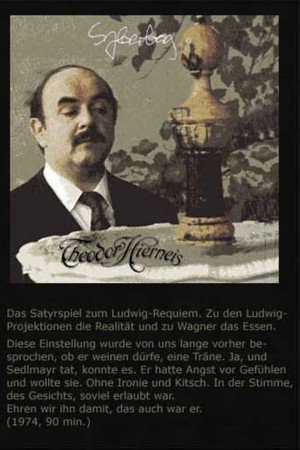
The film consists of a monologue performed by Walter Sedlmayr, who plays Theodor Hierneis, the chef at the court of Ludwig II of Bavaria. The screenplay was written by Syberberg and Sedlmayr and is based on the memoirs of Hierneis.
This compelling Documentary moves beyond the spotlight and past the attention-grabbing headlines to give pop superstar Chris Brown a chance to tell his own story. New interviews with the international phenomenon reveal long-awaited answers about his passion for making music, his tumultuous and much publicized relationships, and the pitfalls of coming of age in the public eye. Also included is new concert footage, behind-the-scenes access, and special interviews from Usher, Jennifer Lopez, DJ Khaled, Mike Tyson, Jamie Foxx and others.
RICHARD WRIGHT was an African-American author of novels, short stories and non-fiction that dealt with powerful themes and controversial topics. Much of his works concerned racial themes that helped redefine discussions of race relations in America in the mid-20th century. Born on a plantation in Mississippi, Wright was a descendent of the first slaves who arrived in Jamestown Massachusetts. This program follows his arduous path from sharecropper to literary giant. Through authors like H.L. Menken, Sinclair Lewis, Theodore Dreiser, he discovered that literature could be used as a catalyst for social change. In 1937 Wright moved to New York and his work began to garner national attention for it's political and social commentary. Much of Wright's writing focused on the African American community and experience; his novel Native Son won him a Guggenheim Fellowship and was adapted to the Broadway stage with Orson Welles directing in 1941.
An in-depth profile of the life and career of Willy T. Ribbs - the controversial Black driver who shattered the color barrier of professional auto-racing and became the first Black qualifier in the storied history of the Indy 500.
The long awaited documentary about Sepultura's incredible journey from Brazil to the world.