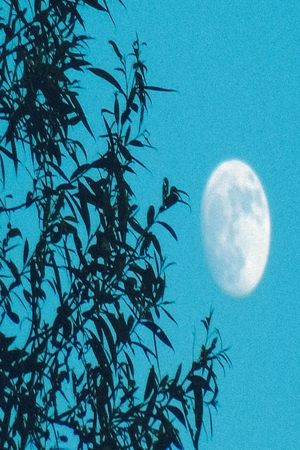
Garden of Des Moines is an intimate interview-style short film that follows drag performers in Iowa as they navigate the challenges of being queer in a conservative state. Through personal stories, the film explores the difficulties they face, from political pushback to societal pressures, while highlighting the joy, resilience, and freedom they find in drag. Set against Iowa's landscape, the film captures the vibrant, defiant beauty of queer expression flourishing in unexpected places
A 16 year old girl recalls the last moments of her summer vacation, spent with friends in the Laurentians north of Montreal. She reminisces about their talks on life, death, love, and God. Shot in direct cinema style, working from a script that left room for the teenagers to improvise and express their own thoughts, the film sought to capture the immediacy of the youths presence their bodies, their language, their environment.
Internet comedian Carl Déman from the humor group JLC lived a life that looked glorious. But beneath the surface was a terrible gambling addiction that almost cost him his life. In 2019, he and other gambling addicts struggle to stay afloat in a contemporary age marinated in gambling advertising. Carl wants to ask those who make the advertising how they think and wonders why the advertising profiles now also come from the world of culture and entertainment.
13-year-old Anderson Cefola documents his month-long grounding in 2018 with an old handheld camera he kept.
A tour of the United States. A Circarama (360 degree) film which originally opened at the Brussels World’s Fair in 1958 and was brought to Disneyland in 1960.
In a comparative study between different forms of calligraphy, the film traces parallels between modern Japanese painting and traditional Japanese writing.
The hotel overlooks the city hall. The city hotel returns the glance. Glances bounce off each other, become directions and points headed towards, together, and outwards all just one frame apart in between the hotel and city hall.
A documentary about the XVII Estonian song festival, a celebration of 100 years of song festivals. Shown are the lighting ceremony of the song festival fire, the procession, the choirs, singers and the public, including performance of the Mart Saar song Leelo led by Gustav Ernesaks.
Two countries, two restaurants, one vision. At Gabriela Cámara's acclaimed Contramar in Mexico City, the welcoming, uniformed waiters are as beloved by diners as the menu featuring fresh, local seafood caught within 24 hours. The entire staff sees themselves as part of an extended family. Meanwhile at Cala in San Francisco, Cámara hires staff from different backgrounds and cultures, including ex-felons and ex-addicts, who view the work as an important opportunity to grow as individuals. A Tale of Two Kitchens explores the ways in which a restaurant can serve as a place of both dignity and community.
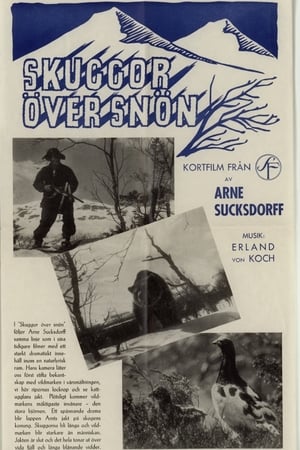
The picture shows various kinds of birds in their natural environments, and in their natural colors, and at such close range that the very eyes of the little fledglings in the nest are easily discerned. Every feather seems distinct and the birds seem to be in such relief that it appears as though one could almost reach out and catch them.
On the 11th of August at 11 minutes past 11am, almost total darkness fell across Southern England and an eerie silence descended as the population gazed skyward at what was the last total solar eclipse of this millennium. A total solar eclipse is a breathtaking event and this documentary programme conveys that awesome feeling by exploring how and why eclipses happen. A mixture of computer-generated views from outer space, footage of eclipses throughout the 20th century (some taken as early as 1927) and original footage taken of this year's total solar eclipse (shot in Cornwall) make this programme a celebration of eclipse mania.
This short film focuses on the job of the Hollywood screenwriter.
Alcoholism and its Ill-Effects was considered to be one of the most popular science propaganda (or educational) films produced in Russia before the revolution of 1917. Alexander Khanzhonkov, the most prominent Russian film producer of that era, financed a special department dedicated to non-fictional cinema, despite the fact that such films were not commercially successful. Unfortunately, not a single copy of the film has survived to the present day. All that remains are 12 frames, which were used by Izvolov to create this reconstruction. He also used extracts from critical reviews, published at the time of the film’s release, to produce a soundtrack.
Upon realising her generation won’t have a future unless the world’s politicians act now on climate change, 15-year-old Greta Thunberg skipped school in August 2018 to protest outside the Swedish parliament. What started as a one person strike soon gained global momentum. We follow Greta and the organisers of the school strikes for climate as they are cementing a worldwide movement ahead of their first global protest that took place on March 15th, 2019. It was the biggest climate strike in history with up to 1.6 million students in more than 125 countries.
Orson Welles acted in Brazilian culture and music by deeply researching Brazil's historical geology, consciously completing a legendary cultural mission. Although being turned down by Hollywood producers, he developed a triumphantly accomplished mission in the language domain - three friends of Welles' testified his love for cinema, his passion for Brazilian music and people and his obstinate endurance against formidable pressures coming from inside and outside Hollywood regarding his unfinished "It's All True".
The director’s grandparents Wilhelmine, an Austrian Catholic, and Bernard, a Jewish Czechoslovakian communist, have always been part of her life, although she never met them in person. Her uncle Hermann lives in what was once their house, with their furniture, Marx and Lenin busts, Hanukkah lamp, countless photos, letters and oil paintings. Through the film Judith Schein asks whether it is possible for a house and its interiors to narrate History.
A day in the city of Berlin, which experienced an industrial boom in the 1920s, and still provides an insight into the living and working conditions at that time. Germany had just recovered a little from the worst consequences of the First World War, the great economic crisis was still a few years away and Hitler was not yet an issue at the time.
Sharing her journey from child to teen activist, Georgie Stone looks back at her life and historic fight for transgender rights in this documentary.
Four neighborhoods. Four churches. Four colors. Blue. Red. White. Green. A square. A ball. Two goals. Fifty minutes, there are no rules. During the third week of June, every year since 1580, four teams of twenty-seven men fight for victory in the arena of Santa Croce. Florence, June, 2013. Calcio storico fiorentino. The origin of football.
This pioneering documentary film depicts the lives of the indigenous Inuit people of Canada's northern Quebec region. Although the production contains some fictional elements, it vividly shows how its resourceful subjects survive in such a harsh climate, revealing how they construct their igloo homes and find food by hunting and fishing. The film also captures the beautiful, if unforgiving, frozen landscape of the Great White North, far removed from conventional civilization.