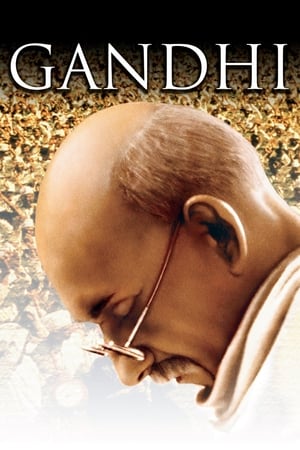
In the early years of the 20th century, Mohandas K. Gandhi, a British-trained lawyer, forsakes all worldly possessions to take up the cause of Indian independence. Faced with armed resistance from the British government, Gandhi adopts a policy of 'passive resistance', endeavouring to win freedom for his people without resorting to bloodshed.
Sarah's life was destroyed when her husband, Satrio, wanted to remarry, making her choose to divorce and struggle as a single mother, but when Satrio became seriously ill, she was forced to take in Satrio and his new wife, Annisa, in her house, testing her fortitude and sincerity in facing inner conflict, jealousy, while learning to forgive and find strength.
An omnibus movie derived from five real events experienced by some urban Jakarta residents during maghrib.
A director of a television series on the history of cinema, who has been grappling with the screenplay of his first feature film, receives an assignment to oversee the installation of a television relay station in a remote region of Zahedan province. He has already hired Turkmen tribespeople for his film and selected his filming location. Meanwhile his wife, who is working on her Ph.D. dissertation about the Mongol invasion of Iran, attempts to dissuade him from accepting the assignment. One night, while working on his history of the cinema series, the director fantasizes a diegetic world that consists of clever juxtapositions of his different worlds: the history of cinema, the history of the mongol invasion, his own film idea and his imminent assignment to the desert.
Fais was impressed by Ahmad, an 11-year-old boy, who visited the Al-Mubarak Tahfiz Al-Quran Islamic Boarding School with his grandparents. The visit was memorable for Fais, the son of the owner of the Islamic boarding school, who remembered his father's will to continue the struggle of the Islamic boarding school.
A troubled teen turns his life around with the help of a classmate. Years later, their reunion sparks old feelings, but uncertainty clouds their story.
The meeting of Maria and Fafat in a church on Christmas Eve, changed their fate. Maria did not expect that her relationship with Fafat would lead to an interfaith relationship. But the two of them had already fallen in love and decided to marry. When their daughter was born and not yet a year old, Fafat died in an accident. Maria was left alone, patiently raising her daughter Laila, according to the Islamic teachings that had been promised to her late husband. However, Ustadzah Habibah saw that Maria's efforts in educating Laila with Islamic teachings were still lacking, so she wanted to take and educate her granddaughter herself. After her husband, would Maria also lose her child?
A young man upsets his Punjabi family when he falls in love with an Irish schoolteacher.
After his wife dies, a blacksmith named Balian is thrust into royalty, political intrigue and bloody holy wars during the Crusades.
An American woman, trapped in Islamic Iran by her brutish husband, must find a way to escape with her daughter as well.
A revered small-town imam faces a crisis of faith when he must choose between upholding the values of his mosque or protecting the safety and spiritual belonging of a male congregant.
Ahmet Nurudin is a dervish and head of the Islamic monastery of the Mevlevi order in Sarajevo. He is a personification of morale and dogmatic belief, everything that Muslim religion of the Ottoman rule rests on. Throughout his life, the atmosphere of the city, the relations with the judge and the mechanism of government, the image of Ottoman Empire at the beginning of the nineteenth century is being revealed. Based on a highly praised novel by Meša Selimović.
The sudden death of Michael Jackson sends a former King of Pop devotee — now a young imam — into a tailspin, in this tender and comedic film from Egyptian filmmaker Amr Salama.
Four Lions tells the story of a group of British jihadists who push their abstract dreams of glory to the breaking point. As the wheels fly off, and their competing ideologies clash, what emerges is an emotionally engaging (and entirely plausible) farce.
Summer is a carefree teenage girl whose world is turned upside down when her mother abruptly converts to Islam and becomes a different person. At first resistant to the faith, she begins to reevaluate her identity after becoming attracted to a Muslim classmate, crossing the thin line between physical desire and piety.
On his way home after helping a family expel an evil spirit from their child, Adam (Arya Saloka), a religious teacher and ruqyah practitioner, is involved in a tragic accident that claims the life of his wife, Aini. Devastated by the loss, Adam abandons his practice and withdraws into a life of prolonged grief. Everything changes when Anwar (Dimas Aditya) asks for his help to save Fitri (Acha Septriasa), a nurse and the daughter of Mansur (Donny Damara), a respected figure in the village where Adam lives. Though reluctant at first, Adam finds the strength to perform ruqyah once again, inspired by a promise he made to his late wife. As he becomes more deeply involved in Fitri’s case, Adam begins to uncover a dark secret hidden behind the supernatural terror haunting her.
Six students were terrorized by a mysterious dancer while running a community service program in a remote village. Apparently, one of them violates the most fatal rule in the village.
Everyone in his village believes that Zein is a simpleton, a half-wit, an amiable buffoon. Thus, his braying laughter and public declarations of love for village maidens only win laughter rather than anger, beatings or worse. However, Haneen, a wandering Muslim holy man, perceives something more in this figure of fun: genuine piety and an inner radiance, marked by a powerful spiritual intelligence. One other person sees more in Zein than most do- the beautiful, pious and sedate young girl in the village.
A former clergyman finds himself back in his old boarding school where the disturbances experienced by its community might help him regain his faith and tie up loose ends in regards to his son's death by a deadly spirit.
Salvador, Bahia, January 1835. After more than a decade of hard work, Guilhermina, 27, a slave of Muslim origin, finally gets the resources to buy her manumission, as well as that of Teresa, 11, her teenage daughter. But, contrary to an old promise, his “lord”, farmer Souza Velho, refuses to sell the girl's letter. When Pacific Licutan, Salvador's most esteemed Islamic leadership, is arrested by the Bahian authorities, the Muslim community goes into a boiling state and begins to articulate a jihad. In desperation, Guilhermina sees in the uprising the only way to win her daughter's freedom.