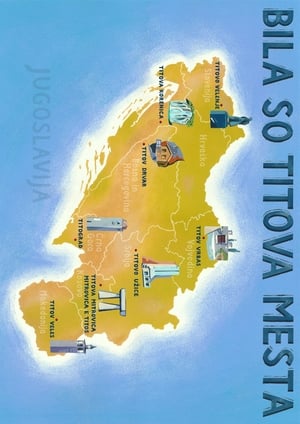
Following the death of Josip Broz Tito (1892–1980), one city in each of the six republics and two autonomous regions of the Socialist Federal Republic of Yugoslavia had the honour to be named after the long-serving president. Having been chosen due to leftist ideas, proletarian character, industrialisation, urbanisation and modernity, they were often privileged. Now located across seven countries, not one of these cities is still named after Tito. We learn the stories of these cities from their residents who look back at the period under Tito’s name. Many of these stories are tragic since the majority of cities have been touched by war.
Filmed in Belgrade in 1962, Parade documents the city’s engagement with the annual May Day celebration by largely ignoring the formal procession. Instead, Dušan Makavejev records the informal moments surrounding it: workers, officials, wanderers, and organizers negotiating space, hierarchy, and appearance. Shot with a detached, humorous eye, the film assembles a mosaic of everyday behavior that reveals the contrast between official ceremony and lived social reality.
Through interviews with historians, publicists, researchers, and eyewitnesses from Slovenia, North Macedonia, Croatia, and Serbia, it reveals a history of mass killings, political persecution, prison camps, and the activities of Yugoslavia’s secret police.
In the mid-1950s, an unnamed convict succsesfully manages to escape from the Goli Otok prison island, seeking shelter in a monastery on the nearby island of Rab and striking a kinship with one of the nuns in it. A few days later, an agent of the Yugoslav State Security Service arrives on the island, desperate to find the man's whereabouts. The nuns and the monks face a decision of their lifetime. Are they going to turn the wounded man they know nothing about to the authorities, or will they continue concealing him and risk their lives in the process?
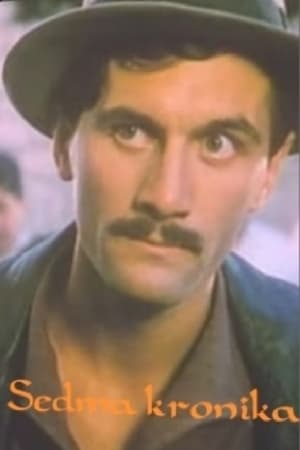
The lives of many people in one Serbian town are changed after Tito's breakup with Stalin.
At his school, 10-year-old Zoran wins the competition for the best essay about Tito. His reward is participation in the march "Revolutionary trails" to Tito's hometown of Kumrovec.
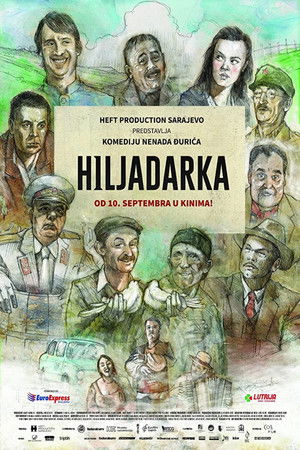
A young man by the name of Atif Kurtovic goes into a mine for the first time in his life to become a miner and to continue exactly where his now retired grandfather had left off. However, his fate is soon completely changed when he is picked as the face for the most valuable banknote in the country, the bill in the amount of one thousand dinars. Because of this, Atif soon finds himself on his way to Belgrade where Tito's personal photographer takes his picture and thus allows Atif to become a part of history. Into this story enters a young girl whose nickname, "Hiljadarka / A Thousand", is no accident and with whom Atif falls in love. When Tito announces his personal visit to Atif's hometown, there begins an adventure that they will all remember for the rest of their lives.
Blue Train is Serbian atipic teenage comedy. Just before Tito's death a high school graduates in Belgrade live their normal life before the end of the school year. Spring is relaxed and they organize the election "Princess Of Spring" for the most beautiful girl in school. Vojislav is in love with Anica, friend from class. While his best friend, convinces him that the organization of the miss elections is the best way to win Anica's heart. Milena has crush in Vojislav, and she want to spoil his plan. After the death of professor of Marxism, in the school comes a new, very young and ambitious professor Božičković, a former pupil of the school. His charm and informal dress manages to win the sympathy of students, especially girls. Professor Božičković like Anica, and he shows that in front of the class. Anica and Vojislav do not appritiate that.
Based on a true story of a meeting in June 1945 between two powerful men with very opposite philosophies and perspectives on the future of their country.
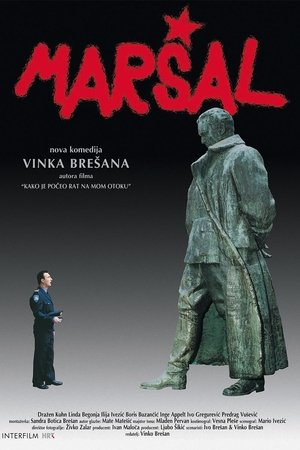
Stipan is a policeman who comes to small Adriatic island off the Croatian coast in order to investigate reported strange phenomena that had frightened the whole population. At first, nobody wants to co-operate with him, but he finally finds that the island is being allegedly haunted by the ghost of Josip Broz Tito, Communist leader of former Yugoslavia. For Luka, the mayor, this is the opportunity to turn entire island into Tito-themed amusement park. Tito's WW2 veterans, on the other hand, don't believe in ghosts; for them, the apparition is actually Tito himself, who had returned in order to lead them into a new revolution which would restore Communism. Written by Anonymous
An essay-style account of the war from the perspective of three generations of women - those of the director, her mother, and that of her grandmother. Originally from Donetsk - an industrial city in eastern Ukraine - the family was uprooted in 2014 when the Russian war against Ukraine first commenced. By 2022, the same enemy once again began knocking on the door of their new home -which was now in Kyiv- and once again destroyed everything that the family had worked so hard to rebuild. Thrown into the limbo of exile, the director (she is also the narrator of the film) dives into a kaleidoscope of memories and chronicles both her personal and collective familial search for something to hold on to amid these turbulent times.
The Kola Peninsula. Varzuga village. A road has recently appeared here. The inhabitants of a distant village talk about how the world coming from outside affects the identity of the village. How can a village survive in the modern world without wasting what the northern land has held for centuries? The priest Mitrofan Badanin commanded ships in the Northern Fleet for most of his life, and now he is restoring the temples of the Kola Peninsula. He shared with the authors of the film reflections on the fate of the village, the characters of people, faith, strengthened by trials at sea.
In autumn, much is heard in the deserted village… Which you can't express with an ordinary documentary. But with a mixture of feature films, old newsreels and "visual anthropology" with the restoration of the old rite – you can try.
Presents what happens to a neighborhood on the Lower East Side in New York City when a Hollywood film crew takes over the area to film part of The Godfather Part 2. Includes interviews with the residents, film director Francis Ford Coppola, and members of the block association.
In this fascinating sequel to "Is Genesis History?", watch a team of scientists discover new evidence for the global Flood. By the time the journey is over, you'll understand exactly how modern science connects to the book of Genesis.
This film is an intimate and moving cinematic record of Shohei Ohtani's journey to MLB stardom. A faithful portrait of his talent development and battle with injuries, and his unique mindset to become a superstar ballplayer breaking all the barriers of race, language, discipline, and culture.
Narrated by Ethan Hawke, Welcome Nowhere tells the true story of a community of Roma people (commonly known as Gypsies) who live in old train boxcars in Sofia, Bulgaria after being forcibly evicted from their homes. Without bathrooms for more than 200 people, they struggle to survive, waiting for help from the government that never seems to come.
The film is just this kind wandering through the personal ways and whys of different kinds of pain in different kinds of people. The film searches through the many levels of pain and finds it in its unique position between disaster and pleasure. Pain is..thus plunges us instantly into the midst of controversy and the unknown.
Sotto il Celio Azzurro
Fernando Lemos, Atrás da Imagem