Swimming, Dancing examines audiovisual representations of the Yangtze (1934–present), from silent film to video art to the contemporary vlog. Inspired by the city symphonies of the 1920s, Swimming, Dancing pieces together a “river symphony”, evoking the images, sounds and contradictions that make up the river’s turbulent history.
Joan Crawford's close-up in Humoresque. Michelangelo's David and Boticelli's "Birth of Venus". Stendhal was overwhelmed by the cultural overstimulation in Florence, which Graziella Magherini described scientifically in 1979 as Stendhal syndrome. Mark Rappaport describes his fascination for the Austrian actor Turhan Bey, who made a career in exotic roles in Hollywood in the 1940s. A very personal essay about the effect of close-ups, the canvas idols of the dream factory and the role of their admirers and fans.
Letter to My Tribe started with a question: Why don’t more Jews and Israelis speak out about Palestine? Over many years my mother, who represents a more messianic perspective, and I have had numerous arguments, some recorded, some not. These form the backbone of this video essay in which Israelis and Jews, journalists, activists and a rabbi are interviewed, and in which documentation of actions on the ground, in the West Bank, are woven with more personal family histories and journeys to Iraq and to Poland.
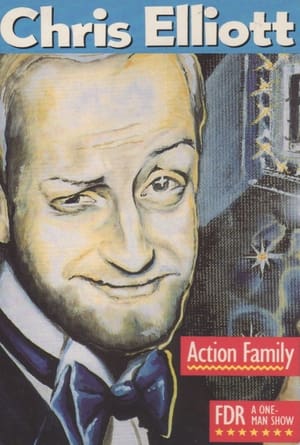
Chris Elliot plays FDR in his live "One Man Show" about the life and times of the president, however, he looks and sounds nothing like the man and he re-enacts events from Roosevelt's life that never happened.
HIPERTEXTO
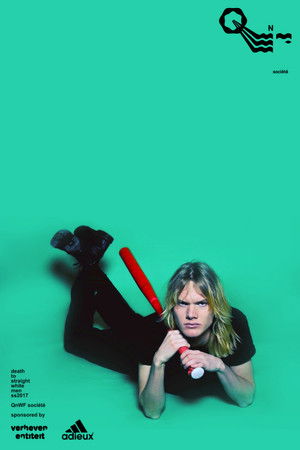
Three commercials, presented as a short film, for fictional clothing brand 'Death To Straight White Men' by the QnWF-Sociétè. This fictional clothing brand and the ready-for-action poses and portraits of the three models were in many ways the foundation for 'E Kolór Korra' (2017).
Ten years after the death of iconic French filmmaker, Chris Marker. A filmmaker, hoping to rediscover that unique sensibility against the uncertainty of the new century, returns to the places synonymous with those incomparable and unforgettable films-- From the cat cemetery of Sans Soleil, to the mausoleum of The Last Bolshevik; The caves of Level Five to the rooftops of The Case of the Grinning Cat. A biographical portrait of one of the 20th century's greatest and most misunderstood filmmakers.
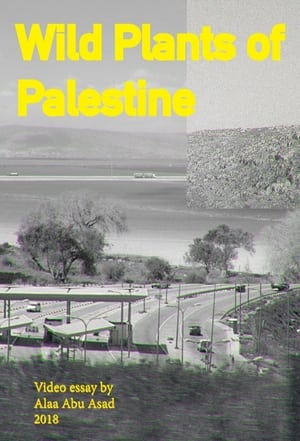
The film follows journeys of observational tours solicited by the Palestinian Museum and conducted by two professors from Birzeit University to collect photos of and information on the Palestinian Flora. The title is adapted from a collection of 123 images (circa 1900 to 1920) of wild flowers in Palestine found in the Matson Collection in the Library of Congress. Despite the tendency to trace the wild plants, the text in general aims at questioning the territorial extension of what is meant by the term “Palestinian”, while standing on insignificant topographical features of the (postcolonial) landscape in West Bank. Furthermore, it addresses photography as a practice and a tool of distributing and restricting information at once.
Lies are just another way of telling the truth. The desire to believe is the hand of the man hanging from a cliff and clinging to the only stone that would seem to save him. But he always ends up falling because the stone is a mirage, just as the cliff is. Death is awakening from this dream in which the essential can be said and in which the continuous and infinite has a beginning, an end and a meaning.
Le Chevalier de Saint-Georges overcame class and race prejudices in 18th century France to become a musical genius who would inspire Mozart.
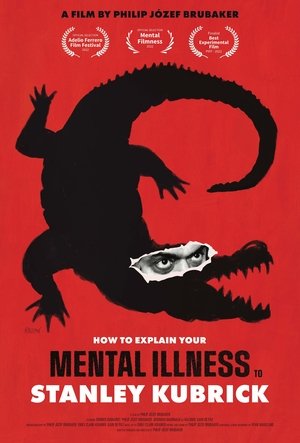
A psychotic filmmaker named Philip summons a manifestation of Stanley Kubrick into his apartment to confront him on the depiction of mental illness in his filmography. Kubrick's obsession with 'crazy' characters who meet an untimely death disturbs Philip, who wishes he could see Kubrick characters who manage their illness. The two directors go on a journey into Kubrick's films to understand insanity in our modern era.
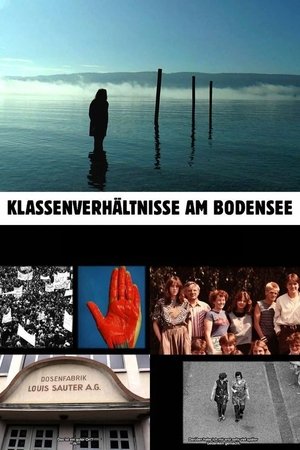
A filmmaker reconstructs a common memory about the formerly industrialized Lake Constance region, which was also largely built up by migration – and in recent years has mainly attracted people who do not like to pay taxes. The imprints speak, the fog. Without talking heads, in perspectives beyond the memorialized self-image of this region, classism becomes comprehensible.
A biopic of the legendary Paul Bellini, by Bellini, of Bellini, for Bellini.
An experimental video essay which uses circles and waves to explore neurodivergent experience.
A century after a village and its paper mill were abandoned, a group of actors is tasked with recreating the fantasized daily life of its inhabitants.
Dedicated to the Children of Ukraine, victims of the brutal Russian invasion...Let everyone ask themselves and the leaders of their countries: what else has to happen, what arguments are needed that Ukraine is finally given the necessary military aid for Victory?
Near Munich, in Bavaria, Germany, is the Schleißheim Palace, where French filmmaker Alain Resnais shot his film Last Year at Marienbad in 1960. Nearby is the Dachau concentration camp, where thousands of people were killed between 1933 and 1945. An essay about the present and the past, beauty and horror, life and death.
A self-portrait in the form of a video essay that explores her identity, her relationship with the places she has lived, and her present.
Video essay about reflections in identities, spaces, using comparisons with the people in her life. How do we express ourselves? What influences us? Are we reflections of what we experience? Of what we see? Of who we know?
German actor Conrad Veidt is best remembered for playing Nazi Major Strasser in Casablanca. In reality, he was an ardent anti-fascist who left Nazi Germany for Britain, falsely claiming to be Jewish in solidarity with his Jewish wife. Using clips from Veidt’s films, acclaimed director Mark Rappaport imagines the actor narrating his life and career from the silent era—including his leading roles in The Cabinet of Dr. Caligari and The Man Who Laughs through to his Hollywood years where he often played a Nazi.