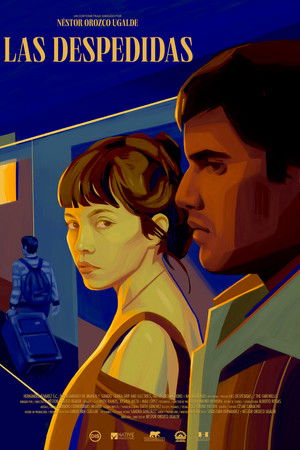
In Seattle, a young immigrant faces love, loyalty, and identity dilemmas. A weekend retreat meant for introspection turns eerie, forcing her to address her future against a backdrop of trauma and cultural dislocation.
Queen Kaikeyi exiles Rama and demands Bharat be king. Bharat, devoted to Rama, refuses the throne and goes to the forest, urging Rama to return. Rama insists on upholding his father's vow. Bharat then rules Ayodhya as Rama's regent, placing Rama's sandals on the throne until his return.
On Saturday, 5 April 1941, one day before the Invasion of Yugoslavia of the Kingdom of Yugoslavia, a colourful group of random passengers on a country road deep in the heart of Serbia board a dilapidated bus, headed for the capital Belgrade. The group includes two gypsy musicians, a World War I veteran, a Germanophile, a budding singer, a sickly looking man, and a hunter with a shotgun. The bus is owned by Krstic senior, and driven by his impressionable and dim-witted son Misko.
Young women at a precision optics factory in wartime Japan push to exceed production quotas, enduring illness, injury, and personal hardship to “serve the country.” Led by Tsuru Watanabe, they fight fatigue and setbacks to keep their line moving—even when duty collides with grief.
BISCUT (HOTSTAR-DISNEY RELEASE -2022) In an Indian village ruled by muscle and money, one man sparks a revolution without guns or bullets by betting his life on just the power of democracy. Biscut is the awe-inspiring story of Bhoora, a poor Dalit (lower caste) youth condemned to a daily struggle for survival, who turns a collective curse into a formidable force for change. BISCUT is the Hindi language word for a cookie or a biscuit.
A nostalgic, coming-of-age story of identical twin sisters who share every aspect of their lives with one another, until one day a boy walks into their lives and puts their strong bond to the test.
Using never-before-seen footage, Japan's War In Colour tells a previously untold story. It recounts the history of the Second World War from a Japanese perspective, combining original colour film with letters and diaries written by Japanese people. It tells the story of a nation at war from the diverse perspectives of those who lived through it: the leaders and the ordinary people, the oppressors and the victims, the guilty and the innocent. Until recently, it was believed that no colour film of Japan existed prior to 1945. But specialist research has now unearthed a remarkable colour record from as early as the 1930s. For eight years the Japanese fought what they believed was a Holy War that became a fight to the death. Japan's War In Colour shows how militarism took hold of the Japanese people; describes why Japan felt compelled to attack the West; explains what drove the Japanese to resist the Allies for so long; and, finally, reveals how they dealt with the shame of defeat.
The time is 1945-46. 10 year old Eda and his friend Tonda live in a small village outside Prague. In school, their class is so wild and indisciplined that their teacher quits and is replaced by the militant Igor Hnidzo. He is very strict – but also very fair. His weakness though, is his interest in young women.
Lieutenant Braden discovers that Sally, the woman he's been falling in love with, has actually been checking out his qualifications to be a U.S. Navy frogman. He must put his personal life behind him after being assigned to be smuggled into a Japanese-held island via submarine to photograph radio codes.
Bob Sharkey, an instructor of would-be spies for the Allied Office of Strategic Services, becomes suspicious of one of the latest batch of students, Bill O'Connell, who is too good at espionage. His boss, Charles Gibson confirms that O'Connell is really a top German agent, but tells Sharkey to pass him, as they intend to feed the mole false information about the impending D-Day invasion.
Bardhi, an orphan boy, goes to the city to work in the house of a rich man, where he learns how to play the violin.
Upon Canada's entry into World War II, the RCMP rounded up thousands of people it considered fascist sympathizers. Among them, 700 Italian-Canadians were held for up to three years in internment camps. None were ever charged with a criminal offence.
The film, which won the 1988 National Film Award for Best First Film of a Director for its "excellent exploration of complex philosophical theme for the first time in Indian cinema," is set in the Buddhist town of Sariput in the desert of Central Asia in the 1st century B.C. The town is struck by a devastating sand storm that leaves behind only four survivors: two monks and two children taking refuge in the monastery. Twenty years later, the monks have become old, while the boy and the girl have grown and fallen in love. The jealous monk deceitfully persuades the boy into becoming a monk, yet the girl wins him back, as a result both are expelled from the monastery, and that is when the sandstorm strikes once again..
Damul (Bonded Until Death) highlights the ill effects of the Bonded Labour System while narrating the story of a bonded labor who is left with no choice but to steal by his landlord.
Greedy innkeepers resort to robbery and murder after their son leaves to seek a better life.
Varun is a bestselling author and Sia is an entertainment lawyer. They both have their distinct way of looking at love. To avoid the burden of commitment, they agree to be romantic partners for only two days a week.
Bharat Nagar is a city terrorized by gangsters and corrupt politicians. An honest police officer tries to restore law and order to it.
The five-month-old baby of impoverished tribal woman Jhumpa Mahato is stolen. Two brothers, Gautam and Raman, who witness the kidnapping, try to help her and become embroiled in the complexities of the investigation.
In the small town of Rechnitz a terrible crime against humanity was performed during the holocaust. Until now, no-one dares to talk about it.
J. Robert Oppenheimer and other key figures involved in the decision to drop the first atomic bomb discuss their motivations in this NBC News documentary. Originally produced and televised in 1965, two decades after the bombings of Hiroshima and Nagasaki, it was re-released in 2023 with an epilogue by Michael Beschloss, NBC News Presidential Historian.