How does a nation slip into war? Dateline-Saigon profiles the controversial reporting of five Pulitzer Prize-winning journalists -The New York Times' David Halberstam, the Associated Press' Malcolm Browne, Peter Arnett, and legendary photojournalist Horst Faas, and UPI's Neil Sheehan -- during the early years of the Vietnam War as President John F. Kennedy is secretly committing US troops to what is initially dismissed by some as 'a nice little war in a land of tigers and elephants.' 'When the government is telling the truth, reporters become a relatively unimportant conduit to what is happening,' Halberstam tells us. 'But when the government doesn't tell the truth, begins to twist the truth, hide the truth, then the journalist becomes involuntarily infinitely more important.'
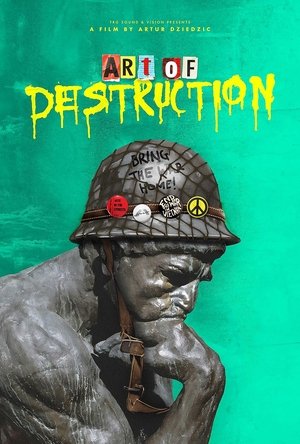
We follow the story of The Thinker bombing at the Cleveland Museum of Art, trying to solve the mystery behind it because no one was ever caught. By following this case, we unravel the whole landscape of Cleveland and the USA in the 60s/70s - student protests, social justice movements, anti-war movements, and radical militant groups. We give a context to the bombing, which is symbolic on so many levels - it's an art piece that randomly became a target for political violence that, by being left unrepaired, became a reminder of the complicated history of the 60s/70s. The Thinker is a silent witness to this fascinating decade, looking down from his pedestal, still thinking about our place in the world as humans.
VIETNAM: AMERICAN HOLOCAUST exposes one of the worst cases of sustained mass slaughter in history, carefully planned and executed by presidents of both parties. Our dedicated generals and foot soldiers, knowingly or unknowingly, killed nearly 5 million people, on an almost unimaginable scale, mostly using incendiary bombs. Vietnam has never left our national consciousness, and now, in this time, it has more relevance than ever. Claiborne documents the Whitehouse fabrication of the Gulf of Tonkin Incident, and further, raises the question of whether JFK was assassinated to promote the Vietnam War. Martin Sheen, who played the leading role in Apocalypse Now almost 30 years ago, has generously lent his powerful voice to this actual history of the War in Vietnam.
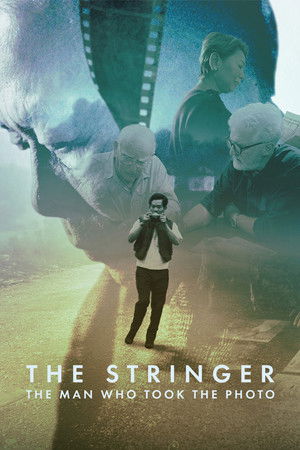
A two-year investigation uncovers a scandal behind the making of one of the most recognized photographs of the 20th century. Five decades of secrets are unraveled in the search for justice for a man known only as "the stringer."
Born a conjoined twin due to the effects of Agent Orange used during the Vietnam War, Duc Nguyen, now a father and husband, seeks the truth about his past and contemplates the future.
During the chaotic final weeks of the Vietnam War, the North Vietnamese Army closes in on Saigon as the panicked South Vietnamese people desperately attempt to escape. On the ground, American soldiers and diplomats confront a moral quandary: whether to obey White House orders to evacuate only U.S. citizens.
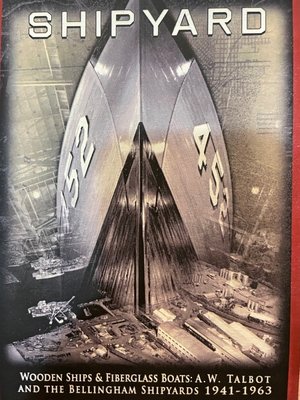
Shipyard is a landmark documentary covering the creation and life of Bellingham, Washington's wooden boat shipyard, which was built in response to the Axis threat of WWII, it's continued growth through the '50's and '60's, as well as it's innovative role in the development and production of fiberglass boats, including patrol riverboats for the Vietnam war.
In the gathering dusk of 18 August 1966, 108 young, inexperienced Australian and NZ soldiers are separated and surrounded, fighting for their lives, holding off an overwhelming force of 2,500 battle-hardened Viet Cong and North Vietnamese soldiers. And, in the pouring rain, amid the mud and shattered trees of a rubber plantation called Long Tan, with their ammunition running out and another Vietnamese battalion massing for the final assault, the digger's situation seemed hopeless. Long Tan is the true story of ordinary boys who became extraordinary men.
American Experience looks at the 1968 Democratic National Convention in Chicago where Vice President Hubert Humphrey won his party's nomination for president amid massive civil unrest and violence perpetrated by Chicago Police and anti-Vietnam War protesters.
A film about one of the most iconic images of the 20th century, the moment when the radical spirit of the 1960s upstaged the greatest sporting event in the world. Two men made a courageous gesture that reverberated around the world, and changed their lives forever. This film is about Tommie Smith and John Carlos' protest at the 1968 Olympics.
A portrait of the diverse opinions of Chicagoans as they reflect on the general state of affairs in America, the war in Vietnam, social and racial conflict, freedom and personal liberty, happiness, and social justice. Ratamata was made by future Tom Palazzolo collaborator Kreines when he was 16 years old, and was an award winner at the Young Chicago Filmmakers Festival.
This documentary interviews young people on war, religion, music, sex, and other topics. Part of NBC's Experiment in Television.
1981. The shabby treatment of returning combat soldiers from Vietnam is investigated.
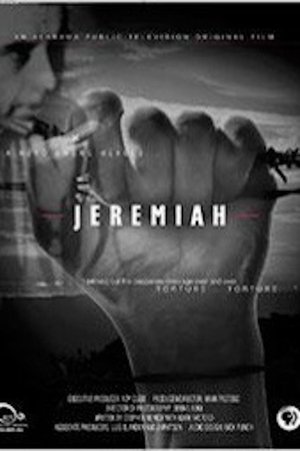
A U.S. Navy Commander Jeremiah Denton leading a plane sortie into North Vietnam was shot down and captured as a POW. For 8 years of his life, he was a prisoner at Hanoi Hilton where he and other POWs were tortured. In a press conference, being forced by the North Vietnamese to say he was being treated well he blinked out the letters TORTURE in Morse code.
A documentary about militant student political activity at the University of California, Berkeley in the 1960s.
For three days in 1971, former US soldiers who were in Vietnam testify in Detroit about their war experiences. Nearly 30 speak, describing atrocities personally committed or witnessed, telling of inaccurate body counts, and recounting the process of destroying a village.
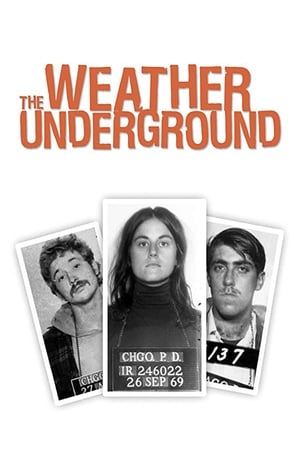
Archival footage, animation and music are used to look back at the eight anti-war protesters who were put on trial following the 1968 Democratic National Convention.
Tom Savini is one of the greatest special effects legends in the history of cinema, but little is known about his personal life until now. For the first time ever a feature length film has covered not only Tom's amazing career spanning over four decades, but his personal life as well.
Many times during his presidency, Lyndon B. Johnson said that ultimate victory in the Vietnam War depended upon the U.S. military winning the "hearts and minds" of the Vietnamese people. Filmmaker Peter Davis uses Johnson's phrase in an ironic context in this anti-war documentary, filmed and released while the Vietnam War was still under way, juxtaposing interviews with military figures like U.S. Army Chief of Staff William C. Westmoreland with shocking scenes of violence and brutality.
Sir! No Sir! is a documentary film about the anti-war movement within the ranks of the United States Military during the Vietnam War. It consists in part of interviews with Vietnam veterans explaining the reasons they protested the war or even defected. The film tells the story of how, from the very start of the war, there was resentment within the ranks over the difference between the conflict in Vietnam and the "good wars" that their fathers had fought. Over time, it became apparent that so many were opposed to the war that they could speak of a movement.