Five young Italian climbers, Paolo Grunanger, Lorenzo Marimonti, Pietro Meciani, Lodovico Gaetani and Giorgio Gualco, members of the expedition organized under the patronage of the Milanese section of the Italian Alpine Club, reached Tamanrasset, in Hoggar, the Tuareg kingdom. From there, with a caravan of camels, they head towards the mountainous volcanic chain of Tahalra, little known to Westerners. During the exploration, climbers will climb seven virgin peaks via very difficult routes and at the same time carry out topographical surveys.
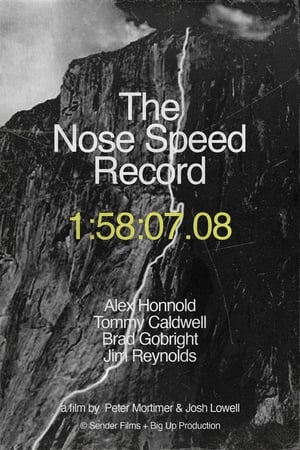
In a battle for El Cap’s coveted Nose speed record, rock legends Tommy Caldwell and Alex Honnold go head to head with Yosemite dirtbags Jim Reynolds and Brad Gobright. Highball bouldering ace Nina Williams flexes her guns and tests her nerves well into the no-fall zone. In rural Utah, conservative Mormon coal miners collide with an influx of out-of-town climbers - with surprising results. And two adventurous Brits, Hazel Findlay and Maddy Cope, pursue first ascents in wild and remote Mongolia.
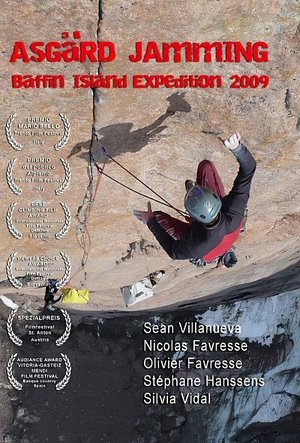
Attempt to make the first free climbing of the Mount Asgard.
In 1973, 6 guides from the National Ski and Mountaineering School (ENSA), including Charles Daubas and Walter Cecchinel, left by truck from Chamonix to Tamanrasset in the desert in Algeria with the aim of climbing some peaks of the Atakor massif including Adaouda and Tizouyag where they do the first of "La Voie de l'ENSA".
Catherine Destivelle has deservedly become the most famous female climber in the world. She rose to prominence with historic climbs, such as the free ascent of the Nameless Tower in Pakistan, and solo winter ascents of the classic north faces of the Matterhorn and the Eiger, climbs that have never been repeated by any woman. She also made history in sport climbing by winning the world championship title. In 1997, this time in Scotland, on the iconic Old Man of Hoy route, opened by Bonington, Patey & Baillie, Martin Belderson crowned Destivelle Queen of the Rock. She was four months pregnant when she made this 137-meter ascent, which was not difficult but on tricky rock.
After being wrongfully convicted for stealing a pair of shoes, Stanley Yelnats is sent away to Camp Green Lake, a boys detention facility where inmates are forced to dig holes all day in the hot desert sun as a form of character building. But Stanley and the other boys start to unravel a mystery, linked with the camps tough-as-nails warden —and possibly Stanley’s family itself.
The explorers Bruce Parry and Mark Anstice climb the remote and little known mountain Puncak Mandala in the Indonesian part of New Guinea. They have to cross remote jungles, climb icy cliffs and navigate the curiosity and fear of indigenous peoples in order to get to the top.
For nearly three years, director Dina Khreino interviewed world-class mountain climbing athletes, listening to what compels them to leave behind families, friends, and everyday comforts to risk everything for a fleeting glimpse into the unknown. What she found was a tribe, a diverse group of professional adventurers and amateur philosophers forged by the ultimate test of body, mind, and spirit. In the face of shifting winds, sheer granite cliffs, and impossible odds, they climb. Each for their own reason, but every one connected by the vertical world. In this rarefied air, these athletes are fundamentally changed, not just as climbers, but as human beings.
Once again, Masters of Stone breaks through to the cutting edge of the sport. Harder, Faster, Bolder, Newer, and more...six points of breakthrough in all.... where human edges toward the superhuman. This is the Super Bowl, Olympics, and Boston Marathon of rock climbing, all rolled into one. More than any other sport, rock climbing continually redefines its rules and resets its limits. Yesterday's impossible becomes today's warm-up as advances in mental and physical mastery combine to break new ground. Every few years the Masters of Stone series delivers a new episode that captures these breakthroughs in a tasty mix of music, character, commentary, and above all, visual action.
Five Bolivian indigenous women share one goal: climbing the highest mountain in America.
They call it the savage mountain. 27 people have perished trying to reach the summit on K2, the world's second highest peak. A U.S. climbing team, funded by millionaire Clairborne is determined to conquer K2.
An international team of climbers ascends Mt. Everest in the spring of 1996. The film depicts their lengthy preparations for the climb, their trek to the summit, and their successful return to Base Camp. It also shows many of the challenges the group faced, including avalanches, lack of oxygen, treacherous ice walls, and a deadly blizzard.
In 1966, John Harlin II died while attempting Europe's most difficult climb, the North Face of the Eiger in Switzerland. 40 years later, his son John Harlin III, an expert mountaineer and the editor of the American Alpine Journal, returns to attempt the same climb.
Behind every breakthrough in the progression of climbing, there's a true story of doubt and determination, perseverance in the face of failure. From boulders, to big walls, to competition podiums, the climbers at the top of the game share a commitment to do whatever it takes to achieve their vision.
Marc-André Leclerc, an exceptional climber, has made solo his religion and ice his homeland. When filmmaker Peter Mortimer begins his film, he places his camera at the base of a British Columbia cliff and waits patiently for the star climber to come down to answer his questions. Marc André, a little uncomfortable, prefers to return to the depths of the forest where he lives in a tent with his girlfriend Brette Harrington. In the heart of winter, Peter films vertiginous solos on fragile ice. He tries to make appointments with the climber who is never there and does not seem really concerned by this camera pointed at him "For me, it would not be a solo if there was someone else" . Marc-André is thus, the "pure light" of the mountaineers of his time, which marvel Barry Blanchard, Alex Honnold or Reinhold Messner, interviewed in the film. An event film for an extraordinary character.
In the shady campgrounds of Yosemite valley, climbers carved out a counterculture lifestyle of dumpster-diving and wild parties that clashed with the conservative values of the National Park Service. And up on the walls, generation after generation has pushed the limits of climbing, vying amongst each other for supremacy on Yosemite's cliffs. "Valley Uprising" is the riveting, unforgettable tale of this bold rock climbing tradition in Yosemite National Park: half a century of struggle against the laws of gravity -- and the laws of the land.
Bravo Marcel
The film shows Catherine Destivelle's trip to Dogon Country, in Mali, where she will make spectacular free solo rock climbing ascents in the sun-warmed cliffs of Bandiagara. Destivelle is accompanied on this trip by a friend climber, Lucien Abbet. A film by Pierre-Antoine Hiroz produced in 1987 by Paradoxe and also featuring Tidjani Koné, Ibrahim Dolo, and the Dogon inhabitants of the Bandiagara Escarpment. The film won the Genziana D'argento for best free climbing film at the Trento Film Festival in 1987.
Two climbers, a photographer and an eagle in the western setting of Monument Valley, USA. The climbers, who are experts, reveal the secrets of their acrobatic skill. The photographer is the spectator who often involuntarily creates comical situations.
Drama about the tragic Nanga Parbat expedition by the two Messner brothers in 1970, on which Reinhold Messners younger brother Günther died.