12 August 2002 is the date which was printed on every shot in this film by the memory of the camera. On that day a huge tower which disrupted the north wing of an abandoned castle was torn down, floor by floor. The film is a record of the methodical disruption of this building by inhuman and all-powerful machines. The voice-over consists of a phone call by the author John Berger (1926), who has written numerous and radical opinion pieces in favour of the people of Palestine.
A woman on the run from the mob is reluctantly accepted in a small Colorado community in exchange for labor, but when a search visits the town, she learns that their support has a price.
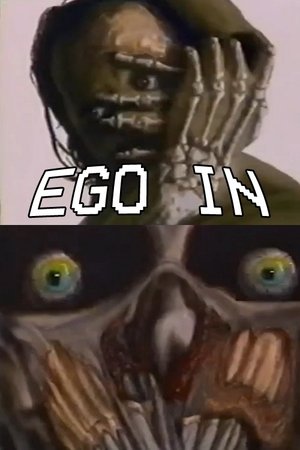
One of Rimmer's early 2000s video works which he made by hand-painting 35mm film, running it on a flatbed viewer, and shooting it off the screen with a video camera to then subject it to further manipulation.
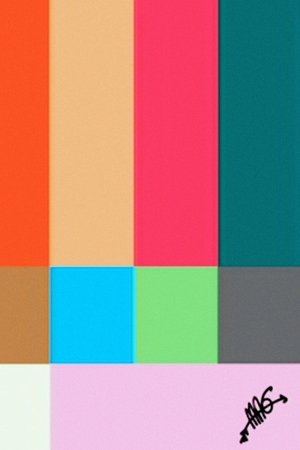
An abstract animation. Preserved by the Academy Film Archive, in partnership with the iotaCenter, in 2007.
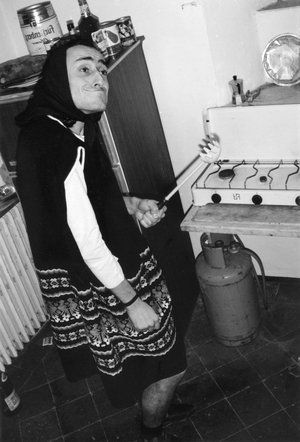
Martina and Sonja, cross-dress in vampire capes and werewolf claws, re-enacting familiar horror tropes. A corresponding soundtrack of stock screams and "scary" music suggests that the girls' toying with gender roles and power dynamics may have dire consequences.
In a leafy forest, a Galician sovereign who longs to attain wisdom meets a sorcerer, who tells him: “Go back to your country and study the Earth and the Stars in the sky; anywhere in the world reflects an image of it. You will ride on this arrow, which you must keep for a hundred years and a day. After this time, stick it in the widest valley of all those you possess, with the tip facing the sky. Then the Moon will come and, just as it exerts its action on the waters of the sea, it will act on the arrow, turning it into a holy mountain." - Legend about the Pico Sacro Inspired by Hokusai's views of Mount Fuji and Cézanne's paintings of Mont Sainte-Victoire, "Pico Sacro [The Holy Mountain]" aims to reveal the mystery and the magic that underlie reality.
By fabricating her biography, Luo Su, a young Chinese white-collar worker from a low-income family, hopes to wed Mr. Win, an alluring bachelor. But when her mother's shocking TV interview exposes her deceit, she loses everything and ends her own life. Left in limbo, she is mystically given one last opportunity to alter her fate within 72 hours - albeit within the body of a man.
Two men who have been friends for quite some time and who live in different cities maintain a correspondence with Super 8 film reels that they occasionally send to each other. One of these film reels shows a woman who reminds the addressee of a former girlfriend. Immediately and without paying attention to his obligations to the company, he drives the company car to the city of his childhood friend, 780 km away. There he finds out that she has been the secret lover of his Super 8 friend for years. After about three or four weeks, which they spend on the coast of another country without any significant difficulties, the lover of the childhood friend rows his boat alone across the Atlantic after an obviously frame-up rescue operation.
For this film, Takashi Makino allowed himself to be inspired by the earth. In a never-ending stream of images, we recognize elements from the forest that he then reduces to an abstraction. The film came about as a classical composition in which the picture and the musical contribution of Jim O’Rourke link up seamlessly and lead the mood in turn. A sense of freedom is what predominates.
Ali takes a personal look at the complexities of his childhood through old photographs, vivid memories and a bunch of tunes in an attempt to reconnect with his feelings at that time.
The wind carries an aspiring healer into a chaotic, virulent parallel world. Paralyzed by a familiar universe that is gradually becoming distorted, she discovers she has the power to stop time.
After escaping from her homeland and now abandoned by the man she loves, Medea must find strength from within to fight against growing injustice - how far is she willing to go?
A short experimental film, exploring the concept that one small change can have a profound impact on a person's life.
“Belladonna Museum” is a short film that portrays a personal experience of a transgender woman in a tragic love relationship: it is a visual poetry that reinterprets iconic paintings from surrealism and post-impressionism to address themes such as emotional dependence, loneliness, objectification, the attachment and the abuse both emotional and physical.
A teenage skateboarder becomes suspected of being connected with a security guard who suffered a brutal death in a skate park called "Paranoid Park".
History as immersion and dispersion in the fragments of the past, a visionary journey accompanied by the voice of Patty Pravo. Presented at the Taormina Festival '97.
A photographer during the Soviet-Afghan war becomes obsessed with a mysterious figure that appears in his images every time the person photographed dies.
A spate of robberies in Southern California schools had an oddly specific target: tubas. In this work of creative nonfiction, d/Deaf first-time feature director Alison O’Daniel presents the impact of these crimes from an unexpected angle. The film unfolds mimicking a game of telephone, where sound’s feeble transmissibility is proven as the story bends and weaves to human interpretation and miscommunication. The result is a stunning contribution to cinematic language. O’Daniel has developed a syntax of deafness that offers a complex, overlaid, surprising new texture, which offers a dimensional experience of deafness and reorients the audience auditorily in an unfamiliar and exhilarating way.
Four Poems is a series of video poems in which the horizontal lines of a poem, usually composed of text, have been substituted for horizontal lines of moving image. The piece explores what remains of a poem when its language is removed, and how images might interact with each other in similar or different ways to words. It asks whether rhyme, rhythm, sibilance, or dissonance, might be effectively created by juxtaposing images. It also asks whether arranging images might create a sense of authorship, intentionality, or a tone of voice, in the way that arranging words might. Finally, Four Poems invites the viewer to consider how they might ‘read’ a poem – does a reading have to occur from top-to-bottom, or might new interpretations be possible when the moving parts of the poem can all be seen at once?