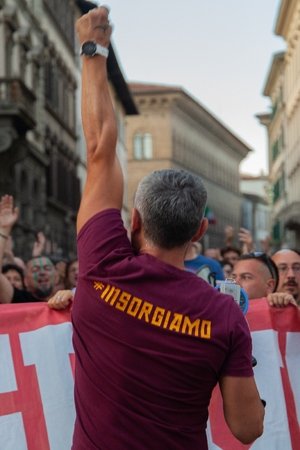
Every summer on Palermo's Mondello beach, over 1,000 cabins are built in preparation of the Ferragosto holiday. Centered around a family who goes into debt, three women holding onto the feeling of youth, and a politician seeking votes -- a vanity fair of beachgoers hiding behind the memory of a social status that the economic crisis of recent years has compromised.
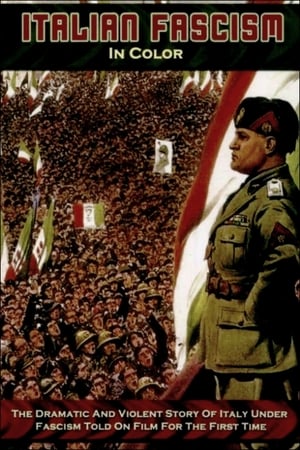
After the World War I, Mussolini's perspective on life is severely altered; once a willful socialist reformer, now obsessed with the idea of power, he founds the National Fascist Party in 1921 and assumes political power in 1922, becoming the Duce, dictator of Italy. His success encourages Hitler to take power in Germany in 1933, opening the dark road to World War II. (Originally released as a two-part miniseries. Includes colorized archival footage.)
A documentary that uncovers the careers of a population of entertainers never heard from before: Black actors in Italian cinema. With modern day interviews and archival footage, the documentary discloses the personal struggles and triumphs that classic Afro-Italian, African-American and Afro-descendant actors faced in the Italian film industry, while mirroring their struggles with those of contemporary actors who are working diligently to find respectable, significant, and non-stereotypical roles, but are often unable to do so. Blaxploitalian is more than an unveiling of a troubled history; it is a call-to-action for increased diversity in international cinema through the stories of these artists in an effort to reflect the modern and racially diverse Italy.
In a race against time and all odds, the revolutionary F1 racing car Ferrari 312B will get back on the Monaco circuit, 46 years later, under the wing of it’s creator, the genius engineer Mauro Forghieri.
Are tourists destroying the planet-or saving it? How do travelers change the remote places they visit, and how are they changed? From the Bolivian jungle to the party beaches of Thailand, and from the deserts of Timbuktu, Mali to the breathtaking beauty of Bhutan, GRINGO TRAILS traces stories over 30 years to show the dramatic long-term impact of tourism on cultures, economies, and the environment.
What are we talking about when we talk about negotiations? About the state's concessions to the Mafia in exchange for ending the massacres? About who assassinated Falcone and Borsellino? Of the eternal coexistence between the Mafia and politics? Between the mafia and the church? Between the Mafia and law enforcement? Or is there more? A group of actors enacts the most relevant episodes of the affair known as the Mafia-state negotiation, impersonating mobsters, secret service agents, high officials, magistrates, victims and murderers, Freemasons, honest and courageous people, and courageous people up to a point. Thus one of the most intricate events in our history becomes an exciting tale.
In this film we join Alice as she meets committed naturists, newcomers to naturism, and discovers a kaleidoscope of naturist opportunities including Pevors Farm and the Merryhill Music Festival.
Filmmaker Suzannah Herbert takes a sharp look at the American South’s unreconciled history through a Mississippi town that mixes antebellum tourism with a community deeply divided over its past. With an unflinching lens, the film captures the debates, memories, and tensions that are building toward a reckoning.
Bournemouth offers a variety of sports, pastimes, steamer trips, and fine dining for holidaymakers, competing with cheaper foreign holidays and offering a variety of transportation options.
The 1960s opened with La Dolce Vita by Federico Fellini and its unforgettable lead: Marcello Mastroianni. The actor seemed to glide effortlessly through his roles — and through life — as if to say that life is not all that serious, or perhaps that it is far too serious not to be laughed at. But what kind of man was hiding behind the actor with the handsome, boyish looks, who appeared so gentle and nonchalant?
He is considered the greatest European poet of the Middle Ages and his work unfolds the whole panopticon of occidental education – theology, philosophy, sciences, politics and literature. But who has really read it, the “Divine Comedy”? Who knows more of its creator Dante Alighieri than that he had an eagle-like profile and was in love with a woman named Beatrice? 700 years after Dante’s death, the filmmaker Adolfo Conti travels through Italy with Dante’s words in mind and eyes to see the world as Dante did. As the film encounters the beauty of arts and the Tuscan landscape, the forces of nature, a dramatic life story is unfolded.
The capture of Naples, the first great European city to be liberated, revealed the magnitude of the tasks involved in re-creating the means of livelihood and the machinery of government in a devastated, starving and disease-ridden city.
Drawing inspiration from his personal encounter with the Italian refugee child Giovanna during World War II, Markus Imhoof tells how refugees and migrants are treated today: on the Mediterranean Sea, in Lebanon, in Italy, in Germany and in Switzerland.
A courtroom in Milan is filled with people brought together by random selection. Long interviews lie ahead. Based on the interviews, some of them will be chosen for jury duty. However, The Call doesn’t focus on judicial proceedings, but rather considers people’s sense of justice through the conversations in the waiting room.
An exciting and unsettling cinematic journey through the life, work and torments of Caravaggio.
Luntano
House of the Wickedest Man in the World is the story of a ruined building near the city of Cefalú in Sicily. In the early 1920s, Aleister Crowley, the most famous occultist of his time, lived in the building, practicing magical rituals. In the summer of 1955, Kenneth Anger, considered one of the pioneers of experimental cinema, traveled with sexologist Alfred Kinsey to Sicily to find Aleister Crowley’s temple to shoot a film about the occultist’s time in Cefalú. The Thelema Abbey film was never released.
Oscar, not quite a child anymore, scavenges for scrap metal for his father. He spends his life in improvised landfills among what remains of leftovers. Worlds apart, yet close-by, there is Stanley. He tidies the church in exchange for a monetised hospitality, picks fruits, herds sheep: anything that keep his foreign body busy. Oscar, the young Sicilian, and Stanley the Nigerian don’t seem to have much in common. Except for the feeling of being thrown into the world, to suffer the same refusal, the same overwhelming wave of choices imposed on them by others.
World-renowned director Martin Scorsese narrates this journey through his favorites in Italian cinema.
Through the perils of air combat, and an emergency landing behind enemy lines in Italy, Hank Sciaroni utilized his capability to speak Italian to help get him and his men to safety as the Germans closed in.