"Solidarity marches for U.S. protesters rippling around the world reached Israel on Tuesday where hundreds of protesters waved 'Black Lives Matter' signs and chanted “George Floyd.” They also called out another name: Solomon Teka. "Over the past five years, six young men of Ethiopian descent have been killed by cops, according to the Association for Education and Social Integration of Ethiopian Jews. Police data also shows Ethiopian Israelis are still disproportionately overrepresented in arrests and indictments even though they make up 2 percent of the population. "Young Ethiopian Israelis have led the protest movement against racism and called for systemic reform."
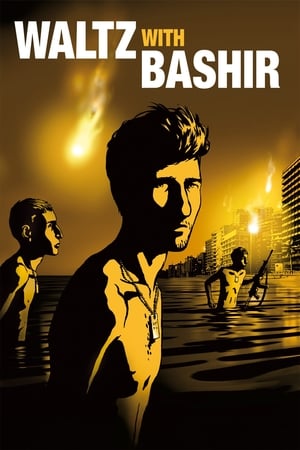
An Israeli film director interviews fellow veterans of the 1982 invasion of Lebanon to reconstruct his own memories of his term of service in that conflict.
Amid the ruins of northern Gaza, Ibrahim clings to the only companion he has left: Farfour, a stray cat he adopted during the war. Farfour has become more than just a pet for Ibrahim. He has turned into his shadow, his confidant, his last connection to humanity. Together, Ibrahim and Farfour navigate a collapsing world, enduring a relentless siege while living in an unsafe building, with no water and electricity. As the war tightens its grip, Ibrahim must flee.
The Israeli filmmaker Shai Corneli Polak records the building of the 'security wall' through Palestinian territory at the village of Bil'in. The villagers protest mostly peacefully, while the Israeli army doesn't react peacefully. By now the Israeli High Court has ruled that the building of the wall was illegal.
An account of the reign of Herod the Great, king of Judea under the rule of the Roman Empire, remembered for having ordered, according to the Gospel of Matthew, the murder of all male infants born in Bethlehem at the time of the birth of Jesus, an unproven event that is not mentioned by Titus Flavius Josephus, the main historian of that period.
King of the Jews is a film about anti-Semitism and transcendence. Utilizing Hollywood movies, 1950's educational films, personal home movies and religious films, the filmmaker depicts his childhood fear of Jesus Christ. These childhood recollections are a point of departure for larger issues such as the roots of Christian anti-Semitism.
In the first century, after the death of Herod the Great, Judea goes through a long period of turbulence due to the actions of the corrupt Roman governors and the internal struggles, both religious and political, between Jewish factions, events that soon lead to the uprising of the population and a cruel war that lasts several years and causes thousands of deaths, a catastrophe described in detail by the Romanized Jewish historian Titus Flavius Josephus.
When many people think of Israel, it is often in terms of modern war or ancient religion. But there is much more to the Jewish state then missiles and prayers. In his debut as a documentary filmmaker, adult-film entrepreneur and political columnist Michael Lucas examines a side of Israel that is too often overlooked: its thriving gay community. Undressing Israel features interviews with a diverse range of local men, including a gay member of Israel's parliament, a trainer who served openly in the army, a young Arab-Israeli journalist, and a pair of dads raising their kids. Lucas also visits Tel Aviv's vibrant nightlife scene-and a same-sex wedding-in this guided tour to a country that emerged as a pioneer for gay integration and equality.
The inside story of the bitter clash between President Obama and Israeli Prime Minister Netanyahu. Amid violence in the Middle East, the film traces Netanyahu's rise to power and his high-stakes fight with the president over Iran's nuclear program.
The Killing Roads is a gripping documentary that exposes the terror unleashed on October 7, 2023, when Hamas launched coordinated attacks across the roads of southern Israel. Through raw, unfiltered stories from victims, survivors, and first responders, the film reveals the unimaginable violence that turned Israel’s peaceful roads into scenes of horror.
Farming Under Fire in Gaza
Filmed on location in the West Bank in the immediate aftermath of the Gaza genocide that began on October 7, this documentary sheds light on the alleged support provided by the Israeli state and army to radical groups. Through the perspectives of both perpetrators and witnesses, it recounts the terror and land theft carried out by radical illegal settlers against Palestinians.
Part of a series of promotional films commissioned by Romania's National Tourism Office in the early 1970s with the aim of reconnecting diasporic communities with the country they left behind. In this case, the film is addressed to Jews who emigrated in the context of the Second World War or were sold by the Romanian state to the State of Israel starting in the 50s and settled in Israel and the USA - therefore, a target group made up of seniors, probably retired , possibly prosperous, eager to revisit the places of youth and willing to forget, temporarily, the traumas associated with them.
Writer-actor Aaron Davidman embodies seventeen different characters in and around the sacred city of Jerusalem as he takes us on an eye-opening journey into the heart of the Israeli-Palestinian story. Exploring universal questions of identity and human connection, the film is about one man's effort to embrace a multiplicity of conflicting viewpoints, chronicling a brave exploration of the complex humanity at the heart of one of the world's most troubling conflicts.
Grandfather and retired Israeli general Noam Tibon rescues his family from Hamas terrorists invading their home during the October 7, 2023 massacre - a coordinated assault on Israel sparking an ongoing conflict.
October 7, 2023 was one of the deadliest days of fighting ever in Israel, with around 1,200 people killed after Hamas launched its attack and 250 taken hostage – many of whom have either died in captivity or not yet released. The project features testimony from four victims and first responders, who witnessed the massacre and its aftermath: a farmer who helped rescue young people, a young survivor of the Nova music festival who took refuge in a shelter only to witness friends being murdered, an ultra-orthodox musician who volunteered to identify victims, and a mother whose son was kidnapped and taken to Gaza. A sentence uttered by the musician, who had seen 100 dead bodies in a single day, was the inspiration behind the title.
Jocelyne Saab toured the city of Beirut devastated by Israeli bombings. She assesses the number of victims and the extent of the destruction.
Rapper and breakdancer Teekay from Eindhoven is known for his somersaults and vlogs that are causing a stir. During the corona riots in 2021, he not only gained national fame as a vlog reporter, but also ended up briefly in jail. After his junior year, Teekay wants to change course and, above all, be an example for other young people. In the film he takes us into his life and talks about his childhood in foster homes, the mistakes he made and about his dreams. What is Teekay looking for?
A close-up look at the New Yorkers who took to the streets during the 2024 Presidential Election.
This documentary, filmed after October 7, places recent events in context and retraces the extraordinary history of this region to shed light on the present, interviewing actors and witnesses to this conflict: Islamists, Jewish nationalists, imams, rabbis, intellectuals, urban planners, soldiers, etc.