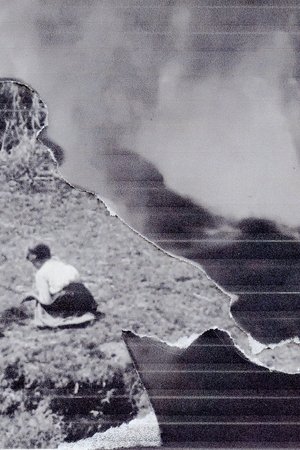
The mind of a prisoner, expressed through various poetic stanzas, corrodes at the same rate as the house they are trapped in.
an experimental short shot completely in black and white and attempts a new technique.
Colors and snowfall surround a street lamp with a loose fixture on time and space in this abstract ambient vid.
Al jet
The end of the world isn’t a global catastrophe, but an inner sense of total collapse, like for a man who’s lost his job and doubts his wife’s loyalty. In despair, he goes fishing and finds a wounded angel. He takes the angel home on his bicycle and introduces him to his family. But soon after, during a party at a local bar, the angel is accidentally shot by a neighborhood policeman. Based on Gabriel García Márquez’s short story 'A Very Old Man with Enormous Wings'.
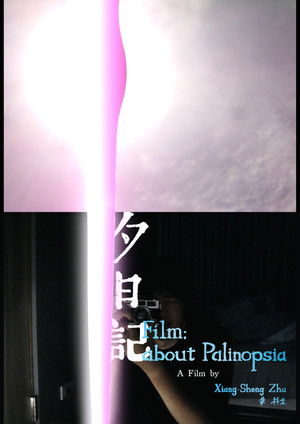
Today, film is no longer used to take photos, but to capture memories. On the day of the "Black-out", the pictorial traces left by digital technology disappear...
Experimental short film
Viet Flakes was composed from an obsessive collection of Vietnam atrocity images, compiled over five years, from foreign magazines and newspapers. Schneemann uses the 8mm camera to “travel” within the photographs, producing a volatile animation.
A naturalistic snapshot of the southern countryside.
The Fall
This movie marks the understanding of cinema as an extra-human effort and finds cinema beyond the human, somewhere on the territory of its non-existence.
An experimental avant-garde film where the character battles with herself, struggling to understand and embrace her true identity. Blending dream-like and reality sequences together, the film connotes inside the character’s mind. Escaping to different parts of her subconscious, she is met with confrontation, fear & desire. This piece of work highlights themes of identity, surrealism & subjectivity, where the instability of the self is at the forefront of the film. The film uses elements of mixed media montage to portray the character’s inner thoughts.
News broadcast interlaced with footage of people doing bizarre, senseless acts.
Extended nature and landscape shots. Shot on 16mm film.
A quick view of three remarkable organic gardens: Le Tomple, Le jardin du Mas d’Abri in the department of Gard and Le jardin des Sambucs in the department of Hérault. The film goes over their general layout along pathways amongst the vegetation, ponds and people or animals that happen to be there at the time.
A man, alone and contemplative, sits in his room until a woman enters.
The story takes place in the landscapes of La Spezia, where urban and rural environments intertwine. Water plays a primary role as a form, alongside the circle (e.g., bicycle wheels, pizzas, clocks…), which sets the rhythm of the character’s life, dynamically accelerating until it becomes very fast. The overlapping forms invite the viewer into the cyclical rhythm of the short film, moving from the spinning bicycle wheel to the washing machine drum in the character’s bathroom, from a freshly tossed pizza to the delivery mailbox, and finally to a dead-end wall. Savana is a race against oneself and against others; it’s a matter of decision and unpredictability — it’s black or white.
Energy cannot be created or destroyed. When we die, where does our energy go? Inspired by Vauhini Vara's essay "Ghosts", in which she prompted Al to help her write about her sister's passing, "GHOSTS" takes us on the emotional journey of grief. We see a ghost figure trying to get through to her sister, who is still alive, and let her know she's still around somehow. There are two poems in this piece, one is a poem written by GPT 3, and the next is the director's (Oriana Mejer) response to it. This film uses spoken word poetry, TouchDesigner motion graphics, and is originally scored by French musician Taime.
Experimental short-film made by brazilian students about the trópicalia and cinema novo movement. The narrative revolves around the song Géleia Geral from the album Tropicália ou Panis Et Circensis and also around the political, artistical and social time from that period.
In the rural desert of Bolivia, where the most important presence is the wind moving between papa flowers and animals, the people who harvest the land, those who built the ancient artifacts and sacred objects and the musicians who play moseñada – songs linked to the first products of the harvest – on the streets of the city have one point in common: labor. With a successful inclusion of stories of enchanted lakes, legends that pass from mouth to mouth – or from orality to audiovisual, in this case – and give a fantastic aura to those lands, Luciana Decker Orozco not only manages to capture life without oscillations . field, but resorts to the incessant movement of images and sound accompaniment to define a sensory and transcendental experience for the viewer.