A groundbreaking hyper-meta documentary psychodrama that centers on Cameron Smith's introspective journey through his greatest vulnerability: love, romance, and his relationship with women. As the filmmaker turns the camera on himself, the story evolves into a raw, unsettling, and unflinchingly honest glimpse into the modern "loneliness epidemic". Through an act of psychological crucifixion, Cameron simultaneously holds up a mirror to society's own struggles with isolation and connection.
Through the eyes of director Emma Becker, “F*ck It, We Fall” delves into the beauty, oddities, and awkwardness that comes with the fall season..
MiniDV visions portraying the anguish of a curious artist who becomes obsessed with replicating images of a woman he sees in his dreams.
A Stone Story
A mentally unstable teen transforms himself into a clown to deal with and mask his own disturbing, nihilistic worldview and deteriorating mental health. the further the film continues, the more prominent his descent into madness becomes.
A hustler who gets in trouble with a gang boss in the port town of Sukago agrees to make good with the don by putting him in contact with a mysterious hitman — an assassin the hustler has no idea how to contact. Instead, he hires an actor to play the role, though the thespian has no idea what he's getting into.
An isolated filmmaker struggles to connect with others in the absence of cameras. When he becomes creatively stuck, the world around him begins to dissolve.
When their bodies and worlds is in crumble, the men found that a closet is a safe place for them to vent, or perhaps hide it all inside, forever.
Three ancient heroes encounter the spectres of their dead loved ones and struggle to let them go.
Alex returns to a lifeless home that she ran away from at a young age. Once home, she begins filming a video about her past life but begins to question why she is putting her misery on display instead of doing what makes her happy.
Picnic
After a woman comes into contact with photographs from an archive, she reflects on her existence through her memories and the memories printed on photographs.
Feeling not real? Let me go insane. An homage to the director's mind. A take on body dysmorphia and the bloody tale of self love.
A father and son, affected by the tragedy at a railway station in Serbia, grieve in different ways.
When the actor in a scene for his film Life And Nothing More… has to quit, a film director casts another man for the part. However, complications arise since the man and the woman who was cast for the scene know each other.
X-ray images were invented in 1895, the same year in which the Lumière brothers presented their respective invention in what today is considered to be the first cinema screening. Thus, both cinema and radiography fall within the scopic regime inaugurated by modernity. The use of X-rays on two sculptures from the Bilbao Fine Arts Museum generates images that reveal certain elements of them that would otherwise be invisible to our eyes. These images, despite being generally created for technical or scientific purposes, seem to produce a certain form of 'photogénie': they lend the radiographed objects a new appearance that lies somewhere between the material and the ethereal, endowing them with a vaporous and spectral quality. It is not by chance that physics and phantasmagoria share the term 'spectrum' in their vocabulary.
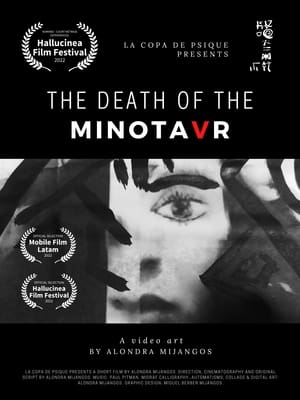
The death of the minotavr talks about the concept of the heroine's journey. Suffering, horror and exhaustion lead the protagonist to a process of transformation, abyss and expiation, because only murdering to minotaur and everything he represents is possible to return to life. From the female gaze, it shows the depth of the emotional wounds caused by domestic violence; the same one that the surrealist Dora Maar lived and that ask why, as a society, instead of killing the minotaur, we blindly continue to send him women only to be devoured and ask them why they simply did not fight, why they did not try get out of the labyrinth.
A Way Out
A woman reflects under the parapet.
A young man performs 'pranayama' sitting against a bleak wall. We observe him through a frame that seems to be connected to him in some way. As we go on to witness the nature of the frame, will the images presented to us be able to convey his intentions, thoughts, and ultimately, his fate? This experimental feature film is comprised of 7 parts of black and white imagery with no sound at all.