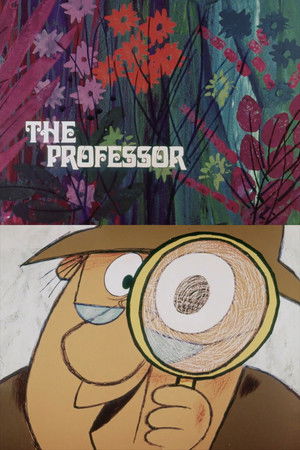
A nutty professor meets a very hungry caterpillar in this animated chase cartoon brimming with swinging 60s backdrops.
Harald is a wrestler. Driven by his ambitious mother he won a vast number of challenge cups. But his true love is flowers. When his favorite is taken away by his mother one day, he has to fight for it.
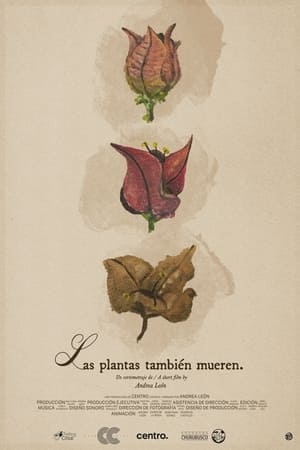
Inside a room full of plants, a woman finds shelter from the outside world. Submerged in delirium, Alba experiences her withering.
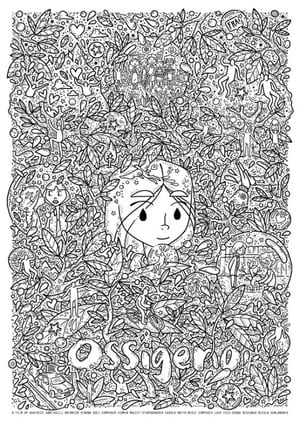
Lena is nine-year-old. One day, she spontaneously makes an act of love that will change her life. She will take care of a plant. An action so simple yet unusual that nowadays only children could instinctively do. Will this revolutionary gesture change the future of our world? In a blurry society made by technological progress and innovation, can a simple action become a revolution?
In 1772, Englishwoman Mary Delany wrote to her niece: “I have found a new way of imitating flowers.” The imitation in question was the art form called decoupage, based on cut-outs and reshuffling of pictures. The charm and botanical precision of these works attracts attention of even today’s artists, among others by an anonymous programmer who is trying to invent a way of capturing the flowers’ vivacity in pictures. With this aim in mind, she has created an algorithm, which would combine science and beauty, similarly to Delaney’s efforts, whose illustrations it is meant to animate.
In 1929, an expedition of university botanists enter an uncharted forest where they discover, and must escape an ancient organism.
In the 19th century, China held the monopoly on tea, which was dear and fashionable in the West, and the British Empire exchanged poppies, produced in its Indian colonies and transformed into opium, for Chinese tea. Inundated by the drugs, China was forced to open up its market, and the British consolidated their commercial dominance. In 1839, the Middle Empire introduced prohibition. The Opium War was declared… Great Britain emerged as the winner, but the warning was heeded: it could no longer depend on Chinese tea. The only alternative possible was to produce its own tea. The East India Company therefore entrusted one man with finding the secrets of the precious beverage. His mission was to develop the first plantations in Britain’s Indian colonies. This latter-day James Bond was called Robert Fortune – a botanist. After overcoming innumerable ordeals in the heart of imperial China, he brought back the plants and techniques that gave rise to Darjeeling tea.
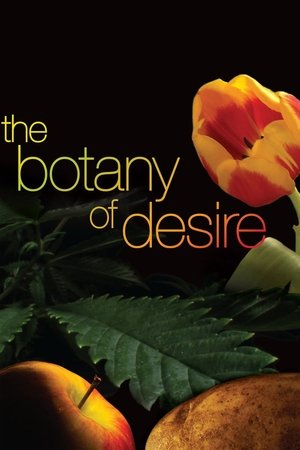
Featuring Michael Pollan and based on his best-selling book, this special takes viewers on an exploration of the human relationship with the plant world — seen from the plants' point of view. Narrated by Frances McDormand, the program shows how four familiar species — the apple, the tulip, marijuana and the potato — evolved to satisfy our yearnings for sweetness, beauty, intoxication.
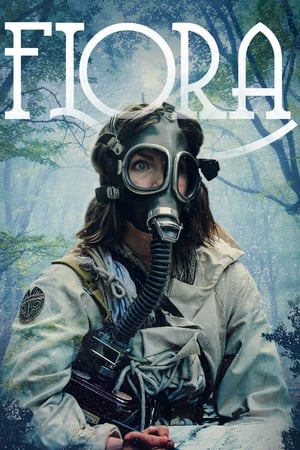
When a drug to replicate plant cells creates a sentient form of flower, the planet is over taken by flora and humankind is depleted. A Chinese task force, a widowed father and his young daughter fight to survive in a mission to inject an antidote to the core of the plants to reverse their growth.
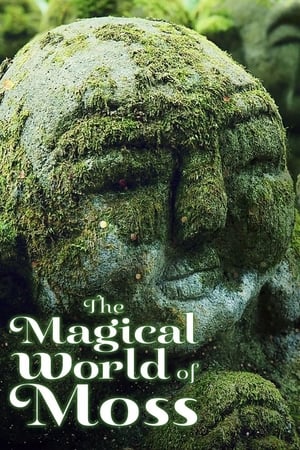
They have no roots, no seeds, no flowers, but mosses show immense survival capacities and can suspend their biological activity for long periods. Today, researchers are exploring the exceptional resistance of these archaic organisms. British ecologists have even resurrected a "zombie" moss that has been trapped in the permafrost for 1,500 years. Associated with decay and disliked in Europe, mosses are deified in Japan. With 25,000 species worldwide, bryophytes - their scientific name - are the seat of real ecosystems, and can develop in inhospitable landscapes, through an extravagant reproduction cycle.
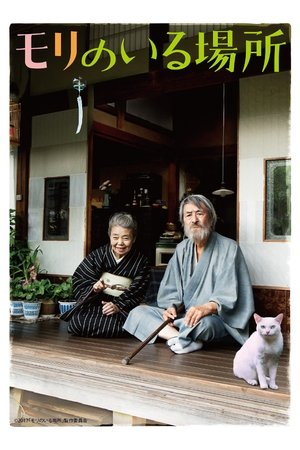
Vegetation thrives in painter Morikazu's garden, which is home to creatures that serve as models for his paintings, including numerous bugs and cats. A sweet and heartwarming day begins for Morikazu, who gazed at these garden creatures on a daily basis for over three decades, and those who love him.
Discusses the temperate deciduous forest biome, highlighting its seasonal changes and the interdependence of plant and animal life. It explains the characteristics of the forest, including its layers of vegetation and the life cycles of various species. The video details how trees, particularly deciduous ones, influence the ecosystem, how animals adapt to seasonal changes, and the cyclical nature of life in this biome, from spring growth to winter dormancy.
Two estranged siblings, a botanist and a magician, come together to try and raise their mother’s body from the dead.
A documentary about the study of plant sentience with original music by Stevie Wonder. Utilizing time-lapse photography, the film proposes that plants are able to experience emotions and communicate with the world around them.
The undertaking of an enthusiastic group of scientists to transform an indoor cycle racing-track built for the 1968 Montréal Olympics into an ecological park. The Biodôme of Montréal contains 4 ecosystems of the 3 Americas, from the Tropical Forrest to the Polar World, from the Laurentian Forrest to the St-Lawrence Marine Environment.
Eve Edgarton decides to devote her life solely to her love of botany, but unexpectedly falls in love with a man who shares none of her intellectual interests.
Akil, a wealthy butchery mogul, has a very close relationship with his younger brother, Sharm. When Sharm is tragically murdered all signs point to Akil's wife, Madison. With no actual proof Akil turns to alcohol and unleashes his rage on his wife. Madison plots revenge on Akil by creating a poison from her repertoire of poisonous botany, the most lethal: The Blood Orchid. Domestic rivalry ensues in this gripping psychological drama.
Geologist Ian Stewart explain in three stages of natural history the crucial interaction of our very planet's physiology and its unique wildlife. Biological evolution is largely driven bu adaptation to conditions such as climate, soil and irrigation, but biotopes were also shaped by wildlife changing earth's surface and climate significantly, even disregarding human activity.
Sayaka works at a office. She's not very good at her job or with love. One night, she finds a man, Itsuki, collapsed in front of her home. She takes him inside and they begin to live together. Itsuki teaches Sayaka about cooking wild herbs and collecting wild herbs, but he has a secret.
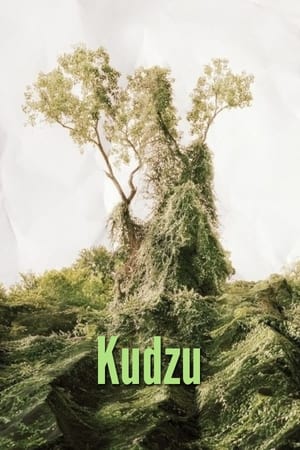
Kudzu, or Pueraria Thunbergiana, is a vine threatening to take over large portions of the Southern landscape. Imported from Japan by the Departement of Agriculture in the 30's for erosion control, its spreading growth has become a problem of menacing proportions. Kudzu is an off-beat, witty, informative documentary about the vine that is devouring the South. Featuring the Kudzu Queen, the Kudzu rock band, a cast of real-life characters and an appearance by former President Jimmy Carter, it illustrates how Southern cultural traditions have quickly grown up around a botanical pest. The eminent American poet and novelist James Dickey ("Deliverance"), recites three stanzas of his poem, "Kudzu."