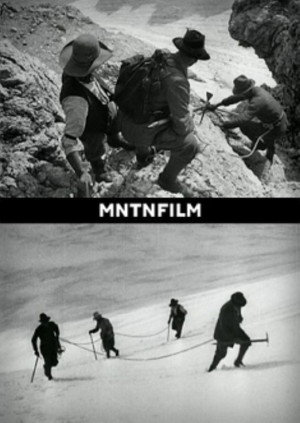
World-renowned snowboarders Travis Rice and Elias Elhardt team up with legendary director Curt Morgan for a celebration of space and time filmed in the deep backcountry of Alaska, exclusively on location at Tordrillo Mountain Lodge.
On the 23rd of June 2016 Britain voted to leave the European Union. Who Are We? is a re-working of material from a BBC television debate transmitted a few weeks earlier.”The most provocative of the bunch is John Smith’s Who Are We?. Leading up to the Brexit vote, BBC’s Question Time became ever more vicious and confrontational. Who Are We? is a manipulation of one of those broadcasts, with David Dimbleby prompting “you, sir, up there on the far right” repeatedly.“Get our identity back – vote leave!” one audience member shouts, while another declares himself a veteran, followed by a swift manipulated cut to rapturous applause. It’s a heavily edited and remixed edition of Question Time, but by highlighting those in the audience with attitudes ranging from nationalistic to xenophobic, Smith’s short film shows the now normalised extremism within our society and our political discourse.” Scott Wilson, Common Space magazine, April 2017
When chimps go to war...
A brief history of Talking Heads (and how they got here!)
What is the difference between a story and a good story? In this short documentary, ten of the greatest screenwriters in Brazil answer this and other questions, guiding us through the universe of creative writing and all its possibilities.
Murray Sinclair's acceptance speech for an award in honor of his role as chair of the Truth and Reconciliation Commission of Canada, intercut with the testimonies of survivors of the Indian residential school system.
Documentary on the making of "The Searchers" (1956), starring John Wayne and directed by John Ford, with outtakes, behind-the-scenes footage and interviews with many of the surviving cast and crew.
An unflinching look at the ongoing debate on violence in movies and its effect on the audience.
In interviews, various actors and directors discuss their careers and their involvement in the making of what has come to be known as "cult" films. Included are such well-known genre figures as Russ Meyer, Curtis Harrington, Cameron Mitchell and James Karen.
A group of filmmakers shadow some glamour photographers in order to discover the skill involved in getting 'magic' to appear on the photos.
A quickfire portrait of the New York City ballroom scene in the ‘80s.
Is this documentary actually about the magnificent palace of Beloeil, owned for generations by the princes of Ligne and about its splendid park? Or is it about those who visit it and those who having fun in its park on a Saturday afternoon? Both actually, because Edmond Bernhard never visits a place without taking an interest in the people present there.
Ahead of the state visit to Britain by Chinese Premier Xi Jinping, the BBC's China Editor Carrie Gracie retraces his remarkable career from living in a cave to becoming the most powerful Chinese leader in decades.
In the hills of rural Pennsylvania, the leader of a local militia must prepare his men for the turbulent political landscape of 2020 while at war with his own conscience. For over ten years, 48-year-old Iraqi War Veteran and machinist Christian Yingling has commanded a troop of private militiamen and women concerned with the government’s infringement on their constitutional rights. The group practices paramilitary drills, stockpiles food and ammo, and attends gun rights rallies in preparation for a doomsday scenario. Now that a worldwide pandemic has hit, followed by a summer of racial injustice protests and a Presidential election like no other, Christian—out of work and nearly out of money—must confront his allegiance and choose to act or not.
How did peacocks, originally from India, end up on an island in Berlin in the 19th century, and hippopotamuses, a century later, on the banks of a river in Colombia? Their lives there appear to be “happy and free”. With rapturous imagery, Elkin Calderòn Guevara and Johannes Förster’s decolonial fable turns them into wild icons, bearing witness to the whims of the powerful.
The film features a conversation between Lucas and Francis Ford Coppola, producer of THX 1138. They discuss Lucas' vision for the film, including his ideas about science fiction in general and in particular his concept of the "used future" which would famously feature in his film Star Wars. Intercut with this discussion is footage shot prior to the start of production of THX 1138 showing several of its actors having their heads shaved, a requirement for appearing in the film. In several cases the actors are shown being shaved in a public location. For example, Maggie McOmie is shaved outside the Palace of Fine Arts in San Francisco, while Robert Duvall watches a sporting event as his hair is cut off. Another actor, Marshall Efron, who would later play an insane man in the film, cut off his own hair and was filmed doing so in a bathtub.
The way of life for people living along the tropic of Capricorn in Queensland 1965. Farming and mining are the main industries in this area of Australia and the only way to get around is by road train, train or plane. The hard way of life for these people is portrayed in this film.
Rae Ripple, a welder from the outskirts of West Texas transforms neglected metal into works of art and in the process finds healing from her traumatic past.
The film was inspired by one of the most important documentaries shot by Krzysztof Kieślowski, Talking Heads (1980). The director asked his interlocutors seemingly simple questions, such as “Who are you?” and “What do you want?”.
A short documentary chronicling the personal lives and narratives of Thai "ladyboys," who are born men but present themselves as women, living openly in Thai society. The film interviews ladyboys from all walks of life-- performers, filmmakers, activists-- to learn what it's like to live in a society with visible gender fluidity, and to explore if Thailand is really as open to and accepting of sexual diversity as it seems.