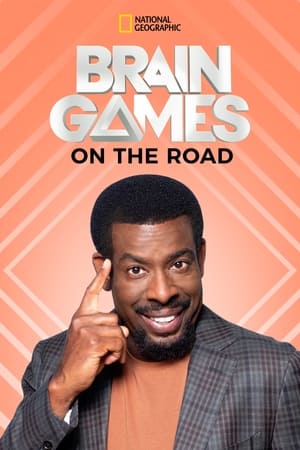
This half-hour comedy hits the streets of NYC, luring unsuspecting contestants to push their personal limits for cash. By never wasting money on fancy lights, stages or expensive props, hosts David Magidoff and Derek Gaines bring the savings to the people with truly “broke a$$” challenges and irreverent games all promising cold hard cash in exchange for contestants’ dignity.
A game show set in a galaxy far, far away, which tests young contestants’ abilities in the core Jedi principles of strength, knowledge, and bravery as they face thrilling and fun obstacles in an attempt to achieve the rank of Jedi Knight
Teams of master magicians create and perform original magic routines using random props.
Two families compete against each other in a contest to name the most popular responses to a survey question posed to 100 people.
Crippled with debt, Grant and Ally go head-to-head in this agonizing competition show to prove they'll do ANYTHING to pay off their student loans.
Prepare for an all-new game show event where the smartest people in the country try to achieve the seemingly impossible task of answering 500 of the most difficult general knowledge questions ever devised. There’s only one simple rule: never get three wrong in a row—or you’re gone. No saves, no helps, no multiple choice, 500 Questions will keep you on the edge of your seat to see if any of these geniuses can do it.
Boyard Land
Jason Manford hosts a game show with just one golden rule – don't come first or last in any game, otherwise you're out!
Status and strategy collide in this social experiment and competition show where online players flirt, befriend and catfish their way toward $100,000.
奔跑吧·共同富裕篇
De Invasie van België
Remote Control is a TV game show that ran on MTV for five seasons from 1987 until 1990. It was MTV's first original non-musical program. New episodes were made for first-run syndication from 1989 until 1990 which were distributed by Viacom. Three contestants answered trivia questions on movies, music, and television, many of which were presented in skit format. The series was developed by producers Joe Davola and Michael Duggan, and directed by Dana Calderwood.
Could you pass off a complete stranger as your new best friend for one short weekend to win £10k, even if your 'friend' was actually a brilliant actor hell-bent on humiliating you?
Catchphrase is a British game show based on the short-lived U.S. game show of the same name. It originally aired on ITV in the United Kingdom between 12 January 1986 and 19 December 2002. It was presented by Northern Irish comedian Roy Walker from 1986–1999; followed by Nick Weir from 2000–2002, and Mark Curry in 2002. In the original series, two contestants, one male and one female would have to identify the familiar phrase represented by a piece of animation accompanied by background music. The show's mascot, a golden robot called "Mr. Chips", appears in many of the animations. In the revived version of the show, the same format remains, but there are three contestants. In August 2012, it was announced that Stephen Mulhern would host a revived version of the show beginning on 7 April 2013. On 21 August 2013, it was confirmed that Catchphrase has been re-commissioned for a second series, following the success of the first.
Shooting Stars is a British television comedy panel game broadcast on BBC Two as a pilot in 1993, then as 3 full series from 1995 to 1997, then on BBC Choice from January to December 2002 with 2 series before returning to BBC Two for another 3 series from 2008 until its cancellation in 2011. Created and hosted by double-act Vic Reeves and Bob Mortimer, it uses the panel show format but with the comedians' often slapstick, surreal and anarchic humour does not rely on rules in order to function, with the pair apparently ignoring existing rules or inventing new ones as and when the mood takes them.
Hollywood Squares is an American panel game show, in which two contestants play tic-tac-toe to win cash and prizes. The "board" for the game is a 3 × 3 vertical stack of open-faced cubes, each occupied by a celebrity seated at a desk and facing the contestants. The stars are asked questions by the host, or "Square-Master", and the contestants judge the veracity of their answers in order to win the game. Although Hollywood Squares was a legitimate game show, the game largely acted as the background for the show's comedy in the form of joke answers, often given by the stars prior to their "real" answer. The show's writers usually supplied the jokes. In addition, the stars were given question subjects and plausible incorrect answers prior to the show. The show was scripted in this sense, but the gameplay was not. In any case, as host Peter Marshall, the best-known "Square-Master" and the man in whose honor the show's first announcer, Kenny Williams, actually "coined" the term, would explain at the beginning of the Secret Square game, the celebrities were briefed prior to show to help them with bluff answers, but they otherwise heard the actual questions for the first time as they were asked on air.
Big money gameshow, where it pays to know what's valuable and what's not. The show's antique expert has travelled around the country and found 8 collectibles, ranging in value from 500 dollars up to a staggering 500 000 dollars. In each show a couple competing together faces the task of eliminating these objects, one by one, winning the value of the last collectible standing. Will their instincts and the expert's advice send them home with a piece of trash or a valuable piece of treasure?
There is a group of mouthy children between the ages of six and nine who are asked questions. The four adult participants in the program must then guess what the little ones' answers to the questions were. Sounds easy, right? It's not that easy! As everyone knows, how a child thinks is not as predictable as one would like it to be.
A new twist on the classic game that follows contestants to the banker’s private island, where they must compete in tough challenges to find hidden briefcases worth over $200 million -- then try to beat the banker in “Deal or No Deal.”
Concentration is an American television game show based on the children's memory game of the same name. Matching cards represented prizes that contestants could win. As matching pairs of cards were gradually removed from the board, it would slowly reveal elements of a rebus puzzle that contestants had to solve to win a match. The show was broadcast on and off from 1958 to 1991, presented by various hosts, and has been made in several different versions. The original network daytime series, Concentration, appeared on NBC for 14 years, 7 months, and 3,770 telecasts, the longest run of any game show on that network. This series was hosted by Hugh Downs and later by Bob Clayton, but for a six-month period in 1969, Ed McMahon hosted the series. The series began at 11:30 AM Eastern, then moved to 11:00 and finally to 10:30. Nearly all episodes of the NBC daytime version were produced at 30 Rockefeller Plaza, New York City. A weekly nighttime version appeared in two separate broadcast runs: the first aired from October 30 to November 20, 1958 with Jack Barry as host, while the second ran from April 24 to September 18, 1961 with Downs as host.