Pedal is a fast-paced documentary film about surviving in the streets of New York City as a bicycle messenger. It features messengers from all walks of life as they battle traffic in a race to make their next delivery on time. Directed by Sutherland and produced by Ana Lombardo, Pedal the documentary lets viewers live the spectacle of the delivery itself. It premiered in 2001 at the South by Southwest film festival, and was later acquired by the Sundance channel, where it aired until 2004.
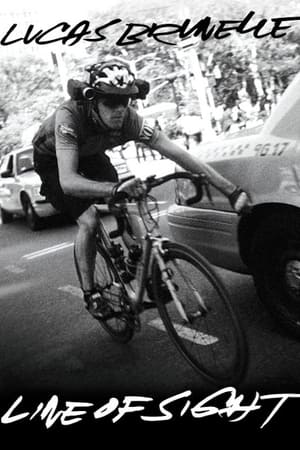
Line Of Sight is a rare view into underground bicycle messenger racing which has become a global phenomenon. For over a decade Lucas Brunelle has been riding with the fastest, most skilled urban cyclists around the world while capturing all the action with his customized helmet cameras to bring you along for the ride.
For fixed-gear cyclists, Los Angeles is a city that has it all. From the neon glow of Hollywood to the sun-drenched boardwalk of Venice Beach, fixed-gear has evolved into a vibrant street culture that is uniquely L.A. From director David Rowe (Fast Friday) comes a new documentary feature that explores a side of L.A. few outsiders have seen. From races through rush-hour traffic to midnight loft parties, To Live & Ride in L.A. is a fast paced-trip through the busy streets and back-alleys of one of the world's largest cities. To Live & Ride in L.A. features talented local riders tearing up the streets with first-time visitor Keo Curry (Fast Friday, Macaframa) - one of the living legends of the sport. Bike to hidden spots off the map, race a midnight alley-cat, keep pace with the riders from Wolfpack, and hang with the local crews, graffiti artists and other L.A. personalities burning up the fixed-gear scene.
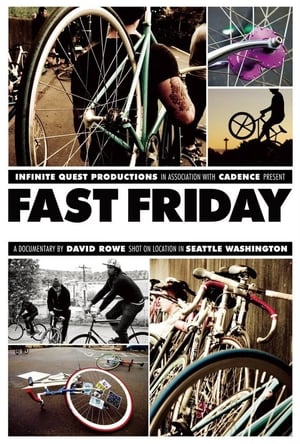
Infinate Quest Productions in association with Cadence present Fast Friday. A Documentary by David Rowe shot on location in Seattle Washington
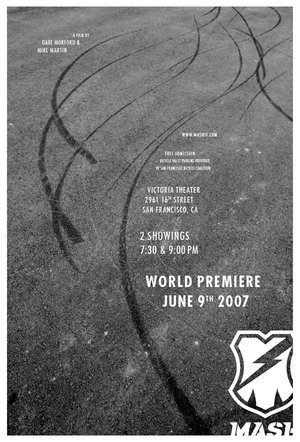
Mash is a testament to the efficacy of the frame, wheels, cockpit, and drive-train that carry us through SF's labyrinth of lanes, alleys, and everything in between. This video recognizes those who have inspired us with their unique presence in the streets, who have created an accelerated style of riding bikes built for the track but tailored for daily abuse. The synthesis of this video sprang from a desire to show the world how these locals take ownership of San Franciscos dense landscape and display an incredible amount of focus, fluidity, and grace in the process.
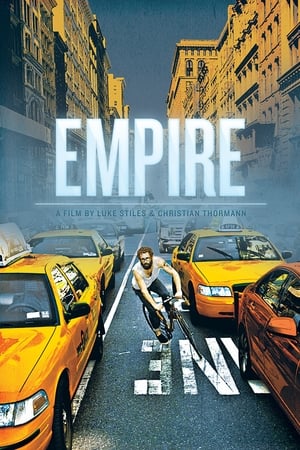
Empire is a movie about having fun riding your bike New York City. In the tradition of BMX and skate movies, Empire follows New York’s best fixed gear riders and a few special out-of-town guests in and out of traffic all over New York City. Inspired by MASH and Lucas Brunelle, Empire is the first full-length fixed gear action sports feature shot entirely with New York City.Featured riders include Tom Lamarche, WONKA, Dwaine, Yatika Starr Fields, Dagga, John Prolly, Kai Perez and surprise guests.
Mash is a group of friends: racers, artists, students, musicians, designers, and photographers, all connected through bikes. What started as a small video project and have grown into a team of racers, a line of bikes produced with Cinelli, and an outlet for friends to support each other through bikes. The accompanying video takes a narrower view than the book, focusing primarily on street-riding in San Francisco. With exceptional riding and up-close cinematography, the video captures the joy of riding track bikes in a city like SF and passes that excitement along.
Pas assez de volume
The last film in Vidokle's trilogy on Cosmism is a meditation on the museum as the site of resurrection-a central idea for many Cosmist thinkers, scientists and avant-garde artists. Filmed at the State Tretyakov Gallery, the Moscow Zoological Museum, The Lenin Library, and the Museum of Revolution, the film looks at museological and archival techniques of collection, restoration and conservation as a means of the material restoration of life, following an essay penned by Nikolai Federov on this subject in the 1880s. The film follows a cast comprised of present-day followers of Federov, several actors, artists and a Pharaoh Hound that playfully enact a resurrection of a mummy, a close examination of Malevich's Black Square, Rodchenko's spatial constructions, taxidermied animals, artifacts of the Russian Revolution, skeletons, and mannequins in tableau vivant-like scenes, in order to create a contemporary visualization of the poetry implicit in Federov's writings.
The last words of the gangster Dutch Schultz form the starting point for this animated documentary. The FBI noted these words down on Schultz’ deathbed, in the hope he would betray his colleagues. Here, spoken in the english version by Rutger Hauer, they accompany the sober, pencil drawn animation based on traced (film) images from Schultz’ time: the late 1920s, early 1930s.
The 94 minute documentary film “From the 50 Yard Line” presents the football field not only as a sports venue but also as a stage for the marching band. The viewer goes on an exciting adventure through band camp, auditions, the marching season, and the regional and national competitions in 2006. You see the great rewards of disciplined practice, the overlooked technical artistry of the group endeavor, and the important life changing effects of instrumental music education. Another layer delves into the misconceptions about marching band, showing "band nerds" in a whole new light.
An interview with actor Dan Zukovic about Hanging Heart (1989)
Aristocratic Italian roots, a close family connection to James Bond novelist Ian Fleming, wartime experiences in the British and Finnish military, post-war Nazi-hunting adventures and a side career as a heavy metal rock singer. And one of the most iconic actors of all time.
A young pair from Stuttgart fly to Shanghai to hop aboard the textile business of his father while she prepares for the birth of their son. A story about the ever more common movement of Germans into the East for professional gain.
Starting with a long and lyrical overture, evoking the origins of the Olympic Games in ancient Greece, Riefenstahl covers twenty-one athletic events in the first half of this two-part love letter to the human body and spirit, culminating with the marathon, where Jesse Owens became the first track and field athlete to win four gold medals in a single Olympics.
Working men and women leave through the main gate of the Lumière factory in Lyon, France. Filmed on 22 March 1895, it is often referred to as the first real motion picture ever made, although Louis Le Prince's 1888 Roundhay Garden Scene pre-dated it by seven years. Three separate versions of this film exist, which differ from one another in numerous ways. The first version features a carriage drawn by one horse, while in the second version the carriage is drawn by two horses, and there is no carriage at all in the third version. The clothing style is also different between the three versions, demonstrating the different seasons in which each was filmed. This film was made in the 35 mm format with an aspect ratio of 1.33:1, and at a speed of 16 frames per second. At that rate, the 17 meters of film length provided a duration of 46 seconds, holding a total of 800 frames.
Pablo, Angel o Demonio is the untold story of a man who changed our world forever. He created the multinational enterprise of cocaine trafficking and through terror brought a country to its knees, but through altruistic generosity he transformed the lives of his people, the underprivileged.
A short documentary on Japanese animation featured on the DVD for The Animatrix (2003).
As the "Murder Hornet" makes national headlines, a small town crew of beekeepers and scientists band together to protect their quiet Washington community from the dangerous invasive species.
Les évadés de Drancy