For this work Alÿs purchased a gun in Mexico City then walked through the city streets with the weapon in his hand. After eleven minutes he was arrested by the police. The following day he repeated the action, this time in cooperation with the police. By presenting a record of this dramatic action alongside footage of its reenactment, Alÿs blurs the boundaries between documentation and fiction. Questioning the concept of authenticity, this work demonstrates “how media can distort and dramatize the immediate reality of a moment,” the artist has said. Gallery label from Francis Alÿs: A Story of Deception, May 8–August 1, 2011.
A filmmaker visits Nigeria for the first time since his parents’ emigration 22 years prior and reflects on the Nigerian 1993 election crisis, colonial history, and repatriation. Adapted from a multi-channel video thesis installation, the experimental essay film engages Yoruba oral traditions through archival materials and autobiographical narration, questioning Nigeria's past, present, and speculative future with an Afrobeat score.
Bits and blocks are the home of the Super Vario Birds who are dancing to the 8bit symphony of Ludwig van Beethoven.
A dream where obsession for German as a second language mixes up with an obsession for neatness and cleanliness as a distinctive feature of the national culture in question seen from the perspective of a foreigner. The dream is not a nightmare only because the set it is dreamt into is the seashore of the mare nostrum, where the dreaming subject is perfectly at home. A homeland which she, in turn, in her more secret thus naïf dreams would dream of being cleaner and tidier as in the reality, especially in front of such beauty of nature. As is right and proper.
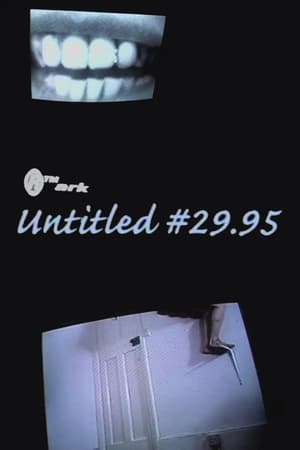
Originally produced anonymously and distributed by RTMark, Untitled #29.95 tells the story of the commercial art establishment's attempt to turn video art into a precious commodified object through the release of limited editions during the nineties.
El siglo de las luces
Furio’s Furious Fragments & Friends - Furio Jesi (1941 Turin -1980 Genoa), enfant prodige moving between a plethora of disciplines – egyptology, history of religions, German philology, literary criticism - passed away prematurely, not without leaving bright fragments which throw light on mechanisms beneath many socio-cultural practices, for instance regarding cultural belonging, the functions of myth in modern society. He saw kind of “mythological machines” at work underneath our cultural production of meanings, historically determined, departing from a void, something that is still in culture but as residue, a missing link to an alleged authentic experience nowadays compromised up to the point to became just rhetoric, a byword, which is in no way neutral, but a tool, a macchina, for maintaining the status quo and serving the power apparatus. As in the case of holidays, celebrations and festivals.
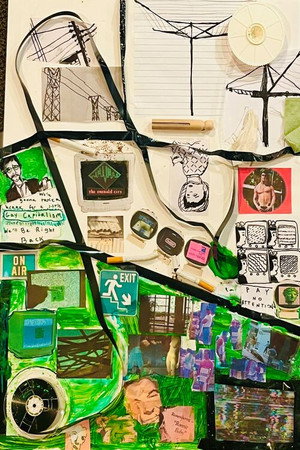
A continuously running two-channel installation, presented on 9" and 13" CRT monitors atop pedestals and overlooked by a green Kit-Cat clock. The smaller CRT bears a painted green square and is framed by a pair of crossed silver opera gloves, at whose intersection rests a vintage push-puppet of two boxers sharing a single red stand. Together, the two monitors display distinct video collages interweaving footage from Emerald Square Mall and the strike during its 1989 construction with remixed interferences from Channel J's Emerald City TV (1976–1979), Huge Video's Heat in the Night (1989), Genet's Un Chant d'Amour (1950), various cigarette commercials, The Wizard of Oz (1939), and a performance of a mylar-clad entity wrapping one of the televisions in videotape. The work has most frequently circulated publicly through its primary video channel.
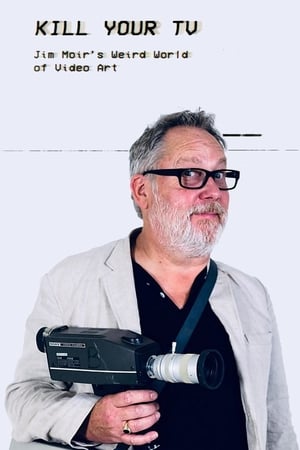
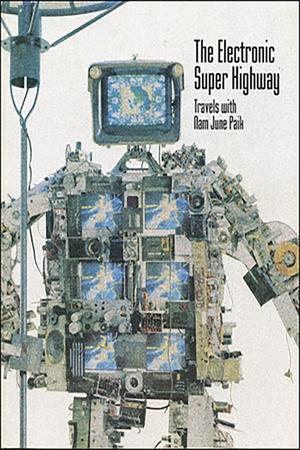
Jim Moir (aka Vic Reeves) explores Video Art, revealing how different generations ‘hacked’ the tools of television to pioneer new ways of creating art that can be beautiful, bewildering and wildly experimental.
After concluding the now-legendary public access TV series, The Pain Factory, Michael Nine embarked on a new and more subversive public access endeavor: a collaboration with Scott Arford called Fuck TV. Whereas The Pain Factory predominantly revolved around experimental music performances, Fuck TV was a comprehensive and experiential audio-visual presentation. Aired to a passive and unsuspecting audience on San Francisco’s public access channel from 1997 to 1998, each episode of Fuck TV was dedicated to a specific topic, combining video collage and cut-up techniques set to a harsh electronic soundtrack. The resultant overload of processed imagery and visceral sound was unlike anything presented on television before or since. EPISODES: Yule Bible, Cults, Riots, Animals, Executions, Static, Media, Haterella (edited version), Self Annihilation Live, Electricity.
A kinetic prayer and structuralist intervention. Shot entirely on an iPhone 11 in a desolate Midwest laundromat, 108 spin documents the mechanics of impermanence. The film shifts from heavy turbulence to suspended repetition—not as a path to completion, but as a study of the loop itself. Featuring a layered soundscape, the work asks the viewer to stare into the rotation until the noise becomes a mantra.
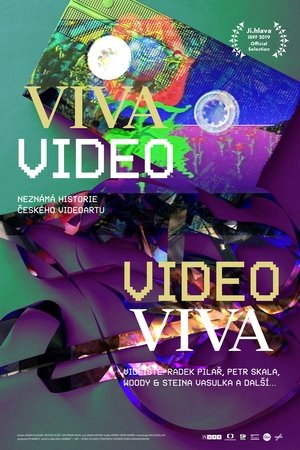
Today, analogue video is attractive primarily thanks to the distinctive aesthetic quality of its pixelated image and raster errors. But for Czech artists who first explored the possibilities offered by video art in the late 1980s, this medium represented a path towards freedom. Through a portrait of her grandfather Radek Pilař, one of the pioneers of Czech video art, the director explores her own legacy of imperative creative fascination. Her film’s main story, i.e., the process of reconstructing the 1989 exhibition Video Day, contrasts this enchantment with life in the final days of the totalitarian regime, which different sharply with the adventures of those who decided to emigrate – whom the filmmaker also visits in order to discover forgotten works, get to know their creators, and re-establish broken ties.
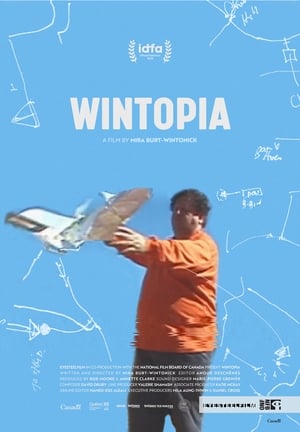
IDFA and Canadian filmmaker Peter Wintonick had a close relationship for decades. He was a hard worker and often far from home, visiting festivals around the world. In 2013, he died after a short illness. His daughter Mira was left behind with a whole lot of questions, and a box full of videotapes that Wintonick shot for his Utopia project. She resolved to investigate what sort of film he envisaged, and to complete it for him.
Cóndor
A group of hometown friends come together after the loss of a loved one.
A collection of 8mm film reels from İlhan Mimaroğlu’s archive—once tucked away in whisky boxes—has found new life through art. Curated by director Serdar Kökçeoğlu and producer Dilek Aydın, the project brings together visual artists and musicians to reimagine these long-lost images. Over thirty artists transformed the footage into fifteen distinct audiovisual pieces, blending experimental soundscapes with contemporary video art. The project concludes with a special highlight: the first-ever screening of Mimaroğlu’s silent short film about a street jazz festival, accompanied by Erdem Helvacıoğlu’s dark jazz score.
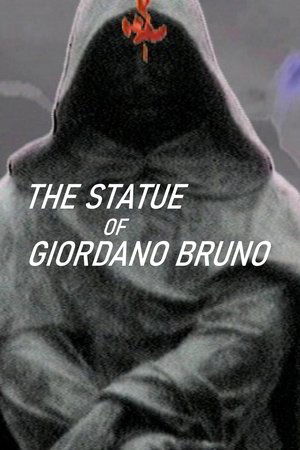
This film was made out of the capture of a live animation performance presented in Rome in January 2005 by Pierre Hébert and the musician Bob Ostertag. It is based on live action shooting done that same afternoon on the Campo dei Fiori where the philosopher Giordano Bruno was burned by the Inquisition in 1600. A commemorative statue was erected in the 19th century, that somberly dominate the market held everyday on the piazza. The film is about the resurgence of the past in this place where normal daily activities go on imperturbably. The capture of the performance was reworked, shortened and complemented with more studio performances.
A Bunch of Questions with No Answers (2025) is a 23-hour film by artists Alex Reynolds and Robert M. Ochshorn. Compiled entirely from questions posed by journalists at U.S. State Department press briefings between October 3, 2023, and the end of the Biden administration, the work removes the officials’ answers, leaving only the unresolved demands for clarity and accountability.
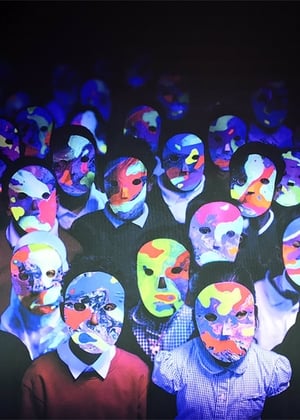
Ted Hughes's 1993 novel The Iron Woman is the springboard for this multi-media project by Mikhail Karikis. The video section of the installation features seven-year-olds from Mayflower Primary School in East London discussing the novel's environmental themes.
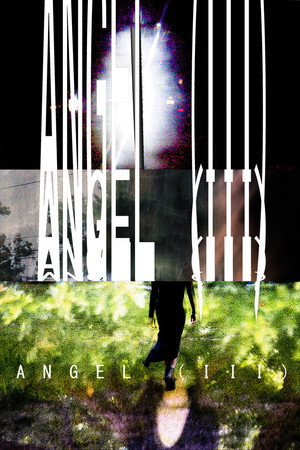
A spectral first-person journey through Los Angeles layers the city across itself as our guide disassociates, giving way to an abstracted daytime ghost story following a woman's splitting of self and perception. ANGEL PROJECT continues.