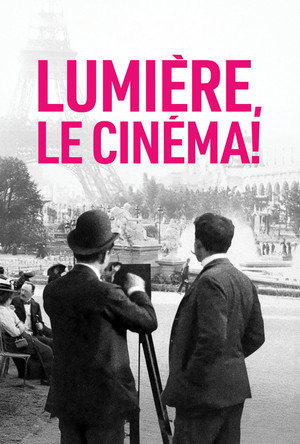
A collection of restored prints from the Lumière Brothers.
Inspired by Lois Patiño's short movies project called "Paisaje-Duración" (Duration-Landscape) and Hiroshi Sugimoto's photo series "Seascapes", "Duração-Diferença" (Duration-Difference) reveals the difference through duration, through time; this short experimental movie seeks to capture, as Patiño and Sugimoto achived, the immanence as the entrance for something more - or something in between.
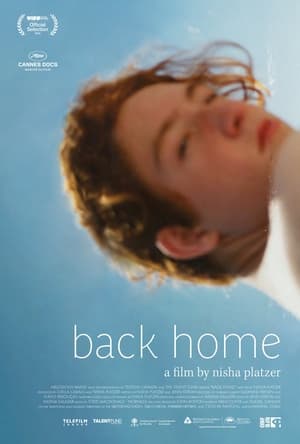
In 1999, 11-year-old Nisha Platzer lost her older brother, Josh, to suicide. Twenty years later, her search for a specialized medical treatment leads her to the door of someone who was once exceptionally close to Josh. And so it is that she finally has the chance to truly know her brother through his chosen family. Captured over five years in which synchronicities continually manifested, Platzer’s documentation of these encounters gently asserts that both grieving and healing are meant to be communal experiences.
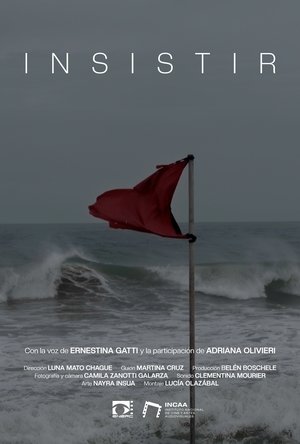
A documentary about the sea and memory. Its movement is its form. Its strength.
In Le Livre d’Image, Jean-Luc Godard recycles existing images (films, documentaries, paintings, television archives, etc.), quotes excerpts from books, uses fragments of music. The driving force is poetic rhyme, the association or opposition of ideas, the aesthetic spark through editing, the keystone. The author performs the work of a sculptor. The hand, for this, is essential. He praises it at the start. “There are the five fingers. The five senses. The five parts of the world (…). The true condition of man is to think with his hands. Jean-Luc Godard composes a dazzling syncopation of sequences, the surge of which evokes the violence of the flows of our contemporary screens, taken to a level of incandescence rarely achieved. Crowned at Cannes, the last Godard is a shock film, with twilight beauty.
NULLE PART
Memory is a collaboration with musician Noah Lennox (Panda Bear), exploring the relationship between a musician and filmmaker and their personal reflection on memories. From Super 8 home movies and entirely handmade, this film explores familiar memories, the present moment combined with past experiences and how it all seems to evade from our present memory.
Jo; or The Act of Riding a Bike is Zefier's third film.
Hercules travels by bicycle from Krefeld on the Lower Rhine to Olympus, the throne of ancient deities. The Hercules myth, as a primal myth of male power, is questioned through biographical reflections and the staging of mythological echoes. The dramaturgical structure of the hero's journey disintegrates in a multi-material perspective into questions about male identity, ideals and remorse.
Then, now, where? how?
A compilation of avant-garde artwork and talent of the mid to late 20th century hosted by Ryuichi Sakamoto.
Experimental short film showing a single 10-minute shot of the sky.
People leave (and return) from a church after Sunday Mass more than 120 years ago. The creaking of time and the darkness behind the ancient ritual of praying for our existence dance eternally, like a river of souls. Liz Taylor's visualy noisy reinterpretation of the film "Congregation Leaving St. Mary's Pro-Cathedral, Dublin" (1901) by the Edwardian filmmaking duo James Kenyon and Sagar Mitchell.
Made in Japan, Last Room is both fiction and documentary. The occupants of the love-hotels and capsule-hotels tell their own intimate, dreamlike stories, interspersed with journeys through the archipelago's landscapes. Soon, these personal stories resonate with a collective history: that of Gunkanjima, the abandoned ghost island of Nagasaki, and then that of Japan as a whole.
A homogeneous structure of wind and light across tree branches in the South region of Isère
A Documentary film, following a group of friends going through their college life. with 3 months of filming starting in August 25th to November 1st 2024. most of everything was filmed in Boston. the purpose of the movie isn't to look amazing and have great story telling, but instead its meant to stamp a period in time. so that in 50 years we can look back and notice the human growth in a movie format. I hope you like the movie and thank you for watching :)
In a remote area of northern Spain, the wind has a name: Tramuntana. Tramuntana takes what it wants—clothes, trees, boats, and the people of the landscape who live with the endless threat of being carried away by its force. This film is a lyrical portrait of this furious wind, woven from the stories passed down by local villagers.
The sequel to Lumière! L'aventure commence (Lumière! The Adventure Begins) reveals another hundred Lumière films, all immaculately restored, and aims above all to explore more deeply the history of the invention and affirmation of cinema in the world. This new feature-length film, following the great success and worldwide release of its predecessor, will confirm to audiences everywhere that the roots of the greatest and most beautiful works in the history of cinema lie in its origins, which are both profoundly French and truly international.
A film essay that intertwines the director's gaze with that of her late mother. Beyond exploring mourning and absence as exclusively painful experiences, the film pays tribute to her mother through memories embodied by places and objects that evidence the traces of her existence. The filmmaker asks herself: What does she owe her mother for who she is and how she films? To what extent does her film belong to her?
An experience of a camera swinging in different gestures facing the optical distortion of the Sun. The last appearance of the smudge.