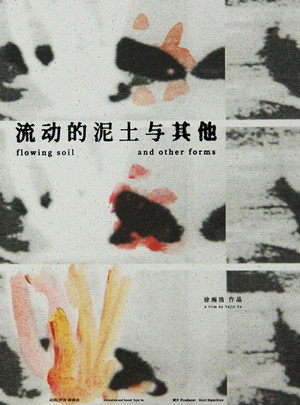
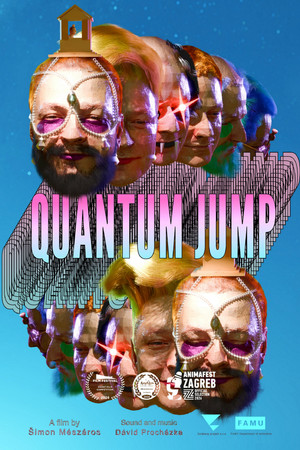
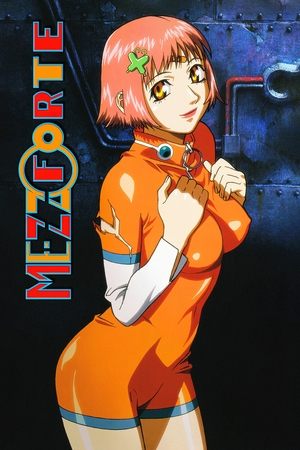
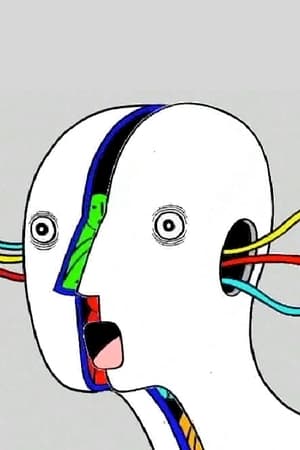
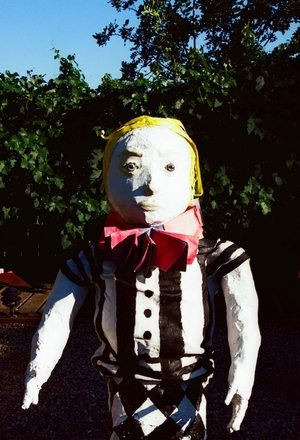
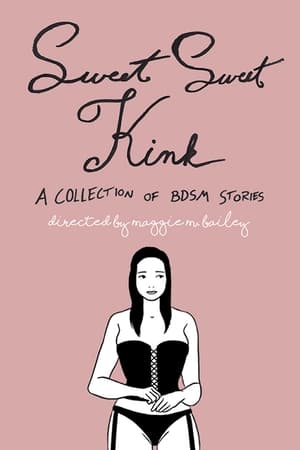
A feminine machine, stuffed with modern nano-technology and useless operations is depicted in this mixed-media 2D animation short, highlighting the consequences of consumerism and the downfall of civilized society. The machine reminiscent of a two-dimensional video game, leads to a destructive chain reaction after a strange malfunction, with people turning into clones and robots.
After a flat tire leaves her stranded in the woods, a woman revisits haunting memories of her self-destructive tendencies on the finger nails. As she peels the skin from her fingers, each strip draws her deeper into the past. With every layer, she steps closer to the hidden child within herself.
In the darkness of a cave, one man who had never seen even his own figure found a hollow flooded with light. An expression of a chaotic world. This experimental graduation film is a mixture of different animation techniques
Len Lye usually timed his films with great care to match their soundtracks, but for All Souls Carnival, he and composer Henry Brant worked separately, preferring to see if the score and visual track would synchronise by chance. Lye also experimented with a new Direct Film technique, drenching the filmstrip in colourful paint and marker pen.
A synthesis of sound and movement; colourful characters dance and move in repetitive patterns to percussive and melodic elements. A combination of motion and music that is hypnotic and beautiful. At first it feels structured and orderly but as more elements are added becomes quixotically expressive.
A surreal short animation by Mirai Mizue.
"Mouris’s film, YOU’RE NOT REAL PRETTY BUT YOU’RE MINE…, built upon the strongest elements of QUICK DREAM, and added a pop music soundtrack. Mouris says, “I shot another 100 foot roll on classmate Jerry Strawbridge’s home animation stand, and edited that into the best sequences from QUICK DREAM. The whole film was a tongue-in-cheek series of odd couples/couplings, which the title suggested. The FRANK FILM photo collage animation evolved here.” - Yale
A horse goddess gives birth to three powerful brothers who set out into the Underworld to save three princesses from three evil dragons and reclaim their ancestors' lost kingdom.
This is no animation, it's one picture. Short experimental film by Mirai Mizue
This short experiments with the flow of oil ink over the surface of the water. Mizue manipulated the ink by blowing with straws or stirring with toothpicks and used stop motion animation techniques to shoot the resulting effects.
Hand painted directly onto film stock by Margaret Tait, this film features animated dancing figures, accompanied by authentic calypso music.
High Voltage is constructed from footage James Whitney contributed to Belson for use in one of his Vortex concerts.
A unique journey across a topography created entirely from a form of digital light and shadow—a bristling terrain of poles bending the light in every direction. This film is the remake of Barcode, an abstract road-movie about light and shadows.
Three books: a film festival catalogue, a dictionary, the Bible. Three works whose materiality has become obsolete by the digital dematerialization. A commentary on the fragility of culture.
In an indeterminate future, forbidden memories challenge a database containing all human memories. An experimental cinematic search between past and future, fiction and fact, Prishtina and Tirana. The future, a glitch.
This newly rediscovered short was created in Jim's home studio in Bethesda, MD around 1961. It is one of several experimental shorts inspired by the music of jazz great Chico Hamilton. At the end, in footage probably shot by Jerry Juhl, Jim demonstrates his working method.
“[T]he sense of moving forward [in space or time] alternates with a sense of expansion and contraction, as the finished cycle [of movement] returns to itself and rushes to catch up with its successor.” (Gadassik) Preserved by the Academy Film Archive in partnership with iotaCenter and National Film Preservation Foundation in 2007.
The screen is divided again and again until the picture arranged in ever changing strips bursts into whirring dynamic.
A vibrant animation by Patricia Marx. Preserved by the Academy Film Archive in 2000.
A pioneer of visual music and electronic art, Mary Ellen Bute produced over a dozen short abstract animations between the 1930s and the 1950s. Set to classical music by the likes of Bach, Saint-Saëns, and Shoshtakovich, and replete with rapidly mutating geometries, Bute’s filmmaking is at once formally rigorous and energetically high-spirited, like a marriage of high modernism and Merrie Melodies. In the late 1940s, Lewis Jacobs observed that Bute’s films were “composed upon mathematical formulae depicting in ever-changing lights and shadows, growing lines and forms, deepening colors and tones, the tumbling, racing impressions evoked by the musical accompaniment.” Bute herself wrote that she sought to “bring to the eyes a combination of visual forms unfolding along with the thematic development and rhythmic cadences of music.”