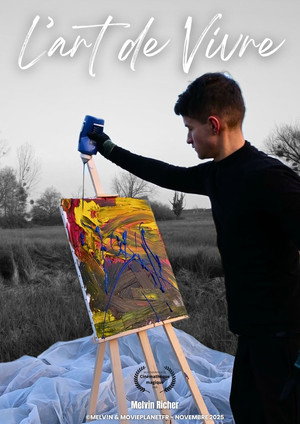
A painter unleashes his craft onto a blank canvas.
Karel Vachek’s graduate film offers us a documentary essay which is both a light-hearted and aggressive little piece and also a parody of investigative film journalism. The Strážnice folk festival, backed by the cultural Party apparatus of the time, for years had little to commend itself to authentic folklore. In the film the event assumes the form of a bizarre stage spectacle with almost surrealistic elements that Vachek reinforces with unconventional approaches (commentary appearing as titles on screen, singing, declamations into the camera, feature etudes, the fusion of news coverage and fiction). The result is a stirring film collage depicting various characters, from crowd-pleasers, Easter egg decorators, kitsch artists and peddlers, to museologists and local residents, all of whom come up against the eccentric "identical” twin reporters Karel and Jan Saudek and a bored actress who appears as an extra. Using their special blend of irony and wit, they present us with the sad truth.
A short documentary on how people view art and its value in today's society.
A brief portrait of famous and brave bullfighter Manuel Benítez el Corbobés; an account on still photos of his triumphs and failures.
The past drags itself into the present day, taking us back to the era of the Dominican Republic's greatest dictator, while we explore the traces of Nazism in the corners of the island. This short documentary borders on a dark and little-known aspect of Dominican history, taking the viewer on a subversive journey through time and memory.
An aspiring classical pianist loses his hearing and, with the help of those closest to him, must find the strength to play again. . .
Through a magical coincidence, the ambitious career woman Rebecca and the lively musical actress Maja switch bodies and have to find their way in each other's lives. What begins as a strange dilemma soon teaches them important life lessons.
Human action is often influenced by the desire for knowledge. This desire is in itself a positive impulse and could be said to be the basis of all progress. Let's move this statement to the ground of scientific research at CERN, and see if it applies here - and then test the common experience that human stupidity permeates every social stratum and, in the case of the elites, is a potential threat.
With the good of the people in mind, Valery Legasov, a Soviet scientist called to the scene of the Chernobyl nuclear disaster, stands up to censorship behind the iron curtain.
Gavin built a giant volcano sculpture that's now in his dad's shed. Gavin seeks his dad's understanding but he's uninterested in modern art and refuses to participate in the documentary.
Denise, Hannah and Leticia are three ordinary women with extraordinary stories to tell. As transgender people, they talk about the challenges of finding their true identities within an intolerant and prejudiced society.
Through interspersed conversation and prose, this experimental documentary follows a poet and a neuroscientist as they explore the definition of love, what it means, and why it matters.
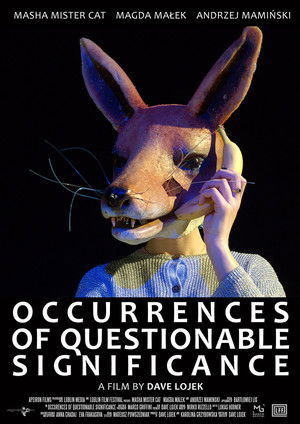
When forest animals invade our cities, the world is in disarray. Office vixen Fiona struggles with her banana phone addiction. Will she succumb to it? Temperamental bunny Barbara only gives her stag sugar daddy Nestor his special massage, after he dines her and plays the big spender. This obscure short film pinpoints postmodern tropes of consumerism, eroticism, and art with an homage to the theater stage and references to literature. This work uses a fantasy language and needs no subtitles.
Through rhythmic re-composition of fragmented images, semi-surreal situations are explored in a documentary style of observation of a man's obsession with a powerful animal, the black horned bull, and the Spanish process of taxidermy through which he attempts to embody its beauty and strength, turning into a Minotaur. The subdued basement space in which the man meticulously studies the motionless flesh of the animal is preceded by a sunlit, empty arena in Spain, the stage in which the bull is presented in its full glory before facing man.
This documentary about the people of Blšany is seen through the eyes of Mr. Tříska, the local one-room school principal and an amateur filmmaker, creator of a movie about “the smallest community in the world with a first league soccer team.” He guides us through an eerie village marked by Communism, a hamlet awakened from its lethargy once every two weeks by a first league soccer match. “Meetings were also held in the country,” claims Tříska, “but executions and trials took place in town. A person had to be careful in the country if he didn’t want to be denounced, but when he went to the doctor he knew he wouldn’t pay for prescriptions; and the bus cost a crown fifty, not ten like today.”
Au cœur du Papotin
A film about filmmaking.
A minimalist portrait of ultimate love.
Struggling with fear, tension, and anxiety amid the early stages of the COVID-19 pandemic, a high school student reflects upon what really matters.
A student work by Jiří Menzel, filmed during his second year at the FAMU film school. Views of old Prague and its tenement buildings, symbolizing the obsolete past, alternate with shots of construction sites for new prefabricated apartment buildings. In spite of certain unavoidable propagandistic overtones added by the director, it is notable as the beginning of his search for a “dramaturgy of colors.”