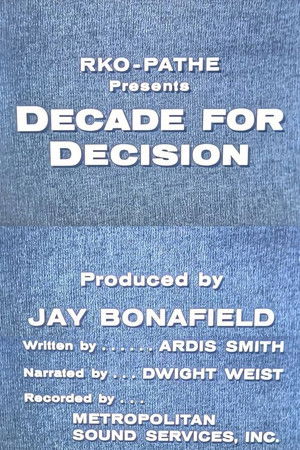
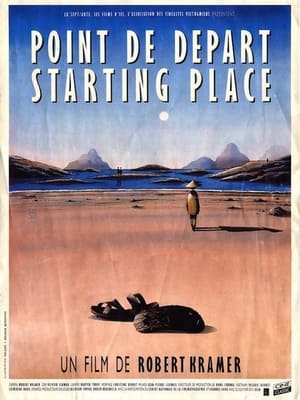
The Vietnam War protest movement from the student point of view is the basis for this documentary shot in the San Francisco Bay area and dealing mainly with a protest march from the University of California to the Oakland Army Terminal in 1966.
Explore the growth of Aberdeen’s sparkling streets.
At Tsinghua University's campus, four people are standing at the intersection of their lives. Among them, there are those who just passed the college entrance examination, the first-generation of post-00 college students who entered their favorite universities with twists and turns , some are leaving their ivory towers, PhD graduates facing difficult choices and some have returned from the United States to enter Tsinghua University. Young teachers are full of "viewing the sky" ideal but face challenges, there are old academicians who still stand behind lectern after their retirement. The film tells the life ideals of the four Tsinghua people and the eternal youth that belongs to this university behind them.
When one thinks of the American Deep South, the image of veiled Muslim students strolling the University of Alabama campus is the last thing that comes to mind. VOICES OF MUSLIM WOMEN FROM THE US SOUTH is a documentary that explores the Muslim culture through the lens of five University of Alabama Muslim students. The film tackles how Muslim women carve a space for self-expression in the Deep South and how they negotiate their identities in a predominantly Christian society that often has unflattering views about Islam and Muslims. Through interviews with students and faculty at Alabama, this film examines representations and issues of agency by asking: How do Muslim female students carve a space in a culture that thinks of Muslims as terrorists and Muslim women as backward?
A fringe communist party struggles to entrench itself within a pro-Palestinian encampment at a British university. Meanwhile, in 1967, the New Left grapples with an unconvinced public.
Intimate and fragmented moments unfold in a community of zoos and animal rescue centers across Argentina. As histories of these institutions are uncovered, dedicated workers commit both day and night to caring for the remaining enclosed animals, fostering a mutual bond that transcends imagined boundaries between human and animal.
Students seeking greater control over the hiring of faculty occupy the offices of the Political Science Department at McGill University. The film crew lives with the students and follows their action through confusion, argument, dissent, and negotiations with faculty. The result is an intimate view of a student political action.
Four students from the President's Leadership Circle at Frostburg State University journey to a remote village in Uganda to discover a radically simple solution to an urgent global problem. What they find there changes their lives in unexpected ways. A Simpler Way is a documentary production from Frostburg State University and Interdependent Pictures that explores the need for simple, affordable solutions to global development issues and the role of personal experience in meaningful, transformative education.
Lexington, Kentucky, 2004. Four young men attempt to execute one of the most audacious art heists in the history of the United States.
MDE
Nestor, Aaron, Benjamin and Rafiki are economics undergraduates at the University of Bangui. Navigating between the overcrowded classrooms, the petty trades that allow students to survive, bribery lurking everywhere, Rafiki shows us what students lives are like in the Central African Republic, a shattered society where the youth keeps dreaming for a brighter future for their country.
The story of the University of Brasília, since it was only a project in Darcy Ribeiro's head until the fateful events in August 1968 when its campus was invaded by the police, during the military dictatorship, thus putting an end to its independence.
Marcel Proust's "In Search of Lost Time" is one of the great novels of world literature. The documentary immerses itself in the very own cosmos, spanning 3,000 pages and hundreds of characters, for which Proust's own world was the source of inspiration, and brings Proust's moral portrait of the Belle Epoque to new life.
A startling expose of rape crimes on US campuses, their institutional cover-ups, and the devastating toll they take on students and their families. The film follows the lives of several undergraduate assault survivors as they attempt to pursue—despite incredible push back, harassment and traumatic aftermath—both their education and justice.
Euller Miller is a young native Brazilian of kaiwá ethnicity who leaves his small village just outside of Dourados (MS) to study dentistry at a public university in the crowded capital city of the state of Paraná. The film follows the complex transition between two very different worlds and the search for new horizons without abandoning his indigenous roots.
Strasbourg was home to one of three Reich Universities founded by the Nazis, known as a project close to Hitler's heart. The university, founded in 1941, is infamous for the human experiments performed on KZ prisoners by the professors of the medical faculty. What did its dean, Johannes Stein, grandfather of documentarian Kirsten Esch, know of these crimes?
They're the curvaceous coeds that drive fraternity guys - and everyone else - wild with desire.
In 2016, an album containing 250 previously unseen photos of Nazi officials was discovered in the USA by Stephan Hördler, a prominent Holocaust historian, who immediately understood the album's inestimable value. The album brings together photographs of a "group of friends," all from the same region of Germany, all of whom became SS men. From 1928 to 1943, the photo album allows us to follow their journey. Hördler conducted the investigation, comparing the photos in the album with other, better-known ones, the faces of these men with those of concentration camp officials, and ultimately revealed that it was at Lichtencburg that these young men were trained, a "school" for future camp executioners, and the bonds of camaraderie and informal network that would allow them to help each other, even after the war.
In the summer of 1989, the 13th edition of the World Festival of Youth and Students was held in Pyongyang. Thousands of socialist youth from 177 countries celebrated their belief in a better society and international solidarity.
Estado de Excepção is a documentary about CITAC (Coimbra Theater Initiation Circle), a university theater group, revealing history since it was constituted in 1956 until the aftermath of the 1974 revolution. It is the history of the theater group university and, through it, the history of theater in Portugal, revealing two remarkable decades of the History of Portugal. Through the Academy of Coimbra, the documentary reproduces student life, the position of women in society, and the change in mentalities of being and being in the world. It reproduces the existing censorship and the fight against the dictatorship, the resistance to an exhausted regime, as well as the emerging contradictions of the democratic revolution. CITAC has a heritage of 50 years of experience in Coimbra. It carries with it the possibility of the theatrical and civic formation of thinking bodies, constituting a proper ball of a possible model, generation by generation, between studies, theater, and social drama.