La traviata in Paris is a film-opera of Giuseppe Verdi's La traviata filmed live on television and worldwide, directed by Giuseppe Patroni Griffi, conceived and produced by Andrea Andermann in 2000. A Traviata that takes place live, with a television reporter who, amid the events of the day that took place in France on June 3, 2000, connects live to the scene of the action but at the time exactly a century earlier, in the Paris of June 3, 1900 (the setting of the opera is thus postdated from the original, which was conceived for the 1850s).
Set in a Siberian prison camp, Janacek's final opera centers on the experiences of recent arrival Alexandre Petrovitch Goriantchikov (Olaf Bar), a nobleman who finds relief from the harsh conditions in the friendship of the illiterate Alyeya (Eric Stoklossa). Recorded at the Grand Theatre de Provence, this stage production is directed by the well-respected Patrice Chereau and features famed conductor Pierre Boulez. Filmed at the Aix-en-Provence Festival on 20 July 2007.
I due Foscari was Verdi's sixth opera and based on Lord Byron's play The Two Foscari. Rich in intrigue, the plot tells of the final days of the famous Venetian doge, Francesco Foscari, and his illegal overthrow in 1457.
The Royal Ballet and the Royal Opera collaborate in Wayne McGregor's production of Handel and Gay's classic opera, in which the nymph Galatea falls in love with a shepherd named Acis.
Opera Australia's 1976 production of Lakmé, an opera in three acts by Léo Delibes, with a French libretto by Edmond Gondinet and Philippe Gille. Set in India during the British Raj, the story focuses on Lakmé, the daughter of a Hindu priest. Lakmé's life is troubled by her infatuation with a British officer.
The Royal Ballet performs Tchaikovsky's classic ballet, choreographed by Liam Scarlett and starring Marianela Nunez as Odette/Odile and Vadim Muntagirov as Prince Siegfried.
"Irresistible" (Opera News) rising-star mezzo Elina Garanca triumphs as Rossini's Cinderella in this delightful Metropolitan Opera production. "As close to pure joy as you will find in a big-time opera house" (New Yorker), conquering audiences and critics alike, "Garanca has a gorgeous voice that she uses with exceptional skill, melting tenderness; but when the part calls for coloratura fireworks, she unleashes a flawless technique and ringing high notes of impressive power" (Associated Press). Filmed in High Definition Widescreen.
LA PIETRA DEL PARAGONE (The Touchstone) concerns the Count Asdrubale who is wealthy and therefore of great interest to many women – notably Aspasia, Fulvia, and Clarice. Only Clarice, however, loves him for something other than his riches. There are also male hangers-on: the corrupt journalist Macrobio, the poetaster Pacuvio, and Giocondo, who is Asdrubale's true friend, but who has his own eyes on Clarice. To test his friends and would-be fiancées, Asdrubale pretends that he has been bankrupted. Sure enough, only Clarice and Giocondo stand by him, and when his fortune is "miraculously" saved, the three have the last laugh on everyone else... or do they? This production is set in what looks like the early 1960s. But the real innovation is the use of blue screen technology: using tiny cameras and sets, along gigantic screens hanging over the stage, a kind of video mixing makes the singers appear to inhabit any number of fanciful settings and perform a myriad of improbable actions.
Verdi’s IL TROVATORE again storms the Met stage in a star-studded, anvil-wielding cast , including Sondra Radvanovsky, Dolora Zajick and Dmitri Hvorostovsky. Marcelo Álvarez sings Manrico, the troubadour of the title. The story is well-known already: The gypsy Azucena has harbored a grudge for thirty years, but she is about to have revenge at last. Meanwhile, her son Manrico is in love with Leonora, but so is his arch-enemy, the Count Di Luna. A pot-boiler, where every tune is a hit.
Göran Gentele's production of Verdi's Un ballo in maschera premiered on television on New Year's Day 1965. Gentele's version is an adaptation in which some of the roles have changed names and locations. The opera is sung in Swedish, and the translation was done by Erik Lindegren.
Set in 16th-century France and Spain, Don Carlos tells of the political and amorous rivalry between King Philip II and his son, Don Carlos, over Elisabeth de Valois. Krzysztof Warlikowski strips down a tragedy haunted by ghosts, and places the intimate at the heart of an imaginary fresco truer than history itself. Along with Philippe Jordan, he reveals to the public the very first version of this great five-act opera: the version modified by Verdi himself for the work’s first performance in 1867.
23-year-old Gioachino Rossini completed his masterpiece IL BARBIERE DI SIVIGLIA incredibly quickly – legend has it in just 13 days – which Rossini attributed to ‘facility and lots of instinct’. The opera, characterized by youthful energy and bold wit, has all the ingredients for comic chaos: an imprisoned young woman, her lecherous guardian and a young noble suitor. Skilfully plotting behind the scenes is Figaro, an irrepressible and inventive character in whom many have seen a resemblance to the young Rossini himself. The score fizzes with musical brilliance, from Figaro’s famous entrance aria to the frenzy of the Act I finale. This recording sees Joyce DiDonato (Rosina) bring literal meaning to the old theatrical motto Break a leg! She did just that in an earlier show but was determined to finish her commitment and was re-staged into the production to allow for the additional challenges that come when a leading lady in a lively physical role must wheel around the other performers...
The Metropolitan Opera's performance of "Hansel and Gretel" features music by Engelbert Humperdinck and is conducted by Thomas Fulton. The Met's storybook production cheerfully evokes a magic world of woodland sprites and candy dreams and yet brings as well the entire apparatus of Wagnerian music and drama to bear on a German fairy tale. This production is sung in English, and features the Metropolitan Opera, Chorus, and Ballet.
Easter is a five story-arc opera about the coming-of-age of juking. The first of its tales aptly deals with contemporary civil unrest with foci on the interrelationships between law enforcement in communities it serves, and corruption within the justice system as a whole. It unfolds from the perspective of an African-American male who feels circumstantially slighted by society, and because of that, takes the law into his own hands and goes on a rampage which erupts into a war in the process.
Natalie Dessay and Rolando Villazón bring Jules Massenet's classic opera to the stage in this dazzling production. In 18th-century France, Manon (Dessay) faces life as a nun, despite catching the eye of many men. When she meets the handsome but penniless des Grieux (Villazón), she falls deeply in love. The pair elopes, but their future together is threatened by outside forces.
In ancient Babylon, SEMIRAMIDE (Anderson) encourages her lover Assur (Ramey) to murder her husband, King Ninus. Her son, Ninius, disappears, believed dead, and Semiramide rules in her own right. 15 years later, as the opera opens, she is about to announce the name of her successor. Idreno (Olsen) and Assur are the leading candidates for the throne and the hand of Princess Azema (Shin), but Semiramide has taken a fancy to young Arsace (Horne), her victorious military leader who has been summoned back to Babylon. Only the high priest Oroe (Cheek) knows that Arsace is actually Ninius, spirited away to safety after the coup. As the queen announces Arsace as her successor, the ghost of her husband appears from his tomb, demanding that Arsace punish the late king’s murderers... Filmed at New York's Metropolitan Opera, John Copley's production of Rossini's last, longest and most elaborate dramatic opera brings together what many consider the definitive contemporary cast.
Recorded at the Musiektheater, Amsterdam on 21 & 25 January 2008. Performed by De Nederlandse Opera, composer Jean-Philippe Rameau's renowned tragedy "Castor et Pollux" tells the myth-based story of the selfless love between two brothers: Castor, who is mortal, and the immortal Pollux. When Castor dies trying to prevent the kidnapping of the woman he loves, Pollux decides to become mortal and replace his brother in the Underworld. Finnur Bjarnason, Henk Neven and Anna Maria Panzarella star.
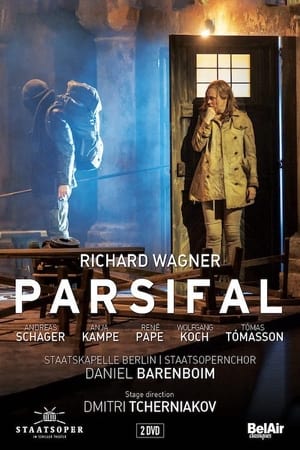
The Met assembled an ideal cast for François Girard’s acclaimed new production of Wagner’s final masterpiece: Jonas Kaufmann in the title role of the fool “made wise by compassion”, René Pape as Gurnemanz, the veteran Knight of the Grail, Katarina Dalayman as Kundry, Peter Mattei is Amfortas, the anguished ruler of the Grail’s kingdom, and Evgeny Nikitin sings the evil magician Klingsor.
A new generation of rising stars shines in Franco Zeffirelli’s classic production of Puccini’s most popular opera. Vittorio Grigolo is the poor poet Rodolfo who falls head over heels for his neighbor, the seamstress Mimì, sung by the radiant Kristine Opolais. Susanna Phillips is the flirtatious Musetta, Massimo Cavaletti is her sweetheart Marcello, and Patrick Carfizzi as Schaunard and Oren Gradus as Colline complete the ensemble. Stefano Ranzani conducts.
This 1969 BBC production is about as close as we can get to a definitive version of Benjamin Britten's PETER GRIMES, one of the greatest 20th Century operas. The story of the individualistic fisherman hounded by his neighbors who believe he murdered his young apprentice packs tremendous emotional power. The compelling narrative is richly enhanced by its subtexts: the lone outsider versus the conformist mob; the dreamer of improbable dreams that lead to tragedy; the artist (dreamer) versus the Philistines, and the homosexual overtones of Grimes' abuse of his child apprentices. Britten is conductor of his work and tenor Peter Pears is Grimes, 25 years after he created the title role at the opera's premiere. As the widow Ellen Orford, soprano Heather Harper is magnificent. Best of all, the sea is an ever-present actor here. When we don't see it in the background it exerts its presence in the abundant visual references to nets, barrels, and other paraphernalia of a seaside fishing village.