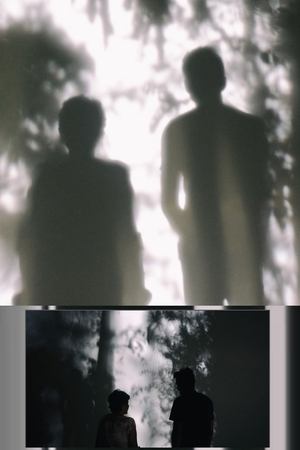
One of Han Ok-hee’s renowned pieces called The Hole uses the flicker, oblique angles, the cross-cutting of reality and fantasy to express inner entrapment and the desire for liberation. Han Ok-hee’s The Hole, The Rope and Untitled not only experimented with cinematic forms of expression, but also played an important role in the protest against forms of expression in experimental films and the artistic protest against the social suppression and censorship in 1970s Korea. (Art Cinema OFFoff)
In the fall of 1986, Richard Fung made his first visit to his father's birthplace, a village in southern Guangdong, China. This experimental documentary examines the way children of immigrants relate to the land of their parents, and focuses on the ongoing subjective construction of history and memory. The Way to My Father's Village juxtaposes the son's search for his own historical roots, and his father's avoidance of his cultural heritage.
"An experimental documentary on Reverend L.O. Taylor, a black Baptist minister from Memphis, Tennessee who was also an inspired filmmaker with an overwhelming interest in preserving the social and cultural fabric of his own community in the 1930′s and 40s. I combine his films and music recordings with my own images of Memphis neighborhoods and religious gatherings" -Sachs
My Mother's Place is an experimental documentary focusing on the artist's mother, a third-generation Chinese-Trinidadian who at 80 still has vivid memories of a history lost or quickly disappearing. She conveys these with a storytelling style and a frankness that is distinctly West Indian. A tape about memory, oral history, and autobiography, My Mother's Place interweaves interviews, personal narrative, home movies, and verité footage of the Caribbean to explore the formation of race, class, and gender under colonialism.
shows visual and metaphorical representation using rope as a motif through various rope images and meanings.
It shows Korea’s traditional colors and culture through the use of superimposing. It is an experimental film, which not only tries to show Korean traditional culture through the use of color, but also tries to show the modern history of Korea.
The Displaced View traces a personal search for identity and pride, within the unique and suppressed history of the Japanese in Canada. Through an examination of the emotional and cultural links between the women of one family, the processes of the construction of memory and the re-construction of history, are revealed. Utilizing an innovative combination of experimental, dramatic and documentary forms, the film emerges as a deeply moving and compassionate love letter. Just as the official history of the Japanese Canadians has been thrown into question, so does the film’s fictionalized narrative, question documentary as truth.
Rainer Kohlberger applied various algorithms to extract the noise from a vast number of action films and used this to reduce the dramaturgy of the narrative to its essence. keep that dream burning oscillates between maximum abstraction and pure blur. Within the blurriness, objects form and disappear. The surface allows the space to be conceived.
This cine-portrait of New York City uses digital effects to turn the countless riders of the subway system into living, breathing paintings.
In the Mojave Desert, fields of solar panels follow the sun’s daily journey in perfect synchronicity.
100% comprised of found footage, this is a meditation on the filmmaker's relationship with herself, others, and how she is perceived by both parties. Showing the filmmaker at various stages of her life, this short seeks to visualize the embarrassing ordeal of being known when you're at your most vulnerable.
Ostensibly searching for an emotional connection with her aging father, the woman contemplates her own inherited culture and familial touchstones. Her North American pop culture sensibility fuses with a distorted Japanese perspective to create a surreal interpretation of a “Japan of the imagination.” This fictional landscape is peppered with invented Japanese myths, ruminations on memory loss, the temporal space of digital photography and the ghosts of inherited imagination.
It started with filming the tree. Something was released in that manner of filming seemingly farthest removed from the procedure of the early films. I first thought a simple ordering of this rich material might be enough, something related to BARN RUSHES [...] But the film only came into its form-life with the idea of linking this deep-rooted and far-outreaching tree material with that film on paranoia that had fascinated me for many years. –L. G.
"With characteristic wit and rigor, experimental filmmaker Larry Gottheim here applies his impressionistic editing style to footage collected during his travels in the Dominican Republic. Gottheim’s formal emphasis on repetition and fissures between sound and image resonates here as a mode of sociological reflection (with the fragmentary montage mirroring elements of ritual while also destabilizing the ethnographic gaze). A largely overlooked antecedent to the contemporary blending of avant-garde and ethnographic filmmaking, MACHETTE GILLETTE… MAMA still poses a potent challenge to documentary convention." - Max Goldberg
Filmed during the production of the Columbia Pictures western "Mackenna’s Gold," this short work presents a non-narrative visual study of the Arizona desert. Rather than documenting the film set itself, "6-18-67" assembles landscape images, time-lapse photography, and ambient sound into an abstract record of place and duration.
A watchman at an apartment complex in Assam, India, spends an ordinary evening. A surreal, expressionistic landscape unfolds.
Footage filmed in Spain, subjected a new visual effects process. Deslaw devoted himself to the discovery of a new machine that enabled film to be developed while using a new method called solarisation.
Two screens of film about - and sometimes shot by - Claes Oldenburg, detailing his inspiration, his methods and his relationship with his partner Hannah Wilke.
Anne Bean, John McKeon, Stuart Brisley, Rita Donagh, Jamie Reid and Jimmy Boyle are interviewed about their artistic practice and the legacy of Surrealism on their work.
A poetic, semi-autobiographical short film of the sun setting over a village, shot from behind the curtains of a small, dimly lit room.