The final 17 years of American singer and musician Karen Carpenter, performed almost entirely by modified Barbie dolls.
Playful and rythmic self-portrait shot on Super 8mm and 16mm. Colored directly on the super 8mm.
Eye-popping digital moving image work with an equally arresting soundtrack from noise music heavies.
Dislocation in time, time signatures, time as a philosophical concept, and slavery to time are some of the themes touched upon in this 9-minute experimental film, which was written, directed, and produced by Jim Henson. Screened for the first time at the Museum of Modern Art in May of 1965, "Time Piece" enjoyed an eighteen-month run at one Manhattan movie theater and was nominated for an Academy Award for Outstanding Short Subject.
Cremaster 5 is a five-act opera (sung in Hungarian) set in late-ninteenth century Budapest. The last film in the series, Cremaster 5 represents the moment when the testicles are finally released and sexual differentiation is fully attained. The lamenting tone of the opera suggests that Barney invisions this as a moment of tragedy and loss. The primary character is the Queen of Chain (played by Ursula Andress). Barney, himself, plays three characters who appear in the mind of the Queen: her Diva, Magician, and Giant. The Magician is a stand-in for Harry Houdini, who was born in Budapest in 1874 and appears as a recurring character in the Cremaster cycle.
A woman returning home falls asleep and has vivid dreams that may or may not be happening in reality. Through repetitive images and complete mismatching of the objective view of time and space, her dark inner desires play out on-screen.
August 2019. Frank recognizes his own story of twenty years ago in a recently published book. He remembers Marie, with whom he had a relationship before she moved to the United States and disappeared from his life. Frank sets out in search of her and finds himself in a USA petrified by a heat wave and lost in suspicion and political paranoia. He heads into the desert in pursuit of Marie.
An anthology of one-minute films created by 51 international filmmakers on the theme of the death of cinema. Intended as an ode to 35mm, the film was screened one time only on a purpose-built 20x12 meter public cinema screen in the Port of Tallinn, Estonia, on 22 December 2011. A special projector was constructed for the event which allowed the actual filmstrip to be burnt at the same time as the film was shown.
This fantastical movie inspired by the music of Michael Jackson features imaginative interpretations of hit tracks from the iconic 1987 album “Bad”.
Pounding backbeats beaten by [(Don't Get)] warm[welcomes]th.
Rather pointless, rather stilted, fetid; not what we want us going after.
There is no escape… From one side of the globe to the other, there is no escaping the faces, the visions, the ever-watchful camera. There is no escaping the mask, there is no escaping the resonating echoes of images and sounds that cross each other over time. There is no escaping the cinema. There is no escaping the terrors of the mind. “A mysterious loner, perhaps a poet, journeys through a series of uncanny surrealistic landscapes with an unclear purpose. His adventure is divided into three sections. The main theme of this experiment is to compare the eerier qualities of different landscapes and interpose the characters within them, elaborating the project’s ongoing preoccupation with extracting sinister moods from ordinary settings. In a way, these can be seen as experimental horror films in which an atmosphere of dread is evoked and sustained without the expected narrative trappings.”
An unnamed passer-by is forced to trace a circular route inside an abandoned tram station, facing loss and time. The broken walls act as a channel, transmitting fragmentary, blurred and analogical memories.
A short experimental cutup film by Jon Moritsugu.
Adopting mainly hand contact printing with photographic enlarger, «Metaphysics of sound» started from September of 2006 and completed in July of 2007. With a 35mm soundtrack image, I made a hand-drawn soundtrack on the 16mm film strip. The sounds were made either by directly contact printing the 35mm sound tracks or collaging the scratch images. According to pattern of sound on the 20% blank of 16mm film strip (normally used as space for optical recording), I edited whole image and made structure of film. Hence the margin is a where image is sound, and vice versa. Later, I studied the sound patterns which varied according to the kinds of images used or the concentration of the image, and made various attempts at rearranging the structure of the sound with the image.
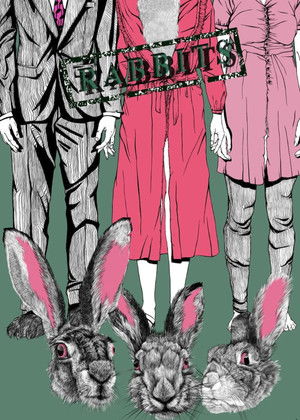
A story of a group of humanoid rabbits and their depressive, daily life. The plot includes Suzie ironing, Jane sitting on a couch, Jack walking in and out of the apartment, and the occasional solo singing number by Suzie or Jane. At one point the rabbits also make contact with their “leader”.
A poetic, semi-autobiographical short film of the sun setting over a village, shot from behind the curtains of a small, dimly lit room.
Part of a collection of restored early works by Nam June Paik, the haunting Beatles Electronique reveals Paik's engagement with manipulation of pop icons and electronic images. Snippets of footage from A Hard Day's Night are countered with Paik's early electronic processing.
Don't ask me why, but I feel we're about to cry trying.
This cacophony runs over me, over everything I see, everything I want to see: it's me.