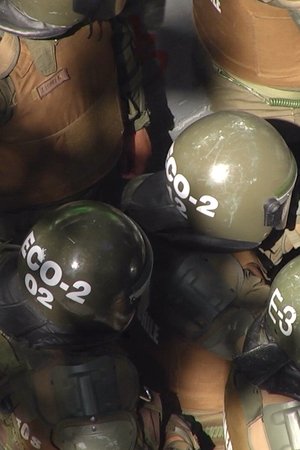
Le dernier souffle, au cœur de l'Hôtel-Dieu de Montréal
A 1-hour Documentary looking at the Manchester post-punk group and its infamous leader Mark E Smith. The Film follows the current band recording their final Session for the John Peel Show (they were his favourite group and recorded more sessions than any other band) as well as chronicling the chaotic history of the band & its numerous line-up changes.
Things are busy at the Paris hospital where young psychiatrist Jamal and his colleagues work. The place is run down, the staff are exhausted, budgets are constantly being slashed. You know the story, but you’ve rarely seen it conveyed as engagingly as in ‘On the Edge’, which employs a handheld camera and meaningful, artistic interventions to observe the daily routine at the psychiatric ward. The deeply sympathetic Jamal is an everyday hero with an exemplary, humanistic disposition, for whom the most important prerequisites for mental health – and for a healthy society in general – are good relationships with other people. He puts his philosophy into practice by listening patiently, giving good advice and organising theatre exercises based on Molière. Realism and idealism, however, are in balance for the young doctor, at least as long as the institutional framework holds up.
A powerful and intimate portrait, Joan Mitchell: Portrait of an Abstract Painter captures Mitchell's independent spirit and testifies eloquently to Mitchell's art. Joan Mitchell was born in Chicago in 1926 and died in Paris in 1992. After graduating from the School of the Art Institute of Chicago, Joan settled in New York City in 1950. She was an active participant of New York's dynamic Abstract Expressionist scene and hung out with fellow painters Franz Kline, Willem de Kooning and Philip Guston and, soon, poets Frank O'Hara, James Schuyler and John Ashbery. In the mid-fifties, she moved to Paris, France. There she was part of a circle of friends that included Pierre Matisse, Samuel Beckett and Alberto Giacometti. Mitchell is one of the great abstract painters of the 20th century. This elegantly edited documentary weaves interviews with the acerbic Mitchell and other leading painters and critics while letting her stunning pictures dominate the film.
Sir John Betjeman visits and explains the architecture of various churches in the Diocese of Norwich. Among those visited: Sandringham church on the Queen's private estate, the Holy House of Our Lady of Walsingham and Norwich Cathedral.
Giovanni Segantini rose from humble origins to become the most important of Italian pointillists, and one of the most important symbolist painters in the 19th century. This film focuses on his way of feeling nature as a source of artistic and spiritual inspiration.
In a society where "celebutantes" like Paris Hilton dominate newsstands and models who weigh less than 90 pounds die from malnutrition, female body image is one of the more dire problems facing today's society. "America the Beautiful" illuminates the issue by covering every base. Child models, plastic surgery, celebrity worship, airbrushed advertising, dangerous cosmetics - no rock is left unturned.
A historical documentary documenting the rise, function, and abandonment of a 17 story building that once housed The Rochester Psychiatric Center. This film tells the story of the building through historical footage, interviews of former staff and patients who recount their memories of the behemoth facility while also exploring the abandoned building as it is today.
Directed by Margot Benacerraf, Reverón is a poetic and visually striking documentary that delves into the life and artistic vision of Venezuelan painter Armando Reverón. Set in the sun-drenched coastal landscape of Macuto, where the artist lived in near isolation, the film captures his eccentric lifestyle and unique creative process. Through evocative imagery and a contemplative narrative, Reverón explores his deep connection to nature, his experiments with light and texture, and his profound artistic genius. This seminal work stands as a tribute to one of Venezuela’s most influential painters and a landmark in Latin American documentary filmmaking.
This film is dedicated to Mas-Félipe Delavouët, the poet discovered by Lawrence Durrell, who wrote 14,000 verses in Provençal over a period of thirty years, and who died on November 18, 1990. "The sky, history and Mediterranean and Provençal myths are the inexhaustable wellspring of this man rooted down there, near Salon-de-Provence" (J.-D. Pollet). "Mas-Félipe Delavouët wrote five books in Provençal, 14,000 verses. A sort of "Odyssey". Of myths. What is stunning in him is that he always talks of disappearances. Cities, works, men, writings, television, etc., everything has to disappear. In order to be reborn. No pain. A sort of hand-to-hand of man and nature. During the filming, I would simply throw out some words... For example, one time I said "creation" and he said: "creation doesn't exist..., creation is before me..., I can only read creation"; this sentence describes Delavouët perfectly (J.-D. Pollet, 1989 and 1993).
A Local Reno Artist and DJ discusses the many inspirations behind her work and how it impacts herself and others.
The film approaches the work of the Greek artist Nikos Koniaris. The particular way in which the painter depicts human suffering is presented through a film - a hybrid of real recording and directed material. The grief, the sick body, is reflected in self portraits, portraits of dying strangers and paintings of dead models. The paintings, apart from his work, also express a different version of himself. All together contribute to the depiction of man as a "garment of pain".
51-year-old Jose Mestre from Lisbon, Portugal has endured a massive tumor on his face for the past 35 years. After it has grown up to 15 pounds, a generous benefactor pays for the 13 hour surgery to remove it.
Song is a story of the last Finnish rune singer and his pupil, and the comforting power of singing.
We aren't dying the way we used to. We have ventilators, dialysis machines, ICUs-technologies that can "fix" us and keep our bodies alive-which have radically changed how we make medical decisions. In our death-denying culture, no matter how sick we get, there is always "hope." Defining Hope tells the story of patients dealing with life-threatening illness as they move between ICUs, operating rooms, hospice care and home. Diane is a nurse caring for end-stage cancer patients when she is diagnosed with ovarian cancer herself. 23-year-old Alena undergoes a risky brain surgery that destroys her short-term memory. 95-year-old Berthold lives with his elderly wife who struggles to honor his wish of dying peacefully at home. Defining Hope follows these patients and others- and the nurses that guide them along the way- as they face death, embrace hope, and ultimately redefine what makes life worth living.
Ninety-year-old sound artist and comedian Henry “Sandy” Jacobs lives a quirky existence at the end of Sunnyside Drive, a steep and winding dirt road washed by fog from the Pacific Ocean. Sixty feet down the hill lives his eccentric 84-year-old friend and neighbor, architect and former Frank Lloyd Wright collaborator Daniel Liebermann. These extraordinary old men, influential artists in the 1950s and ’60s, continue, each in their own way, to search the world for perfection. Sunnyside takes us to an extraordinary place, a microcosm with its own distinctive rhythm and remarkable inhabitants. It is a film about creativity, the capacity to dream and, ultimately, the transience of life.
With his seemingly naïve, symbolic paintings, Joan Miró formed a new artistic language in the 20th century. Brought up in Barcelona, the painter, graphic artist and sculptor was drawn to Paris and, under the influence of the surrealists, developed his unique style and poetic imagery that unite Catalan folk art and fantastic elements. Robin Lough followed the 85-year-old Miró to theatre rehearsals and went to see him in his studio on Majorca. There he met with an amazingly creative and disciplined artist, whose visionary pictures paved the way for abstract expressionism.
About Jösta Hagelbäck (1945-2009), Swedish film director, writer, poet, musician, actor etc. A human bipolar mixture of genius and madman. Invited to Hollywood, had an artistic hit with the film "Kejsaren/The Emperor" (1979) at the Berlin Film Festival.
Janko Kráľ
Dedicated to the portrait work of Paul Cézanne, the exhibition opens in Paris before traveling to London and Washington. One cannot appreciate 20th century art without understanding the significance and genius of Paul Cézanne. Filmed at the National Portrait Gallery in London, with additional interviews from experts and curators from MoMA in New York, National Gallery of Art in Washington DC, and Musée d’Orsay in Paris, and correspondence from the artist himself, the film takes audiences to the places Cézanne lived and worked and sheds light on an artist who is perhaps one of the least known and yet most important of all the Impressionists.