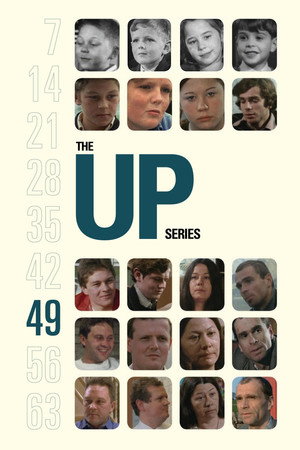
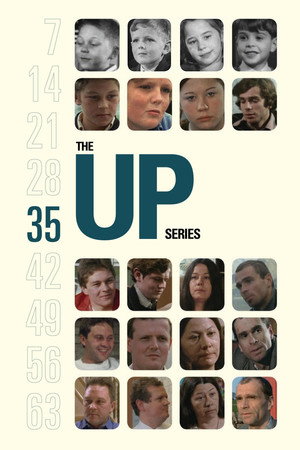
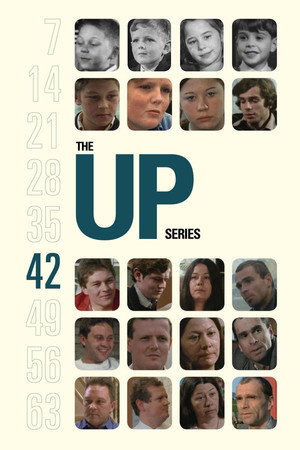
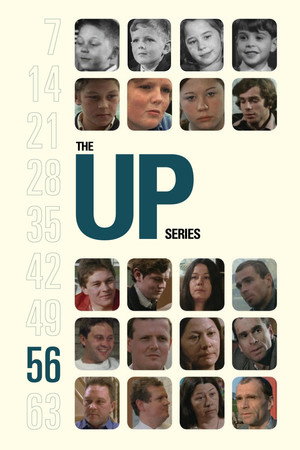
49 Up is the seventh film in a series of landmark documentaries that began 42 years ago when UK-based Granada's World in Action team, inspired by the Jesuit maxim "Give me the child until he is seven and I will give you the man," interviewed a diverse group of seven-year-old children from all over England, asking them about their lives and their dreams for the future. Michael Apted, a researcher for the original film, has returned to interview the "children" every seven years since, at ages 14, 21, 28, 35, 42 and now again at age 49.In this latest chapter, more life-changing decisions are revealed, more shocking announcements made and more of the original group take part than ever before, speaking out on a variety of subjects including love, marriage, career, class and prejudice.
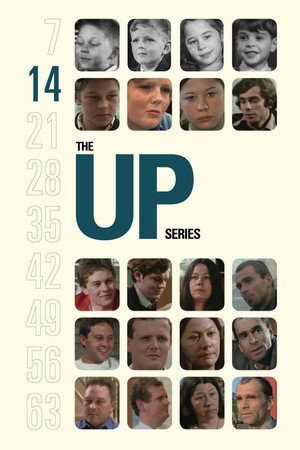
After a 7 year wait, director Michael Apted revisits the same group of British-born children from Seven Up! The subjects are interviewed as to the changes that have occurred in their lives during the last seven years.
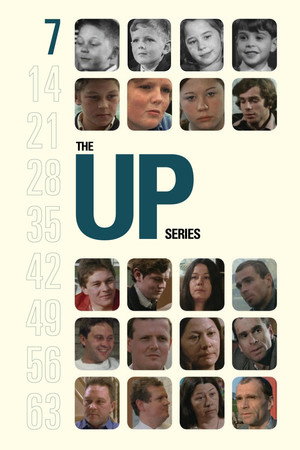
A group of British children aged 7 from widely ranging backgrounds are interviewed about a range of subjects. The filmmakers plan to re-interview them at 7 year intervals to track how their lives and attitudes change as they age.
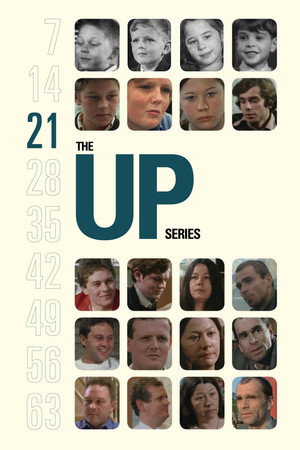
After another 7 year wait, director Michael Apted revisits the same group of British-born children from Seven Up! and 7 Plus Seven. The subjects are interviewed as to the changes that have occurred in their lives during the last seven years.
Director Michael Apted revisits the same group of British-born adults after a 7 year wait. The subjects are interviewed as to the changes that have occurred in their lives during the last seven years.
When a cross-section of seven-year-olds were interviewed for 7 Up in 1964 it was immediately evident that their social backgrounds influenced their attitudes towards life. While the upper class children were confident and self-assured, those from middle and working class backgrounds were resigned to a challenging life of hard work. This premise was put to the test every seven years when the same group were interviewed about the progression of their lives. 49 years in the making, the changes that occurred to the original 14 make for fascinating television and are in many ways the stories of all our lives. From success and disappointment, marriage and childbirth, to poverty and illness, nearly every facet of life has been captured on film. Now, at the age of 56, the group are once more brought together and, with the benefit of hindsight, assess whether their lives have been ruled by circumstance or self-determination.
Music as a counter-project to a bourgeois existence: Musicians, club and label operators, record store owners and other music lovers talk about how, despite social and economic constraints, they realize their very different, bohemian and sometimes precarious life projects on the sidelines - and always go on. Detailed essays, experience reports, portraits and interviews are dedicated to the alternative music and club scene in Berlin and Hamburg.
Returning a female crab to the sea, waiting for octopus to reach one kilo, not fishing for lobsters out of season, and raising awareness of generational change are some of the messages that María Maceiras, Merce Silva, and Rogelio Santos Queiruga convey in their videos. The three communicators from the Ría de Muros y Noia show us what a day in their lives is like: a day of work among pots, trawls, and hooks, a day of work between TikTok, Instagram, and Facebook—in short, a day among networks.
What happens to two dying coal towns in British Columbia when an American corporation provides a contract for millions of tons of coking coal? The film follows the consequences for the towns of Natal and Michel, suggesting that industrial growth has its price, especially with regard to the environment.
For over 50 years, the Kahnawake Mohawks, of Quebec, Canada occupied a 10 square block area in the North Gowanus section of Brooklyn, which became known as Little Caughnawaga. The men, skilled ironworkers, came to New York in search of work and brought their wives, children and often, extended family with them. The story of the Mohawk ironworkers is an important one and is one that has been told and continues to be told through documentaries, newspaper and magazine articles. Yet the stories of Kahnawake Mohawk women who lived in Brooklyn have gone untold.
Japan has an estimated 24000 actors and talents working in the media, mostly playing nameless roles in independent films. A large portion of these actors are unrecognized by the general audiences and not even listed in the talent directories. This documentary provides an intimate look into the lives of these actors, the aspirations behind their dreams, and the challenges they face in the film industry. The subjects in this film are the actors who appeared and participated in the audition of Takaomi Ogata's movie "Cinderella Girl."
A biopic on the author M. R. James. If M.R. James wrote his ghost stories purely to entertain his friends, why do they seem to strike such resonances in readers? Why are they so terrifying? Clive Dunn's fifty minute documentary sets out to try to answer this question. In the words of its fictional narrator, nicely played by Dangerfield's Bill Wallis, "was there something that made [Monty James] believe that evil and malice could become palpable?"
The Serengeti sustains one of the biggest lion populations in Africa: approximately 3,500 lions in 300 prides. But this pride, residing in the central Serengeti, is an exception. 22 lions in all: they are a Super Pride. Few lion prides reach Super Pride status. Keeping cubs alive to maturity is the Super Pride's ultimate goal, but sometimes the greatest threats to a lion cub's life come from other lions...
Ravis par Marine (Le Pen)
Thirteen years of war. Dozens of car bombings every month. One goal: to become an Olympic champion. The true story of grit and determination, of young men literally fighting for their lives one day on the battlefields of Iraq and competing to fight for their Nation the next one. Despite living under the persistent threat of ISIS, these athletes will strive to accomplish their task. The amazing journey of the Iraq National Team from obscurity and desperation to the edge of an historical qualification to Rio 2016. Will private Waheed be able to manage his army duty with his desire to go to the Games? Is young Jafaar ready to aspire to the Olympic stage he has been dreaming of, despite living in the most dangerous suburb in the world? Will promising heavyweight Saadi come back from his mission to liberate Falluja? Will Iraq finally be a peaceful Country?
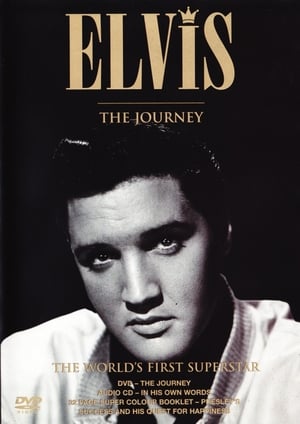
Documentary examining the unique connections the singer shared with Britain, and what made the UK such a sanctuary for him. The programme features contributions from some of those who were closest to him, from his own children to friend Elvis Costello, as well as celebrity fans including Jools Holland and Freddie Flintoff.
A doc made during the nightmarish filming of The Suspended Step of the Stork at Florina.
A documentary on the genesis, writing, shooting and analysis of the film "The Name of the Rose".
Dramatised documentary which describes the police investigation that led to the conviction of David Mulcahy for the notorious Railway Murders in the 1980s of three young women in the London area and for the rapes of many others. This investigation was based largely on the testimony of John Duffy to a psychologist in prison where he was serving life after being convicted of the same offences ten years earlier, having denied at the time of his trial that he had had an accomplice (Mulcahy). -Anonymous