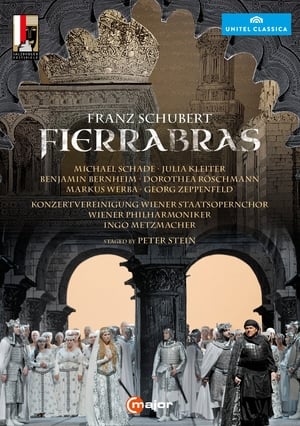
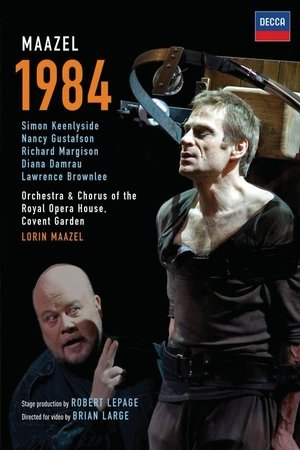
A young woman, married to a wealthy man, but miserably lonely; trapped within a world ruled with an iron fist. Katerina is driven by a lust for life and for love. Her husband, though, is impotent; her father-in-law a tyrant. No wonder, then, that she longs to free herself from this yoke. When Sergei starts work on the family estate, she sees in him a chance for salvation. However, their subsequent affair marks the beginning of a descent into crime.
The deformed Phantom who haunts the Paris Opera House causes murder and mayhem in an attempt to make the woman he loves a star.
The gorgeous and evocative Otto Schenk/Günther Schneider-Siemssen production continues with this second opera in Wagner’s Ring cycle. Hildegard Behrens brings deep empathy to Brünnhilde, the favorite daughter of the god Wotan (James Morris) who nevertheless defies him. Morris’s portrayal of Wotan is deservedly legendary, as is Christa Ludwig, as Fricka. Jessye Norman and Gary Lakes are Sieglinde and Siegmund, and Kurt Moll is the threatening Hunding. James Levine and the Met orchestra provide astonishing color and drama. (Performed April 8, 1989)
Siegfried is the third of the four operas that constitute Der Ring des Nibelungen (The Ring of the Nibelung), by Richard Wagner.
Lyrical biography of the classical composer, depicted as a romantic hero, an accursed artist.
It's an event that draws many thousands of music lovers to one of the most beautiful cities in the world every summer: the opera season at the ancient Arena di Verona. The 2,000-year-old roman amphiteatre with its gigantic stage dimensions is one of the largest and best preserved Roman construction of its kind, and with over 22,000 seats it is undoubtedly one of the most spectacular open-air venues of the world! The revered master of opera Franco Zeffirelli, who died shortly before the premiere of Il Trovatore, created a legendary scenery with groups of giant sized armoured knights, a fortress turning into a luminous cathedral, an enormous choir, horses, breathtaking fights: “his perhaps best arena production” (Opernglas). It brings Anna Netrebko to the Arena of Verona where she is giving her much-anticipated debut in one of Giuseppe Verdi’s most popular operas.
This first film of Cyprus' first director, Giorgios Filis, depicts music and dance customs in the form and style of a folk opera, with traditional Cypriot dances and songs. The film consists of a folkloric inventory based on the folk culture of Cyprus, as well as on similar ritual happenings. The narration and dialogue are entirely in the Cypriot dialect and are characterized by a rhetorical and poetic mood.
The historic Toscanini television concerts with the NBC Symphony Orchestra. This concert, broadcast in two parts, on 26 March and 2 April 1949, from NBC Studio 8H, features the opera "Aida" by Giuseppe Verdi. (Both broadcasts were released as "Vol. 3" in the DVD series.)
The film covers a hundred years in the lives of the Ricordi family, the Milan publishing house of the title, and the various composers and other historic personalities, whose careers intersected with the growth of the Ricordi house. It beautifully draws the parallel between the great music of the composers, the historic and social upheavals of their times, as well as the "smaller stories" of the successive generations of Ricordi.
Třetí koncert na kurtech
The film follows the staging of the opera Olimpiade while at the same time exploring the dramatic life of its composer Josef Mysliveček, a friend and teacher of W. A. Mozart.
Frederick Ashton's La Fille mal gardée (The Wayward Daughter) is one of the choreographer's most joyous and colourful creations. Inspired by his love for the Suffolk countryside, the ballet is set on a farm and tells a story of love between Lise, the daughter of Widow Simone, and Colas, a young farmer. It contains some of Ashton's most stunning choreography, most strikingly in the series of energetic pas de deux that express the youthful passion of the young lovers, performed here by Natalia Osipova and Steven McRae. The ballet is laced with exuberant good humour, and elements of national folk dance, from dancing chickens and a maypole dance to a Lancashire clog dance for Widow Simone, performed by Philip Mosley.
Jenny is young. Her life is over. She killed someone. And she would do it again. When an 80-year-old piano teacher discovers the girl’s secret, her brutality and her dreams, she decides to transform her pupil into the musical wunderkind she once was.
Changing colors according to the music.
Prince Abesalom runs into an orphaned Eteri while hunting, falls for her and brings the woman to his palace as his fiancé. The Prince’s aid Murman loses his self-control at Eteri’s beauty and gives her a spelled necklace as a wedding gift. Eteri contracts a mysterious disease that only Murman is capable to heal.
Franco Zeffirelli's magnificient staging of Puccini's final opera - a fairy tale set in a mythical China - is one of the most popular in the Met repertory. In this Live in HD production, Maria Guleghina takes on the title role and Marcello Giordani is Calaf, the unknown prince. Marina Poplavskaya and Samuel Ramey co-star, and Andris Nelsons conducts in his Met debut.
Modrá ruža
Having triumphed at the Met in some of the repertory’s fiercest soprano roles, Sondra Radvanovsky stars as the mythic sorceress who will stop at nothing in her quest for vengeance. Joining Radvanovsky in the Met-premiere production of Cherubini’s rarely performed masterpiece is tenor Matthew Polenzani as Medea’s Argonaut husband, Giasone; soprano Janai Brugger as her rival for his love, Glauce; bass Michele Pertusi as Glauce’s father, Creonte, the King of Corinth; and mezzo-soprano Ekaterina Gubanova as Medea’s confidante, Neris. Carlo Rizzi conducts.
John Eliot Gardiner goes in search of Bach the man and the musician. The famous portrait of Bach portrays a grumpy 62-year-old man in a wig and formal coat, yet his greatest works were composed 20 years earlier in an almost unrivalled blaze of creativity. We reveal a complex and passionate artist; a warm and convivial family man at the same time a rebellious spirit struggling with the hierarchies of state and church who wrote timeless music that is today known world-wide. Gardiner undertakes a 'Bach Tour' of Germany, and sifts the relatively few clues we have - some newly-found. Most of all, he uses the music to reveal the real Bach.
Disciplined Italian composer Antonio Salieri becomes consumed by jealousy and resentment towards the hedonistic and remarkably talented young Salzburger composer Wolfgang Amadeus Mozart.