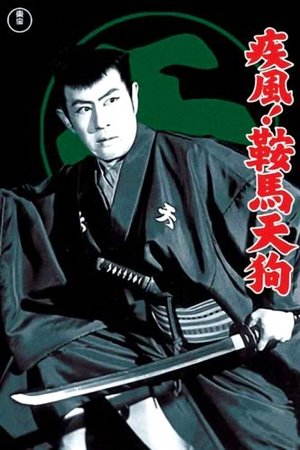
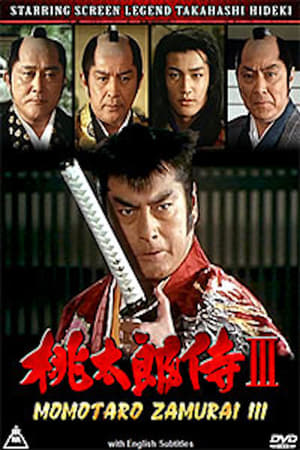
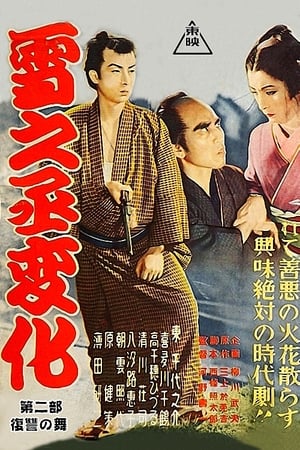
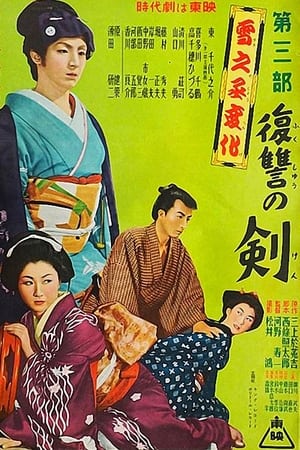
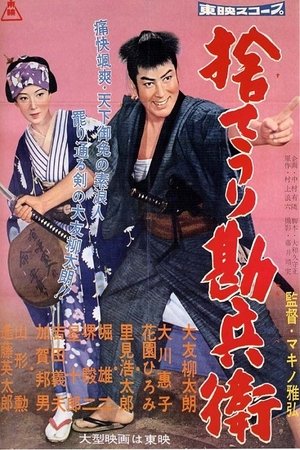
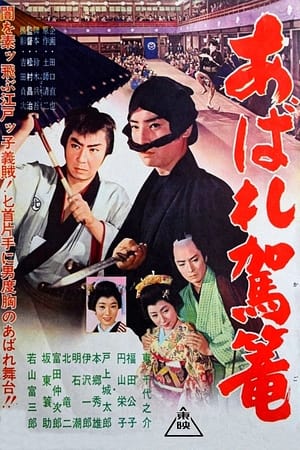
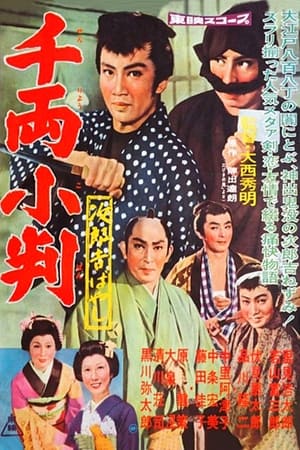
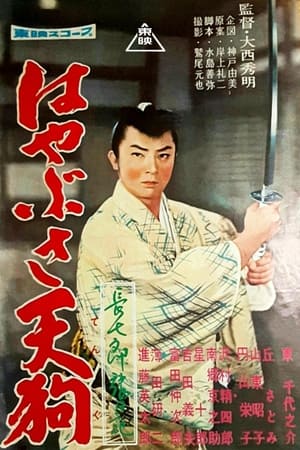
Two young swordsmen, Akado Suzunosuke and Tatsumaki Rainoshin, arrive at the city of Edo in their quest to test and improve their skills. Soon they become involved in a conflict against a mysterious group of demonic criminals led by the king of hell, Taira no Masakado — a strugle to which both were destined since the moment they were born.
The story of Ryoma Sakamoto, considered to be the architect behind the downfall of the Tokugawa shogunate. He was considered an outlaw by his own clan, hunted by his government, and was despised by supporters of the Shogun as well as the Loyalists for desiring the opening of Japan to the West in order to learn its technology, in the hopes of one day defeating the West with a modern army and navy.
It is a historical drama that follows Katsu Kaishu's efforts to surrender Edo Castle bloodlessly in the first year of the Meiji period.
In this film, Hibari plays a dual role as brother and sister. The story involves a journey to Hanagasa for an incognito Lord (Kotaro Satomi) to overthrow an attempted usurpation of his domain, while being harassed by vassals of the usurper (Kensaku Hara). There's also a mysterious ronin played by Jushiro Konoe. The songs are seamlessly woven into the narrative and don't overwhelm the action. While the plot is derivative it is good example of its type and quite enjoyable. Note that there are some flashback sequences in black and white.
Utaemon Ichikawa plays the role of Hikoshiro Navate, who has a strong sense of justice and opposes power and tyranny with his will and spirit.
A hotshot investigator solves a series of gruesome murders in this exciting and dark classic.
A samurai returns to his homeland after a three year absence and finds his fiance is now one of the prince's concubines.
A giant stone statue comes to life to protect the residents of a small town against the depradations of an evil warlord.
Takahagi Sutegoro is highly skilled at casing locations for thieves so that he can sell detailed floor plans to them. He suffers an injury to his leg while trying to help a parent and a child being threatened by samurai. Heizo jumps in and chases the samurai away. Feeling indebted to Heizo, Sutegoro decides to become his spy. Now, together they will try to stop scheming Myogi Danemon’s gang of merciless thieves...
In 1908, Director/Producer Shozo Makino (father of Japanese cinema) directed and produced the first dramatic film in Kyoto. “Honnô-ji Gassen” was shot at Shinnyo-Do Temple. Considered a lost film.
Kenji and Shintaro, once esteemed as the castle town's best Samurai, were anticipated to become the next Sensei and top Samurai until an assault changed their fate. While saving their lord, Kenji's injury marked the end of his swordsmanship career, and the loss of his purpose led to a life of drunkenness, earning him the nickname "the quitter." Despite this, Kenji's wife, Rin, continued to support him, recognizing his enduring passion. Following Sensei Yamamoto's death, a will declared that the next Sensei would be determined by a showdown between Kenji and Shintaro, leading Rin to dedicate herself to Kenji's redemption through rigorous training. The time has come for Kenji to confront Shintaro.
During the 1700s in Japan, a young samurai warrior learns about love and the secret of killings vampires.
Tatsuya Nakadai, the world’s greatest living actor, returns to the screen in a brilliant adaptation of a story by novelist Shuhei Fujisawa. A traveling gambler known as “Funeral Uno” he is now 86 years old and returning to his hometown for the first time in 30 years. Partly told in flashbacks, he is forced to face his lifelong nemesis, Boss Kyuzo, a vile yakuza portrayed by another superstar of samurai cinema, Atsuo Nakamura! Before the two old gamblers can settle a 30-year-old score they must put their lives on the line in a game of dice that can only lead to a bloody sword duel the likes of which has never before been seen! Superb performances all around in a film loaded with surprises and exciting swordplay!
This historical film depicts the life of a man who was at the mercy of the waves during transition from the end of the Edo period to the Meiji Restoration, and therefore, shows audience the dynamic change from Edo to Meiji. Before the war, the director, Eisuke Takizawa, together with the writers, formed a scenario writer group "Narutaki-gumi and they shot many historical masterpieces.
Set during Japan's Shogun era, this film looks at life in a samurai compound where young warriors are trained in swordfighting. A number of interpersonal conflicts are brewing in the training room, all centering on a handsome young samurai named Sozaburo Kano. The school's stern master can choose to intervene, or to let Kano decide his own path.
Seppuku Day 17 Ako ronins, including Kuranosuke Oishi, who were entrusted to the Hosokawa family, and the events of the two days before are depicted as a tragic romance between one of the ronins, Jurozaemon Isogai, and Omino. An adaptation of Seika Mayama play "Genroku Chusingura, the Last Day of Oishi", which tells about the torments of life and death of samurai living in feudal times.
In a poor district of Edo lives a young samurai named Soza. He has been sent by his clan to avenge the death of his father. He isn't an accomplished swordsman however, and he prefers sharing the life of the residents, teaching the kids how to write etc. When he finally finds the man he is looking for, he will have to decide whether he follows the way of the samurai or chooses peace and reconciliation.
A look at the relationship between a young blind samurai and his wife, who will make a sacrifice in order to defend her husband's honor.
In the Edo period, a nameless ronin accepts an assignment to go to a mountain pass and wait. Near the pass he stops at an inn where a collection of characters gather, including a gang set on stealing shogunate gold that's soon to come over the pass. When the Ronin's assignment becomes clear, to help the gang, he's ordered to kill the inn's residents, including a woman he's rescued from an abusive husband. He's reluctant to murder innocent people; then he learns that the gold shipment is a trap and he's part of a double cross. How he sorts through these divided loyalties tests of his samurai honor, and perhaps of his love for a woman.
Yasube Nakayama left the clan and lives in Edo. One day, Yasubei visits his uncle Rokuroemon Kanno to borrow money from a moneylender in the amount of 13 ryo in order to save Oteru, the daughter of a merchant. However, the next day, Rokuroemon was killed in a fight by the Murakami brothers. Yasubei rushed to the scene, took revenge and became the husband of Miya, the daughter of Horibe Yahei.