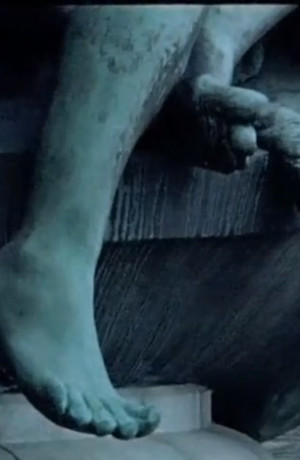
The film appears like a ritual with splendids and crypteds psalms. The Great Master of Order (Marcel Mazé, new fetish actor after Aloual) seduces the young male prey with a running cinema projector which carves Murnau's Nosferatu extracts on their bodies. Metamorphosis, rituals passages, Eros and Thanotos, illusion and reality, film into the film are the themes and images in perpetual osmosis in this Stéphane Marti's opus.
Playtime’s cosmopolitan spectacle, presented in a kaleidoscopic montage across seven large screens, interconnects the lives of its archetypical characters—hedge fund managers and art world players in London; a photographer in Reykjavik; and a Filipina houseworker in Dubai—each of whom is based on a real-life individual directly affected by the market collapse.
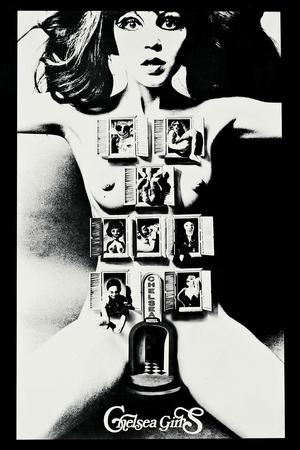
A lonely hairdresser watches the title sequence of "That Cold Day in the Park" then visits a local park to invite a down-and-out skinhead to his apartment. He draws the silent man a bath and talks to him as he soaks. He locks his guest in a bedroom. Next day, the skinhead leaves through the window and visits his sister, who's making a film called "Sisters of the SLA." He helps with a screen-test. The hairdresser has dreams and fantasies involving the skinhead, the skinhead returns to visit him, and then the filmmaker pays a call on the two men, exposing her brother as faking his silence and pretending a lack of sexual interest. Fantasies can come true.
Marguerite loses her wallet, and it's found by Georges, a seemingly happy head of family. As he looks through the wallet and examines the photos of Marguerite, he finds he's fascinated with her and her life, and soon his curiosity about her becomes an obsession.
Glimpses of lives from a village in Assam reveal the relationship between its history and the present. People’s lives and beliefs are entangled with ecological strings , as nature stands witness to the narratives that unfolded there. A young boy, Rahul, hopes to write a book on his experience of growing up in this village. His mother, being deeply connected with nature can sense messages and signs arising from nature.. Urmila, a pregnant lady, is driven by sensorial experiences. But, In contrast to the serenity and harmonious living; there lurks a violent societal past.These peaceful and quiet lives intersect in a space where traumatic memories of death and loss in Assam’s thirty years of secessionist movement keep resurfacing.
Cremaster 5 is a five-act opera (sung in Hungarian) set in late-ninteenth century Budapest. The last film in the series, Cremaster 5 represents the moment when the testicles are finally released and sexual differentiation is fully attained. The lamenting tone of the opera suggests that Barney invisions this as a moment of tragedy and loss. The primary character is the Queen of Chain (played by Ursula Andress). Barney, himself, plays three characters who appear in the mind of the Queen: her Diva, Magician, and Giant. The Magician is a stand-in for Harry Houdini, who was born in Budapest in 1874 and appears as a recurring character in the Cremaster cycle.
At the beaches of Aracaju(Brazil), popsicle sellers believe in the myth of a girl dressed in white called Eva Maria.
A young woman, injured and alone, desperately seeks refuge in an empty house before finding an abandoned train car. Haunted by surreal visions, she repeatedly collapses. At dawn, her motionless form draws the curiosity of local children, leaving her fate uncertain.
A Japanese salaryman finds his body transforming into a weapon through sheer rage after his son is kidnapped by a gang of violent thugs.
Seeking fulfillment, a young drifter forgoes isolation to embark on a year-long murder spree.
Eleven young film-makers got together to collaborate in this atypical project. Atypical not only because of its technical specs, but because of its narrative structure. There are several scenes with only the city in common, and more as a conceptual presence at that than as a precise geography. None of those scenes contains a single "story": Each one of them is part of a larger situation that we cannot see, as though the beginning and end of each "story" had to be filled in by the audience.
A short film recounting the travels of a lonely astronaut confronted by the unknown. Unfolding as a mystery, it becomes a carefully subtle, autobiographical examination of the feeling of loneliness and the existential issue of not understanding life on earth and ones place among it.
A man and woman embark on a sexual journey to detach mind from body. The relationship slowly grows into one of emotional domination, physical disease, abandonment and the creation of personal pornography.
The main protagonist is a young fellow who tries to live his life within 30 frames. He's a person suitable for any atmosphere, which makes him different from the rest. He's like a plant that differs from others, an informer who wants to escape out from his skin. This man loves, hates, eats, drinks, lies ill, laughs, cries, kisses, plays... These are agonies of a contemporary man.
Yo creo que...
Experimental film by Aldo Francia that consists in diverse situations through the 123 steps of the Santa Justina staircase in the Cerro Larraín of Valparaíso.
Exploring the duality between friendship and loneliness, this intimate narrative short tells the story of David, a bright young boy struggling with a broken home life, as he tries to reconnect with his childhood best friends as they search for something to do in their small suburban town.
The Kuwaiti short film العاصفة (The Storm) explores Kuwait's social and economic shifts before and after the discovery of oil. Through the perspectives of an older father and his modernized son, it delves into the challenges of tradition versus rapid modernization.
A filmmaker recalls his youth in the town of Onomichi. In the present, he shoots a film in Onomichi alongside his cast, crew and family.
An anthology of one-minute films created by 51 international filmmakers on the theme of the death of cinema. Intended as an ode to 35mm, the film was screened one time only on a purpose-built 20x12 meter public cinema screen in the Port of Tallinn, Estonia, on 22 December 2011. A special projector was constructed for the event which allowed the actual filmstrip to be burnt at the same time as the film was shown.