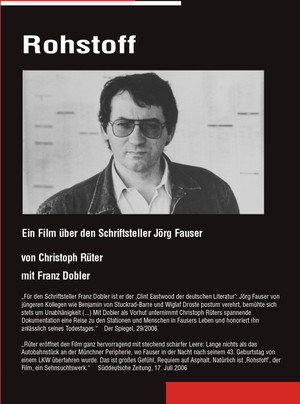
Rohstoff
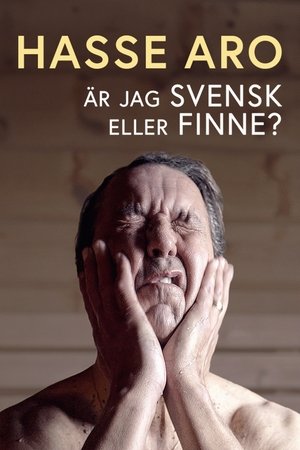
Hasse Aro - Är jag svensk eller finne?
Franco on Trial is the new film by Dietmar Post and Lucía Palacios. After the success of Franco's Settlers, their first encounter with Franco's dictatorship, they are now setting their sights on one of the darkest chapters of European history: the presumed organized extermination that took place during the coup, the war, and the subsequent dictatorship led by Franco, as well as Argentina's current effort, by invoking the principle of universal jurisdiction, to prosecute Francoists accused of committing crimes against humanity. The film is also a sore reminder of an issue that still stands today: the clear-cut accountability held by Germany, Italy, and Portugal. The film accomplishes to give both sides a voice - those against whom the killing has been directed; and the side of the perpetrators.
Gretel, a real estate broker, guides us through places laden with sentimental value and the memories behind each object, each space. The property owners share a deep desire for change and the uncertainty of an island in transition. While property transactions are common in Latin America, in Cuba, they are a recent reality, offering an opportunity to reflect on the value of a house – as a home and as a metaphor for the system, for a nation.
A look at the April 15, 1989 tragedy at Hillsborough Stadium in Sheffield, England, where a stampede in the stadium's standing-room-only areas killed 96 people and injured 766. The film also examines the ongoing efforts of victims' families to seek truth and justice, as well as tangible effects on English football, including stadium upgrades and the emergence of the English Premier League.
The story of the Mohanas, an indigenous fisherfolk community on Manchar Lake, as they face the sorrow of bidding farewell to a unique heritage that has sustained them for centuries.
Le Narrateur
During the Irish housing crisis, a documentary crew follows a greedy and corrupt Landlord who claims to have solved the housing problem for college students by creating "Boxtown", accommodation for students made out of cardboard boxes located in the car park beneath their college. But is this the paradise that the Landlord would have them believe?
O Que Eu Conto do Sertão é Isso...
{ Auto-biography of all the video experience Gabriel had based on his childhood’s productions. }
A Texas congressman sets a series of events in motion when he conspires with a CIA operative to aid Afghan mujahideen rebels fighting the Soviets.
Schtonk! is a farce of the actual events of 1983, when Germany's Stern magazine published, with great fanfare, 60 volumes of the alleged diaries of Adolf Hitler – which two weeks later turned out to be entirely fake. Fritz Knobel (based on real-life forger Konrad Kujau) supports himself by faking and selling Nazi memorabilia. When Knobel writes and sells a volume of Hitler's (nonexistent) diaries, he thinks it's just another job. When sleazy journalist Hermann Willié learns of the diaries, however, he quickly realizes their potential value... and Knobel is quickly in over his head. As the pressure builds and Knobel is forced to deliver more and more volumes of the fake diaries, he finds himself acting increasingly like the man whose life he is rewriting. The film is a romping and hilarious satire, poking fun not only at the events and characters involved in the hoax (who are only thinly disguised in the film), but at the discomfort Germany has with its difficult past.
Docufiction set in Jeddah, starring Aws, Lily, and Mema, the three children take the lead and freely create their own horror story
A unique glimpse into the world of Phyllis Lambert, renowned Canadian architect, urban activist, patron and founder of the Canadian Centre for Architecture in Montreal.
A true story about Johann Georg Elser, a quiet carpenter who tried to assassinate Hitler with an explosive device in 1939.
Documentary about filmmakers of the New German Cinema who were members of the legendary Filmverlag für Autoren (Film Publishing House for Authors). Among them are Werner Herzog, Rainer Werner Fassbinder, and Wim Wenders.
Clouds 1969 by the British filmmaker Peter Gidal is a film comprised of ten minutes of looped footage of the sky, shot with a handheld camera using a zoom to achieve close-up images. Aside from the amorphous shapes of the clouds, the only forms to appear in the film are an aeroplane flying overhead and the side of a building, and these only as fleeting glimpses. The formless image of the sky and the repetition of the footage on a loop prevent any clear narrative development within the film. The minimal soundtrack consists of a sustained oscillating sine wave, consistently audible throughout the film without progression or climax. The work is shown as a projection and was not produced in an edition. The subject of the film can be said to be the material qualities of film itself: the grain, the light, the shadow and inconsistencies in the print.
Chile hosts a decisive World Cup qualifier at Santiago’s National Stadium just weeks after the stadium had been transformed into a concentration camp and killing field for opponents of Augusto Pinochet (who had just gained power in a military coup). Though FIFA investigates the matter, the game goes on, with the Chilean team winning in a walkover after their opponents from the Soviet Union boycott in protest over the stadium's use
The Unconditioned Unconcealment
2022 marks the 25th anniversary of ABC airing Rodgers & Hammerstein’s “Cinderella” (1997), a revolutionary TV musical that embraced racial diversity in casting and has impacted generations over the years, starring an all-star cast led by Brandy Norwood as Cinderella and Whitney Houston as her fairy godmother. ABC News is producing a news special dedicated to the legacy of this film, reflecting how the idea of a princess has evolved and what makes the film still relevant today.