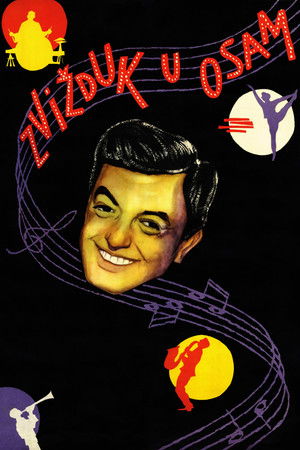
A pair wander the streets of Warsaw, meeting famous Polish musicians.
A group of dancers congregate on the stage of a Broadway theatre to audition for a new musical production directed by Zach. After the initial eliminations, seventeen hopefuls remain, among them Cassie, who once had a tempestuous romantic relationship with Zach. She is desperate enough for work to humble herself and audition for him; whether he's willing to let professionalism overcome his personal feelings about their past remains to be seen.
A documentary film that highlights two street derived dance styles, Clowning and Krumping, that came out of the low income neighborhoods of L.A.. Director David LaChapelle interviews each dance crew about how their unique dances evolved. A new and positive activity away from the drugs, guns, and gangs that ruled their neighborhood. A raw film about a growing sub-culture movements in America.
The Hollywood musical is brought to a Glasgow street. Amidst the crush of city life, two street musicians provide the backdrop for a girl meets boy story, with a spark of purely Glasgow magic.
Delinquent Tyler Gage receives the opportunity of a lifetime after vandalizing a performing arts school, gaining him the chance to earn a scholarship and dance with up-and-coming dancer Nora.
It's hard to define her. And that's precisely the way Lady Gaga wants it. Yes, Stefani Joanne Angelina Germanotta had a plan to remake herself into an outrageous icon. It began with Italian Catholic New York City roots then expanded to glam pop, electronic rock, burlesque and even jazz alongside nonagenarian crooner, Tony Bennett. Piano lessons began at age four and taught Stefani to create music by ear. There were lead roles in high school standard Broadway show productions then open mic nights at downtown clubs and 1 1/2 years of formal training at N.Y.U.'s Tisch School of the Arts. Even a rape at age nineteen slowed but did not stop the mission that would yield over 200 million combined album and song sales. No wonder that Gaga's fans call her "Monster Mother." An outrageous fashion sense has wrought costumes made of plastic bubbles and raw meat. While elaborate videos and spectacular stage sets are the norm,
Dance for All
Anma (The Masseurs) is a representative and historical work by the creator of Butoh dance, Tatsumi Hijikata in his early period in the 1960s. The film is realized not only as a dance document but also as a Cine-Dance, a term made by Iimura, that is meant to be a choreography of film. The filmmaker "performed" with a camera on the stage in front of the audience. With the main performers: Tatsumi Hijikata and Kazuo Ohno, the film has the highlights such as Butohs of a soldier by Hijikata & a mad woman by Ohno. There is a story of the mad woman, first outcast and ignored, at the end joins to the community through her dance. Inserted descriptions of Anma (The Masseurs) are made for the film by the filmmaker, but were not in the original Butoh. The film, the only document taken of the performance, must be seen for the understanding of Hijikata Butoh and the foundation of Butoh.
Honey Daniels dreams of making a name for herself as a hip-hop choreographer. When she's not busy hitting downtown clubs with her friends, she teaches dance classes at a nearby community center in Harlem, N.Y., as a way to keep kids off the streets. Honey thinks she's hit the jackpot when she meets a hotshot director casts her in one of his music videos. But, when he starts demanding sexual favors from her, Honey makes a decision that will change her life.
A series of four dance workouts featuring music and moves from the hit movie, Step Up Revolution. From the living room to the dance floor, these are moves that you can do anywhere!
Welcome to CRUNCH Fitness! If you're on a mission to flatten your belly, firm your thighs, lift your butt and get your body fighting fit then it's time for Belly, Butt & Thighs Bootcamp.
A high-school folk dancing group heads to Latvian School Youth Song and Dance Festival, an event that takes place every five years and is part of the Latvian national identity – this is the culmination point of five years of work. Away from their homes and parents, they spend seven days and nights together. They are 18 and have just graduated, and this seems to be the last idle summer of their lives. Dreams mix with boredom, silly jokes with serious conversations. Taking care of one another creates affection and grows into a collective power. There are thousands like them at the festival. Every individual sensation turns into a common celebration that becomes more than just a tradition.
Turtle Dreams, produced for WGBH-TV, originally aired September 2, 1983. Shot by Ping Chong. Composed by Meredith Monk, performed by her and her Vocal Ensemble.
A former professional dancer volunteers to teach dance in the New York public school system and, while his background first clashes with his students' tastes, together they create a completely new style of dance. Based on the story of ballroom dancer, Pierre Dulane.
A shy Greenwich Village book clerk is discovered by a fashion photographer and whisked off to Paris where she becomes a reluctant model.
Documentary following Japanese girl group Perfume on their 2014 world tour. Featuring live performances and behind-the-scenes footage, the film also includes in-depth interviews with members of the band as they perform in front of sell-out crowds across the world.
A funny, cruel exploration of the male psyche, Enter Achilles is set in a typical British pub, a shabby, nicotine-stained boozer. Pop songs tumble out of the jukebox, there is football on the TV, and the eight men lark around, pint glasses in hand. But their blokish fun is balanced on a knife-edge of tension, for beneath the mateyness lurks a disturbing undercurrent of paranoia and insecurity, where weakness is brutally exploited and violence covers up vulnerability.
Three sisters dance the Mikado in this very early film from the Edison company.
Santiago Mitre co-directs his first movement following The Student together with choreographer Onofri Barbato. Although it would have been more accurate to say “his first film-story-adventure-movie-great movie following The Student”, the word movement fits perfectly in Los posibles, the most overwhelmingly kinetic work Argentine cinema has delivered in many, many years. The film deals with the adaptation of a dance show directed by Onofri together with a group of teenagers who came to Casa La Salle, a center of social integration located in González Catán, trying to find some refuge from hardship. Already entitled Los posibles, the piece opened in the La Plata Tacec and was later staged in the AB Hall of the San Martín Cultural Center. Now, it dazzles audiences out of a film screen, with extraordinary muscles and a huge heart: Los posibles is a rhapsody of roughen bodies and torn emotions. Precise and exciting, it’s our own delayed, necessary, and incandescent West Side Story.
At Mr. Rad's Warehouse, the best hip-hop crews in Los Angeles compete for money and respect. But when a suburban crew crashes the party, stealing their dancers — and their moves — two warring friends have to pull together to represent the street.