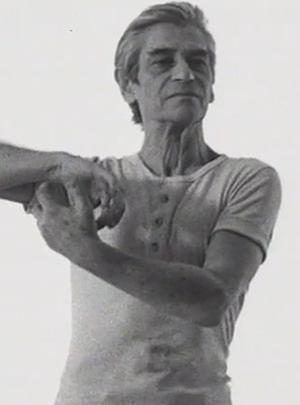
Choreographer Daniel Nagrin performs in a studio and in the sun.
Povesť o zbojníkoch
This documentary will explore the Afro-Caribbean dance, ‘whining’ alongside the practice of twerking to analyze respectability politics, pressures to accommodate whiteness, and gendered criticism of sexual expression within the Black diaspora. Using archival footage of West African dance, expert opinion from dancing and gender studies professors, and the active participation of partygoers in a dance experiment, Watkins will paint the picture of the defiance, autonomy, and ancestral veneration intrinsic to these traditional movement styles.
Documentary following the actors playing the role of Billy in Billy Elliot the Musical as they prepare for their West End debut.
Somber tides a cry from the species, startled into survival against the elements. One last breath before being trampled by the Earth or maybe conversely a battle to wage against winds and tides clutching on before extinction.
This intimate, uncannily moving documentary profiles Norma Canner, a pioneer in dance movement therapy, who found in dance a way to help people who had been discarded by society. The film traces the evolution of Norma's career from Broadway actress in the '40s, through her ground-breaking work in creative movement with disabled and mentally retarded children in the '60s, to her present work as a dance therapist with adults. Utilizing drawing, music, theater, and dance in the context of other modes of therapy, her work has proved extraordinarily beneficial for handicapped individuals, as well as providing cathartic healing experiences for those with deep emotional scars; And her work with children who were blind, deaf, or autistic has became a model.
The story of Ohad Naharin, renowned choreographer and artistic director of the Batsheva Dance Company, an artistic genius who redefined the language of modern dance.
Men and women of the !Kung people in Ojokhoe, Namibia perform healing dances by firelight. First we see men perform the giraffe dance, and then women perform the !gwa dance.
When he arrives in Saint Petersburg, at the age of 29, Marius Petipa is just an obscure dancer who fled western Europe to escape his debts. He is far from imagining that his engagement in the troupe of the Russian Imperial Ballet, then rather mediocre, will reveal him, forty years later, as one of the greatest choreographers in the history of dance. It is within the Bolshoi Kamenny theaters, then Mariinsky, in a still provincial capital where three productions a year are enough to satisfy an undemanding audience, that this native of Marseille will invent a new art of ballet, over the course of sixty of creations, between 1862 (La fille du pharaon) and 1895 (Le lac des cygnes).
Annabelle (Whitford) Moore performs one of her popular dances. For this performance, her costume has a pair of wings attached to her back, to suggest a butterfly. As she dances, she uses her long, flowing skirts to create visual patterns.
This is Ska is a Hi-Energy documentary on JAMAICAN dance music from 1964
A newly discovered film showing Tamara Karsavina dancing Mikhail Fokine’s ‘La Danse du Flambeau’ (‘The Torch Dance’). This performance was filmed in 1909. Tamara Karsavina’s shoes are not reinforced at the tip like today’s pointe shoes; she may have had cotton or wool stuffed into the toes of her shoes. (https://nycdancestuff.wordpress.com/2013/08/01/tamara-karsavina-michel-fokines-la-danse-du-flambeau-1909/)
Argentina continues Saura’s lyrical exploration of the essence, talent and patrimony of popular dance and song in both fiction and documentary
Summer 1991. The last days of the Soviet Empire. Dark clouds gathered over Moscow as the Soviet government prepared to turn back the clock of history. While the world focused on the crashing Soviet Empire, this film focuses on the people who would've been among the first to suffer repression - the women and men who have broken sexual taboos in a consummate act of liberation against a rigid, crippled world. This is a view from their vantage point, unveiling the shadow-side of Soviet culture in the wake of the revolution, where the real provocative nudity is the nakedness of the soul.
A documentary about legendary butoh dancer Kazuo Ohno.
Ankoku Butoh is a style of avant-garde dance that established itself in the counter culture experimental arts scene of post WWII Japan. The dance form is thought to have been founded by Tatsumi Hijikata, who both created and performed in butoh pieces from the late 1950’s - through the early 1970’s. In butoh, the style of movement is extremely stylized and deliberate, vacillating between slow and sharp, expressing feelings of dread, sexualization, violence, calmness, birth and “creatureness” among other things. This performance of Summer Storm was originally recorded in 1973 at Westside Auditorium, Kyoto University, Japan, and was Hijikata’s last public performance before his death in 1986 with Butoh of Dark Spirit School. Video version produced in 2003.
Chao-Li Chi shadow boxes indoors and practices with a sword outdoors. Theoretically, the film describes in a single continuous movement three degrees of traditional Chinese boxing, Wu-tang, Shao-lin, and Shao-lin with a sword. A long sequence of the ballet-like, sinuous Wu-tang becomes the more erratic Shao-lin; in the middle, there is an abrupt change to leaping sword movements, in the center of which, at the apogee of the leap, there is a long held freeze-frame.
After being invited by Benjamin Millepied to a rehearsal for the L.A Dance Project's premiere performance, Oscar-nominated director Alejandro G. Iñárritu was inspired to make a video-exercise that documents movement and dance in an experimental way, with a stream of consciousness narrative. The story takes place in a secluded, dusty space and centers around LADP dancer Julia Eichten who seems to be on an eternal search... for herself.
At The Ballet is the rise and fall of a Prima ballerina.
An insight into the life of the world's most famous male dancer, Rudolf Nureyev.