Der Rosenkavalier - Bayerische Staatsoper
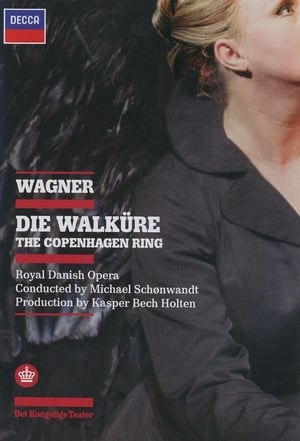
Die Walküre (The Valkyrie), WWV 86B, is an opera in three acts by Richard Wagner with a German libretto by the composer. It is the second of the four operas that form Wagner's cycle Der Ring des Nibelungen (The Ring of the Nibelung). The story of the opera is based on the Norse mythology told in the Volsunga Saga and the Poetic Edda.[1][2] In Norse mythology, a valkyrie is one in a group of female figures who decide which soldiers die in battle and which live. Die Walküre's best-known excerpt is the "Ride of the Valkyries". DVD release June 2009.
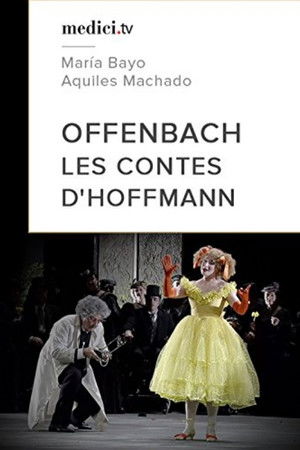
Opera in three acts, a prologue and an epilogue, by Jacques Offenbach (1819-1880), with a libretto in French by Jules Barbier (1825-1901), based on a work that Barbier himself and Michel Carré (1821-1872) had written based on stories by E.T.A. Hoffmann (1776-1822). Approximate duration: 2 h 45 min Recommended for those over 15 years old. The young poet Hoffmann, accompanied by Nicklausse, his alter ego and confidant, is in a tavern next to the theatre where Mozart's Don Giovanni is being performed. During the opera's intermission, some diners arrive at the bar who, upon seeing the poet, encourage him to sing and tell them the story of his famous love affairs. Hoffmann finally gives in and shares with them the stories of Olympia, Antonia and Giulietta. They, absorbed in the poet's stories, remain in the tavern, forgetting about the opera performance.
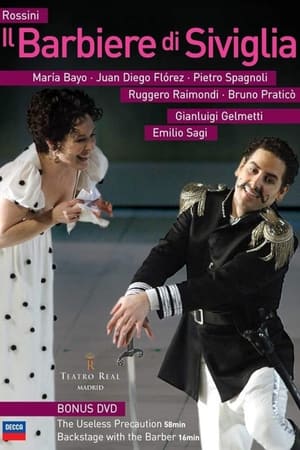
Stage director Emilio Sagi's production of the legendary Barber of Seville is enriched by a bright distribution. Maria Bayo returns to one of her signature role as Rosina, opposite Juan Diego Florez, the Rossini expert tenor. The title role is embodied by the Italian baritone Pietro Spagnoli, while Ruggero Raimondi and Bruno Pratico reconcile the audience with Don Basilio and Don Bartolo.
In his new production, Robert Carsen places the action at the end of the Habsburg Empire, underscoring the opera’s subtext of class and conflict against a rich backdrop of gilt and red damask
Mozart’s early masterpiece returned to the Met for the first time in more than a decade with Music Director Emeritus James Levine, who led the work’s company premiere in 1982, again on the podium. Tenor Matthew Polenzani brings both steely resolve and compassionate warmth to the title king of Crete, who is faced with an impossible decision. With her rich mezzo-soprano, Alice Coote sings the trouser role of Idomeneo’s son Idamante, who loves the Trojan princess Ilia, sung with delicate lyricism by Nadine Sierra. Elza van den Heever gives a thrillingly unhinged portrayal of the jealous Elettra. Jean Pierre-Ponnelle’s timeless production blends the grandeur of ancient myth with the elegance of Enlightenment ideals.
Die Meistersinger von Nürnberg
This telecast offers a rare opportunity to see the legendary Joan Sutherland in the role that first catapulted her to international stardom. She drove audiences wild by the way her opulent voice caressed the music’s long phrases and sprinted effortlessly through the fiendish runs, trills, embellishments and stratospheric high notes. One of the glories of the operatic world, her portrayal of Donizetti’s hapless heroine is a multifaceted and moving characterization. The incomparable tenor Alfredo Kraus is Edgardo, the man Lucia loves but cannot have. (Performance taped November 13, 1982. Broadcasted September 28, 1983.)
All the throbbing eroticism—and ultimate heartbreak—of Puccini’s youthful score is unleashed by James Levine and his top-flight cast. Plácido Domingo is Des Grieux, the handsome, headstrong young aristocrat who falls head over heels for the enticing, impetuous Manon Lescaut (Renata Scotto). Manon returns his love, but her obsession with luxury ruins them both. Gian Carlo Menotti’s opulent production, with sets and costumes by Desmond Heeley, superbly captures the colorful world of 18th century France.
Robert Lepage’s dreamlike production, with its thousands of twinkling LED lights stretching across the stage to represent the sea, encapsulates the mystic feeling of L’Amour de Loin, Saariaho’s haunting opera of distant love. Eric Owens is Jaufré Rudel, a troubadour in 12th century France who has become tired of his hedonistic life and longs for an idealized love. Enter the Pilgrim (Tamara Mumford) who tells him his perfect love does, in fact, exist, far across the sea. She is Clémence, Countess of Tripoli (Susanna Phillips). The magic of the characters’ inner lives as they explore the meaning of love, longing, life, and death is heightened by Saariaho’s hypnotic and bewitching score, conducted by Susanna Mälkki.
Anthony Dean Griffey creates a haunting portrait of the outcast fisherman who struggles under the burden of presumed guilt. This chilling production by Tony Award-winning director John Doyle also features the superb Patricia Racette as the sympathetic Ellen Orford and the Met chorus in a truly hair-raising performance as the oppressively judgmental fishing village.
Verdi: La forza del destino
A musical adaptation of Victor Hugo's novel "Notre Dame de Paris" which follows the gypsy dancer Esmeralda and the three men who vie for her love: the kind hunchback Quadimodo, the twisted priest Frollo, and the unfaithful soldier Phoebus.
This is a performance of Wagner's three-act opera Der fliegende Holländer ("The flying Dutchman"), performed by Bayreuther Festpiele, directed by Dmitri Tcherniakov. The staging was notable for two other milestones, as Oksana Lyniv became the first woman to conduct at Richard Wagner’s legendary Festspielhaus since its opening in 1876, and the sensational Lithuanian soprano Asmik Grigorian made her house debut with a standout performance as the opera’s heroine, Senta. The exceptional cast also included John Lundgren (The Dutchman), Georg Zeppenfeld (Daland), Eric Cutler (Erik) and Marina Prudenskaya (Mary).
Part of Tutto Verdi series - Macbeth (2006) Parma. Macbeth is one of the most multi-layered, profound and demanding roles that Verdi ever wrote for a baritone and the Italian singer Leo Nucci is arguably the most distinguished in his field. The role has repeatedly brought him lasting success and he enacts it with an intensity that only the very experienced stage personality can muster. French singer Sylvie Valayre is known for her versatile interpretations of spinto and dramatic coloratura soprano parts, especially for particularly gruelling roles like Lady Macbeth. Supported by Italian bass Enrico Iori as Banco and tenor Roberto Iuliano as Macduff, they make up a wonderful cast under the baton of Bruno Bartoletti, musical director of the Teatro Regio di Parma.
“Let us assume that Switzerland is truly a paradise. The music hereto was written long ago. We have merely forgotten it.” (Daniel Schmid) This is the material from which the most Swiss of all operas is made: the legendary Wilhelm Tell – a Swiss hero: straightforward, a primus inter pares of the indomitable freedom fighters, a good shot, surefire. A myth that becomes a poetic playground: nature in turmoil, the struggle for freedom and forbidden love. A legendary overture at a gallop with an iconic post horn motif – all this and much more in the thirty-seventh and last opera by Rossini.
Renée Fleming lights up the Met stage as Hanna Glawari, the fabulously wealthy widow of the title in Lehár’s beloved operetta, set in Paris and seen in a glittering production directed and choreographed by Broadway’s Susan Stroman. Nathan Gunn is Danilo, Hanna’s former flame, who is supposed to woo and marry her in order to keep her fortune in their home country of Pontevedro. Kelli O’Hara sings Valencienne, the flirtatious young wife of the Pontevedrian ambassador in Paris, Baron Zeta, played by Thomas Allen, and Alek Shrader is her suitor, Camille. Andrew Davis conducts the waltz-rich score, and the new English translation is by Jeremy Sams.
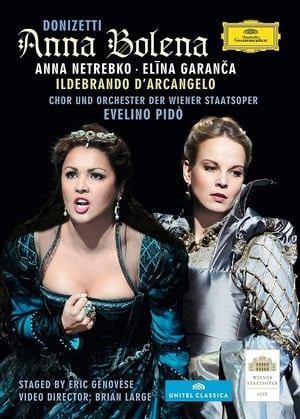
Gaetano Donizetti and his librettist Felice Romani kept the focus of their opera ANNA BOLENA on the personal rather than the political in this fictionalized Tudor tale: Henry VIII of England wants to get rid of his second wife, Anne Boleyn, so that he can marry her lady-in-waiting, Jane Seymour. He brings Lord Richard Percy, Anne's first love, back from exile so that he can find an excuse to accuse her of adultery. With the unwitting aid of Smeaton, a court musician, and Lord Rochefort, Anne's brother, the trap is easily sprung. This 2011 live recording from the Wiener Staatsoper showcases Anna Netrebko as she "scored a personal triumph" in her debut as the hapless Tudor Queen, while her stage partners - notably Elīna Garanča as Jane Seymour and Ildebrando D'Arcangelo as Henry VIII - were likewise showered with critical acclaim.
Conducted by Riccardo Muti, the master of the Scala in Milan for twenty years, the Verdian melodrama unfolds before our eyes. This Cavani's approach is ageless and excellence is pre-eminent: to start with, the role of Riccardo is played by the wonderful Salvatore Licitra. As for Maria Guleghina, she plays an exceptionally good Amelia. Riccardo Muti proves once again what a wonderful Verdian he is.
Berlioz’s epic masterpiece retells the magnificent saga of the aftermath of the Trojan War and the exploits of Aeneas. Rising tenor Bryan Hymel, in his Met debut, stars as the hero charged by the gods with the founding of the city of Rome. Susan Graham is Dido, Queen of Carthage, who becomes Aeneas’s lover, and Deborah Voigt sings Cassandra, the Trojan princess whose warnings about the impending destruction of Troy go unheeded. Francesca Zambello’s atmospheric production, featuring choreography by Doug Varone, is led by Met Principal Conductor Fabio Luisi.