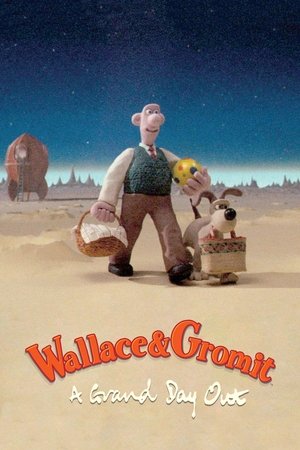
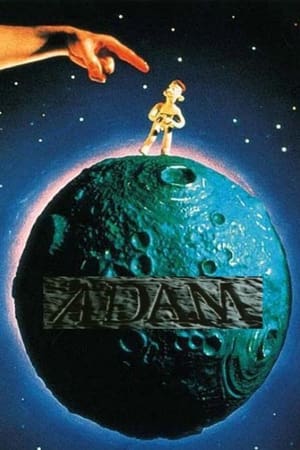
Wallace and Gromit have run out of cheese, and this provides an excellent excuse for the duo to take their holiday to the moon, where, as everyone knows, there is ample cheese.
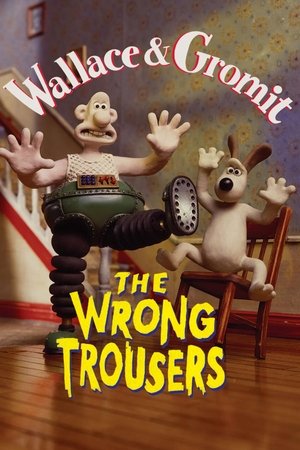
Wallace rents out Gromit's former bedroom to a penguin, who takes up an interest in the techno trousers created by Wallace. However, Gromit later learns that the penguin is a wanted criminal.
Wallace's whirlwind romance with the proprietor of the local wool shop puts his head in a spin, and Gromit is framed for sheep-rustling in a fiendish criminal plot.
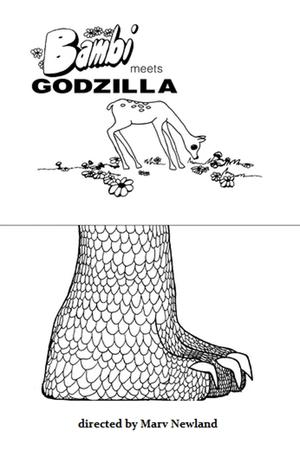
A deer, disillusioned by the consumerism that defines his life. A lizard, ostracized from society, forever wandering. A chance meeting in the middle of a field. Who will survive? And who will transcend existence? Preserved by the Academy Film Archive in 2009.
Begins as a whimsical piece with 'sheets' of lines running down the screen, progressing into more and more complex geometic patterns but without deviating from the basic precepts of 'dot and line' animation. Jazz piano on a lazy Sunday afternoon, and a spring color palette. -- Stephanie Sapienza. Preserved by the Academy Film Archive in 2001.
A collaborative piece by Gore and Beckett, the film begins with one of Gore's characters composing a letter, to eventual mail it. Beckett's animation takes over at this point, transforming the envelope into a looping, cascading form that seems to be perpetually turning itself inside out. A brief Gore finale bookends the piece, which is one of only two extant examples of Gore's unique animation work. This film is usually appended to Gore's own Dream of the Sphinx. [Source: Mark Toscano] Preserved by the Academy Film Archive in partnership with CalArts in 2009.
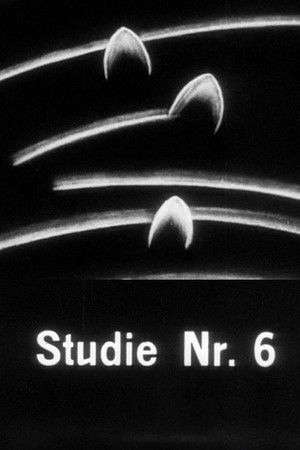
The first Studies were synchronized with records (Fischinger made a total of 13 Studies all without sound). It was only with the introduction of sound, beginning with Study No 6 that the films did full justice to this musical principle. The play of the white lines, the arcs, and the upside-down U’s running hither and thither like ballet dancers was brought into perfect synchronization with the music, and thus the films offered an abstract illustration of the melodies. Study No 6 is certainly the best of his films in terms of forms. - Hans Scheugl and Ernst Schmidt, Jr. Preserved by the Academy Film Archive in 2001.
Mountain Music illustrates what happens when technology gets too advanced too soon. Preserved by the Academy Film Archive in 2012.
The animation, music, and optical printing of Kitsch in Synch was produced by Beckett and the students in two classes he was teaching at CalArts. Although a group project, it is clear that Beckett was the director. The playful, catchy soundtrack is used to create a cycle of building tension and release. The brightly colored shapes create approximate symmetrical formations and become more densely layered, with glimpses of iconographic objects and even live footage near the end. Preserved by the Academy Film Archive, in partnership with the iotaCenter, in 2007.
In Flesh Flows we see a balance of Beckett’s keen drawing ability, in the probing erotic forms, and his technical acuity, which transforms the carnal images into a compelling, transcendent experience. Preserved by the Academy Film Archive in partnership with iotaCenter and National Film Preservation Foundation in 2007.
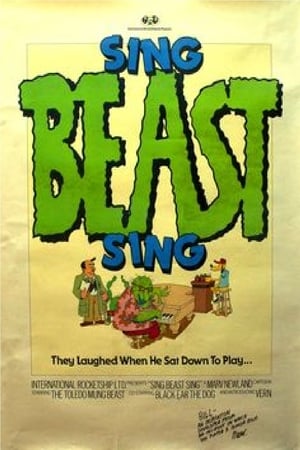
Del is a song writer for the obnoxious Mr. Mega, and in love with Didi, Mega's secretary. His quest to write a hit tune brings him to the wacky world of Flooby Nooby, where he just might learn to write songs from the heart.
Beckett cycles through a limited number of drawings, but adds new information to each drawing every time we see it, giving the sense of a world that is infinitely rich and also obviously contained tightly within the edges of the paper. Preserved by the Academy Film Archive in partnership with iotaCenter and National Film Preservation Foundation in 2007.
Opens with a short canonical statement of a theme upon which the entire film is constructed. The canon is repeated in contrasting variations by means of color. A second section poses the same image in deep film space. The image unfolds itself repeatedly, leaving the receding image to continue on smaller and smaller. Preserved by the Academy Film Archive in 2005.
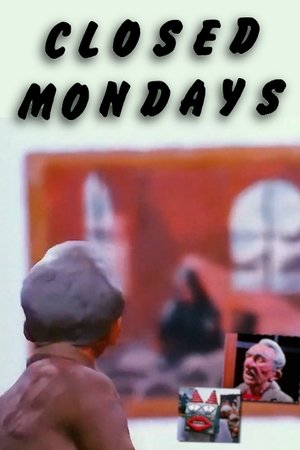
An intoxicated man trespasses into an art gallery after hours.
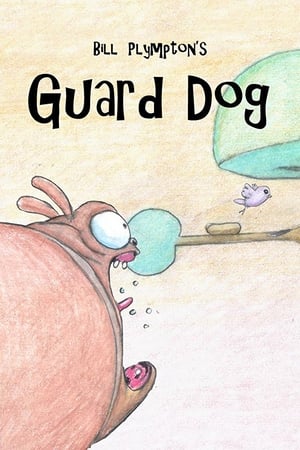
Why do dogs bark at such innocent creatures as pigeons and squirrels... what are they afraid of? This film answers that eternal question.
A vibrant animation by Patricia Marx. Preserved by the Academy Film Archive in 2000.
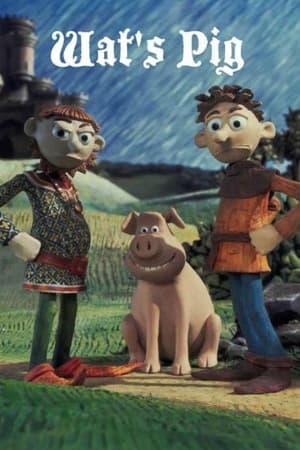
In a Medieval castle, a marauder tries to kidnap the twin infant sons of the lord. He makes off with only one, whom he drops about a mile away. A pig rescues this baby, so one brother grows up high on the hog, the other down with the swine; one is lazy, his lost brother is industrious. Years later, when a neighboring prince declares war, the brother in the castle is too soft to fight. Through happenstance, the twins are united just before the final battle. Will the upper-class brother let his humble sibling lead the troops to certain defeat and death? Preserved by the Academy Film Archive.
The bizarre adventures of the cartoon character Foska, drawn by 22 animators working in collaboration. Each animator worked on his or her own sequence only and did not know what action preceded or followed his or her sequence, except that the first drawing of a sequence is the last drawing from the previous sequence. Preserved by the Academy Film Archive in 2010.
An animated comedy short from the 1920s. Preserved by the Academy Film Archive in 2008.
An animated short consisting of 4 segments: bowl, garden, theatre, marble game. Preserved by the Academy Film Archive in partnership with Harvard Film Archive in 2015.