Phyllis Bigler has been going to the Spanish Peaks of Colorado since she was a child. Now in her 90s, she tells her stories.
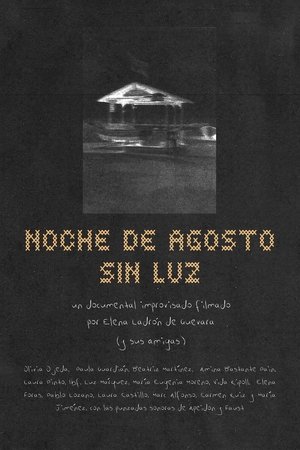
Noche de agosto sin luz
Disjointed moments from the filmmakers’ daily lives during the past year. Captured on a 1985 VHS camcorder with color and luminosity distorted by its failing color Newvicon tube. Cut with distorted tape-recorded fragments of nostalgic broadcast television ephemera. Scored by whatever was handy— from an ambient electronic song with a surprising amount of pipe organ (Oneohtrix Point Never - Boring Angel) to midi versions of your favorite SNES soundtrack (Donkey Kong Country – Aquatic Ambience, Opening, and Treetop Rock) to a not-quite-right rendition of a song that will make you want to say “Oh, Angelo, that’s tearing my heart out!” (Xiu Xiu – Falling). A voyeuristic peak at home movies that exist somewhere between soon to be forgotten and forgotten long ago. The occasional dot matrix time stamps in the corner of the footage somehow make it harder to place in time.
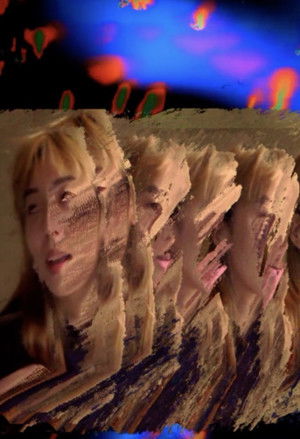
In 2002, Lana Kaiser became well known in the first season of the German version of the Idol television franchise. She was born in 1985 and went by her birth name Daniel Küblböck. At only 17 years old she polarised the audience with her androgynous appearance and open bisexuality. On September 9th 2018, Lana disappeared from a cruise ship on her way to North America. Most media outlets and the majority of the public didn‘t consider calling her by her chosen name, Lana Kaiser. Philipp Gufler's video installation is a personal portrait of the singer and entertainer.
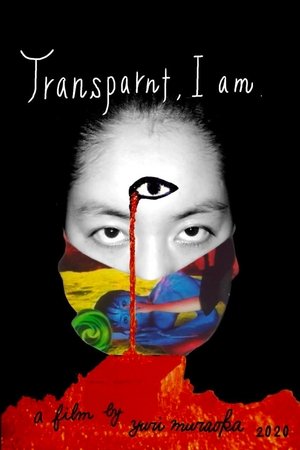
In the year 2020, when the world was forced to ‘change’, I wanted to confirm what changed and what did not change in me. The white mask I wore became the screen projecting my past. My family is sometimes hurt, but support me as I suffer from schizophrenia. We live today while looking for the answer to ‘Who are we?’
Faced with an assignment to film something personal, Cem begins a quiet search for what that really means. A casual conversation with a close friend leads him to turn the camera toward the people who already shape his life. Through moments with his grandmother, spontaneous talks about family, and reflections on his dream of becoming a filmmaker, MozikMoro slowly transforms into a portrait of connection and self discovery. Between the ordinary and the intimate, Cem captures a world that is both deeply personal and universally human.
A portal, a sorceress, a fictional device to portray existence as a moment encapsulated inside an instantaneous photograph to present fragmented biographical elements —family disintegration, rootlessness, scars, two loyal companions, the promises of a new land—subverting the notion of a home-movie and transform it into a pilgrimage tool of self-discovery, mirroring the fragile nature of memories.
Eligibility is a film made by Ryan Cunningham. In this film, they discuss the question, "Why do I have to prove myself?" Through 80 minutes of documentary, archival, and narrative formats, Ryan explores this topic. Made within a week of 2025 and with a couple of all-nighters, this is proof of Eligibility. Anything can be a movie, so why not make one?
The Eye explores silent landscapes where nature and absence coexist. Between the memory of places and resilience in the face of time, the film oscillates between beauty and existential vertigo, capturing what persists and what fades.
An unhinged, diaristic examination of devastating friendship breakups.
Cartas de Arapuca
What are they? What do they seek? When all the lights go out, they will wander. And you will never see them.
At the Myrtle-Wyckoff intersection, transportation arteries and the community overlap and interact, connect and collide, react and respond. Where are people going? Where are they coming from? And, what lies underneath all of the activity?
A shot-on-video look at three impoverished Black communities in rural Georgia in 1976 - America's bicentennial, interspersing photos with footage and voices of those in their communities.
In the fall of 1986, Richard Fung made his first visit to his father's birthplace, a village in southern Guangdong, China. This experimental documentary examines the way children of immigrants relate to the land of their parents, and focuses on the ongoing subjective construction of history and memory. The Way to My Father's Village juxtaposes the son's search for his own historical roots, and his father's avoidance of his cultural heritage.
"An experimental documentary on Reverend L.O. Taylor, a black Baptist minister from Memphis, Tennessee who was also an inspired filmmaker with an overwhelming interest in preserving the social and cultural fabric of his own community in the 1930′s and 40s. I combine his films and music recordings with my own images of Memphis neighborhoods and religious gatherings" -Sachs
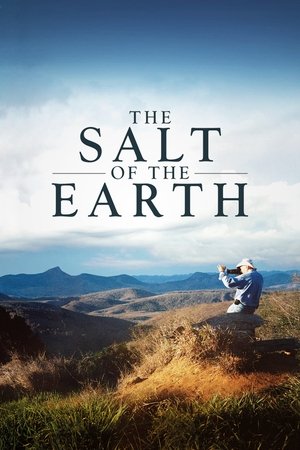
During the last forty years, the photographer Sebastião Salgado has been travelling through the continents, in the footsteps of an ever-changing humanity. He has witnessed the major events of our recent history: international conflicts, starvations and exodus… He is now embarking on the discovery of pristine territories, of the wild fauna and flora, of grandiose landscapes: a huge photographic project which is a tribute to the planet's beauty. Salgado's life and work are revealed to us by his son, Juliano, who went with him during his last journeys, and by Wim Wenders, a photographer himself.
Actors work with a director to find the rhythm of a scene.
Through phone call conversations, an aspiring Ilocano filmmaker relates to his mother working in Italy about his dreams and struggles while documenting the invisible betweenness of their language and distance.
what was the last dream you had?