As the campaign to force Jews out of Germany ramps up, the American government blocks efforts to help rescue many of these displaced persons, and Americans' antisemitism only seems to get worse.
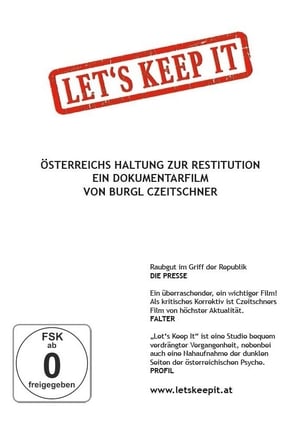
Let's keep it is a cinema documentary (99') about the still problematic attitude of the Republic of Austria towards the restitution of "aryanized" real estate which - for whatever reason - became the property of Austria after 1945. The film is also the director's bow to the victims of the darkest chapter of Austria's recent history. A chapter that seems to have been extended to a certain extent when it comes to restitution of looted property to the descendants of Holocaust victims.
Shortly before Christmas 1744, Vienna, the center of power in the Habsburg Empire, is the scene of a disastrous drama with repercussions for the whole of Europe. Against the spirit of enlightenment and tolerance, the very young Maria Theresa orders the expulsion of the allegedly disloyal Jews from Prague.
Tucson, Arizona, September 1996. At the request of his son Martin, George Goldsmith tells him of his past in Nazi Germany as a member of a family of Jewish musicians and the strange history of the Jüdischer Kulturbund, a Jewish organization sponsored by Reichsminister Joseph Goebbels.
The true story of how businessman Oskar Schindler saved over a thousand Jewish lives from the Nazis while they worked as slaves in his factory during World War II.
Holocaust survivors, children of survivors, and grandchildren - as well as German freedom fighters - express their shock at the Covid era's fear-mongering and divisive dictates that are reminiscent of the prelude to the Holocaust. This ambitious five-part docu-series is the brainchild of Holocaust survivor and human rights activist Vera Sharav.
Kurt Gerstein—a member of the Institute for Hygiene of the Waffen-SS—is appalled to discover that a poison gas he helped discover is being used to kill Jews. Driven by his conscience to alert the rest of the world, Gerstein teams up with a young Jesuit priest, Riccardo Fontana, but their protestations fall on deaf ears in the Vatican.
13 years ago, director Bob Entrop made the film A piece of blue in the sky, the first film in the Netherlands that depicted the murder of almost 1 million Sinti and Roma during the Second World War. There is a taboo on what happened during the war, you don't talk about it with anyone and certainly not in front of a camera. Requiem for Auschwitz is a sequel, with the most valuable moments from the first film, supplemented with the grandchildren and the creation and performance of the 'Requiem for Auschwitz' by Sinti composer Roger Moreno Rathgeb by the Sinti and Roma Philharmonic from Frankfurt and a Jewish choir in the Berliner Dom in Berlin, during Holocaust Memorial Day. During his visit to Auschwitz in 2020 with four musicians from the Dutch Accompaniment Orchestra, Roger shows them the places that inspired him.
The true story of Charlotte Salomon, a young German-Jewish painter who comes of age in Berlin on the eve of the Second World War. Fiercely imaginative and deeply gifted, she dreams of becoming an artist. Her first love applauds her talent, which emboldens her resolve. When anti-Semitic policies inspire violent mobs, she escapes to the safety of the South of France. There she begins to paint again, and finds new love. But her work is interrupted, this time by a family tragedy that reveals an even darker secret. Believing that only an extraordinary act will save her, she embarks on the monumental adventure of painting her life story.
A documentary chronicling the adolescent years of Elie Wiesel and the history of his sufferings. Eliezer was fifteen when Fascism brutally altered his life forever. Fifty years later, he returns to Sighetu Marmatiei, the town where he was born, to walk the painful road of remembrance - but is it possible to speak of the unspeakable? Or does Auschwitz lie beyond the capacity of any human language - the place where words and stories run out?
A Canadian artist turned diamond merchant in Vienna, Austria risks his life to smuggle Jews out of the Third Reich.
An account of the life and work of the Polish writer Stanisław Lem (1921-2006), a key figure in science fiction literature involved in mysteries and paradoxes that need to be enlightened.
Lithuania, 1941, during World War II. Hundreds of thousands of texts on Jewish culture, stolen by the Germans, are gathered in Vilnius to be classified, either to be stored or to be destroyed. A group of Jewish scholars and writers, commissioned by the invaders to carry out the sorting operations, but reluctant to collaborate and determined to save their legacy, hide many books in the ghetto where they are confined. This is the epic story of the Paper Brigade.
For four years (1977-1981) Esaias Baitel documented a violent Parisian neo-Nazi gang. Having gained their trust, he was able to get close to them. Living among the gang members, he witnessed horrific events, and while hiding his real identity, he photographed a one-of-a-kind collection of gripping stills. Over thirty years have passed. Esaias Baitel has laid his camera down. He returns to the dark nights he spent in the City of Lights, the city where he lived a double life, going back and forth from the gang to the young family he had just started.
What would your family reminiscences about dad sound like if he had been an early supporter of Hitler’s, a leader of the notorious SA and the Third Reich’s minister in charge of Slovakia, including its Final Solution? Executed as a war criminal in 1947, Hanns Ludin left behind a grieving widow and six young children, the youngest of whom became a filmmaker. It's a fascinating, maddening, sometimes even humorous look at what the director calls "a typical German story." (Film Forum)
"Long is the Road" - The first feature film to represent the Holocaust from a Jewish perspective. Shot on location at Landsberg, the largest DP camp in U.S.-occupied Germany, and mixing neorealist and expressionist styles, the film follows a Polish Jew and his family from pre-war Warsaw through Auschwitz and the DP camps.
Once upon a time, a poor woodcutter and his wife lived in a great forest. Cold, hunger, poverty, and a war raging all around them meant their lives were very hard. One day, the woodcutter's wife rescues a baby. A baby girl thrown from one of the many trains that constantly pass through the forest. This baby, this "most precious of cargoes", will transform the lives of the poor woodcutter's wife and her husband, as well as those whose paths the child will cross—including the man who threw her from the train. And some will try to protect her, whatever the cost. Their story will reveal the worst and the best in the hearts of men.
This documentary explores the creation of the Holocaust Memorial in Berlin as designed by architect Peter Eisenman. Reaction of the German public to the completed memorial is also shown.
In 1944 Poland, a Jewish shop keeper named Jakob is summoned to ghetto headquarters after being caught out after curfew. While waiting for the German Kommondant, Jakob overhears a German radio broadcast about Russian troop movements. Returned to the ghetto, the shopkeeper shares his information with a friend and then rumors fly that there is a secret radio within the ghetto.
In 1939, just finished the Spanish Civil War, Spanish republican photographer Francesc Boix escapes from Spain; but is captured by the Nazis in 1940 and imprisoned in the Mauthausen concentration camp, in Austria, a year later. There, he works as a prisoner in the SS Photographic Service, hiding, between 1943 and 1945, around 20,000 negatives that later will be presented as evidence during several trials conducted against Nazi war criminals after World War II.