Gaza-London
Tout le temps, tout le temps, tout le temps...?
Until now, they have stood on the sidelines. They have not appeared before the cameras. They have not taken part in public discussion. It is mainly to them that the documentary film by the well-known journalist Ewa Ewart was devoted. It shows the face of the Smolensk catastrophe through the eyes of the victims' families. April 10, 2010 went down in the memory of Poles as a day of national drama. But for the characters in the film, it was the day of their greatest personal drama. Along with the presidential couple, their loved ones passed away in shocking circumstances. For most, the time passing since the Smolensk catastrophe does not bring relief. Ewa Ewart and her film crew accompany the families at various stages of their struggle with difficult emotions. The film is in the process of being made and will include sequences and stills that have not been used anywhere before.
A short film depicting the universality of life, growth, and how beautiful life is to simply exist. The film shows how beautiful it can be when we show tenderness & love for one another, through the narration & home movies of four sisters & their mother from when they were born up to the present. The film was made over 18 years on The Australian Coast.
Rosa is from Croatia and lives in Switzerland, with her husband who depends on her care. She takes care of everything. Her children have grown up and want to leave home. Rosa stays behind alone.
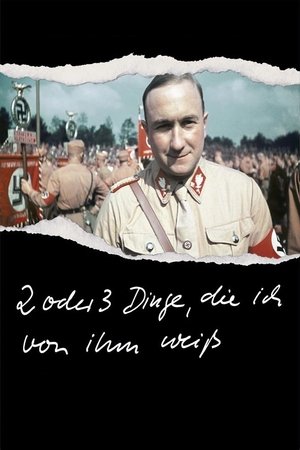
What would your family reminiscences about dad sound like if he had been an early supporter of Hitler’s, a leader of the notorious SA and the Third Reich’s minister in charge of Slovakia, including its Final Solution? Executed as a war criminal in 1947, Hanns Ludin left behind a grieving widow and six young children, the youngest of whom became a filmmaker. It's a fascinating, maddening, sometimes even humorous look at what the director calls "a typical German story." (Film Forum)
On the outskirts of Den Helder lies De Nollen, an inland dune area where nature, sculpture, and painting merge into a truly immersive experience. It is the life's work of artist Rudi van de Wint. He died unexpectedly in 2006. His sons, Ruud and Gijs, carried on his dream, out of love for their father and for De Nollen. But plans for a Rudi van de Wint museum in the area led to cracks in their idyllic existence.
Kekaiulu Hula Studio follows the Proclaimed Hula Halau of the same name, showcasing their twist on what the real reason for hula is and what life as a dancer in the halau is really like. Something previously unseen in the public eye.
The rock-wild youth of the 1960s during the apparitions of their idols.
A meeting between the daughter and the grandmother of the director, Iván Mora Manzano, at a time when the memories of one, the girl’s, were taking shape, and the other’s the grandmother’s, were vanishing. This starting point is used as a pretext to talk about other topics such as the importance of family memories and the search for memory.
In the Year of Hip Hop takes a retrospective look at the Slovenian hip hop/rap music scene. Boris Petkovič explores in great detail the evolution of a music style which, from the very start, has intimately reflected the social situation of its artists. Hip hop has always absorbed the "vibes" of the place where it is taking root, and Slovenia is no exception. According to Petkovič, in today's Slovenia, rap is the one and only form of music that discusses the state of our society and of human relationships without any inhibitions. If rap is not your cup of tea, this film can make you change your mind.
A docu-film about the city Lucknow where the creators ask their family members important questions they have always wanted answers to, while indulging in tomfoolery around town. The film showcases the differences in the way three different generations perceive Lucknow. An ode to the city, and an attempt to provide solace to the social misfits of the creators' hometown.
In the late ‘70s, in the midst of the military dictatorship, a surrealist literary work- shop is the oasis of Martín, a tormented young man who seeks to improve his poetry. Caron, a brilliant and eccentric writer, adopts him as a son. Their bond is recorded in short home movies and an unusual correspondence.
The artist Johanna Faust is about to leave her children to finally devote herself to her art again. A vague memory comes to her mind: Didn't her grandmother do the same thing, with terrible consequences? The intimate road movie tells of lost mothers and abandoned children, of the temptations and the price of self-fulfilment, of the abysses of motherhood and of the deep longing for another life.
An Austrian director followed five successful African music and dance artists with his camera and followed their lives for a year. The artists, from villages in Ghana, Gambia and Congo, were the subjects of Africa! Africa! touring across Europe, but they have unbreakable roots to their homeland and their families. Schmiderer lovingly portrays his heroes, who tell their stories about themselves, their art and what it means to them to be African with captivating honesty. The interviews are interwoven with dance scenes and colourful vignettes set to authentic music.
Hora Por Año
Jöran has a bipolar disorder, which makes him vulnerable to depression, mania and psychosis. He can sympathize well at the moment, but that has been different in the past. Jöran delves into his dark past and talks to the people who experienced his illness up close. How do you deal with this disorder and the misunderstood behavior that comes with it? And how do you break the taboo that still exists on disease pressure?
Plataneros
The hairstyles of four Afro-descendant people from Mexican - Senegalese families, represent the starting point to reflect, through memories that emerge from their past and present, what it is like to live in México wearing a Black Crown and the consequences that implies.
"What would the world be like without Beethoven?" That’s the provocative question posed by this music documentary from Deutsche Welle. To answer it, the film explores how Ludwig van Beethoven's innovations continue to have an impact far beyond the boundaries of classical music, 250 years after his birth.