Schultze is an accordion player and newly without work. When the local music club celebrates its 50th anniversary, his taste of music changes unexpectedly.
On a film reel electrified by static charges, we meet five people who survived the impact of lightning.
All across the globe, Chinatowns are under threat of disappearing – and along with them, the rich history of a community who fought from the margins for a place to belong. Big Fight in Little Chinatown documents the collective fight to save Chinatowns across North America.
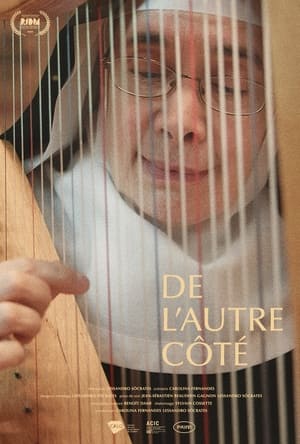
The oldest Quebecois Benedictine convent open its gates to a documentary filmmaker for the first time. Observed up close, life behind its walls is busier than one would expect. About twenty cloistered nuns, most of them over 70, share their daily life with diligence and humor. A contemplative portrait of a community of sisterhood and solidarity emerges, punctuated by prayer, work and games evenings.
Zoe McIntosh introduces us to Peter One, King of Caravans, and his realm, the Bignell Street Motel Caravan Park in Whanganui. Bignell Street has a reputation for being a place of last resort for the down and out, where people with nowhere else to go can always find a caravan roof for their heads. A social butterfly and a self-admitted garage sale addict, motel manager Peter says he acts as a de facto social worker to the weird and wonderful itinerant inhabitants of his trailer park, although some claim he’s just as strange and desperate as they are. - NZIFF 2013
Ich glaub, ich mach nicht mal Filme, ich glaub, ich filme nur irgendwas, um irgendwem zu beweisen, dass ich eine Person bin
Silent footage shot on the set of CASQUE D’OR provides a glimpse of film director Jacques Becker at work.
It was just two days before Christmas in 1958 when John Cruitt's mother died after being seriously ill with multiple sclerosis. At the time, he was a student in Cecile Doyle's third grade class. And an act of kindness she showed him became stamped in his memory. So, more than 50 years later, he wrote her a letter.
A quarter of a century ago, the documentary film by Juris Podnieks “Is It Easy to Be Young?” was a triumph on the cinema screens of the Soviet Union. Has it become easier for today's youth of Russia than it was for their peers in the USSR?
An attempt to connect the past and present time through poems, stories, documents; connect the spaces from Kronstadt to Moscow with the voices of the past, the words of Osip and Nadezhda Mandelstam, A. Akhmatova.
Three homeless people hide from the winter cold in a plywood hut near Paveletsky railway station in Moscow. One day it occurs to them to build a real house. Maybe it will change something in their lives?
A human story about a man stuck between worlds. Boring observations of the everyday life of an old woman.
Parents are not allowed into the Kremlin for the New Year Tree, children must go there alone. And now, after visiting the most important New Year tree in Russia, the children go to the Cathedral Square of the Kremlin, where their parents are waiting for them. Faces of children, adults. Sometimes this exit turns out to be quite successful, and sometimes it simply crosses out the previous festival. And in any case, he always says a lot.
The film is based on a conversation between two philosophers and a historian, Merab Mamardashvili, Dmitry Seseman and Yuri Geller, which took place 25 years ago in 1986. So much has changed in the world since then, and the thoughts of the film's characters about freedom and slavery, about totalitarianism and democracy remain relevant today.
“I keep coming back to those memories. Death this time came very close and took my friend. And she left me. This is how the year began. The strangest year of my life. When I realized that I was gradually losing everything and did not understand how this happened. last year of the millennium. The first year of the life that was left to me for some reason. With this author's introduction, a film diary of one year begins with the miracle of a continuing life.
For a month, Uncle Misha has been guarding a barge arrested for debts. Nothing seems to happen to him here. For days on end, he moves around the ship following the shadow, escaping from the heat and a hangover, inventing activities for himself. Waiting for the owner. Uncle Misha is alone all the time, and only local children come to the barge to swim, fish, he allows.
An elderly couple retires and they are alone with each other in their large and very quiet Moscow apartment. Talking out loud about approaching old age, about loneliness and love is too awkward. They have been together for so long that they understand each other without words. But sometimes this silence becomes unbearable.
Almost like a lab experiment. A 2nd year student decided to live for a month on a scholarship of 2200 rubles.
“The Shine and Poverty of Kirill Filippov,” this is how the mother of a young aviator who builds an airplane at home in the kitchen would call this film.
Lyrical sketch about Odessa. Its heroes are the original city itself and its ordinary inhabitants.