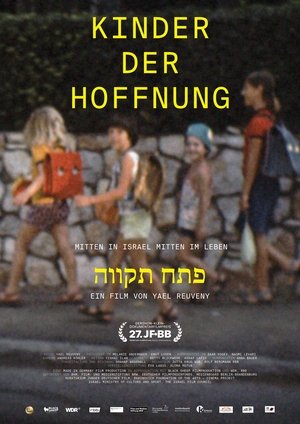
Sima Shimony, age 69, embarks on a mission to find her friends and staff from the "ALYN" Institute for Children with Disabilities, which was situated in the secluded San-Simon monastery in Jerusalem, during the 1960s. Armed with a small camera attached to her wheelchair, she sets off on a journey across the country together with her friend Pini Newirth, also a polio child, to unfold and reclaim the story of the children affected by the Polio epidemic. In a futile attempt to rebuild their bodies so they could walk, the children were subjected to excruciating medical procedures with no parents or family at their side. But growing up together forged a group of remarkable, self-driven women and men with disabilities who eventually launched the Disability Rights movement in Israel.
I AM ISRAEL is an epic film which will take you on a soaring journey through the Land of the Bible, and introduce you to Jewish men and women whose very lives are a testimony to the promises of God.
In an unprecedented and candid series of interviews, six former heads of the Shin Bet — Israel's intelligence and security agency — speak about their role in Israel's decades-long counterterrorism campaign, discussing their controversial methods and whether the ends ultimately justify the means.
A self-described liberal from cosmopolitan Tel Aviv, Zaki wanted to get behind the politics of Israel’s controversial settlements in the occupied territories — so she moved there, temporarily, setting up an improvised cafe where she could chat with settlers from her own generation.
Nobody captured the atmosphere of 1990s Berlin better than German photographer Daniel Josefsohn, who died in 2016 at the age of 54, leaving his mark in advertising with his irreverent aesthetic and punk sensibility. It was his spontaneous, imperfect images shot for an MTV campaign in 1994 that first made him famous.
In the nearly 50 years since Israel's decisive victory in the 1967 Six-Day War, hundreds of thousands of Israeli citizens have established expanding communities in the occupied territories of the West Bank. Frequently coming into direct conflict with the region's Palestinian inhabitants, and facing the condemnation of the international community, the settlers have been viewed by some as the righteous vanguard of modern Zionism and by others as overzealous squatters who are the greatest impediment to the possibility of peace in the region.
Free access to the Gaza Strip has remained closed to international journalists since the war began on October 7, 2023. AFP's permanent reporters are among the few professional witnesses to have experienced this conflict from the inside. They have watched, filmed, photographed, testified, all whilst struggling to ensure their own survival. From their exile, they recount this war, which is the deadliest ever recorded for members of the press.
Documentary that follows the lives of several Jewish refugees who fled to Shanghai during WWII.
Ze’ev Vladimir Jabotinsky? Most people don’t know much about him. Most people know he was the father of Herut movement, a revisionist. And who really knows what revisionism really means. A few people know that he translated Allan Poe’s Annabel Lee; even fewer read his historical novel, Samson. The Raven tries to fathom Jabotinsky’s deceptive character. The film follows his conflicted, controversial character, the meaningful choices, desires and abilities that eventually led him to end his life prematurely but left a huge mark on Zionism and Israel. - See more at: http://nfct.org.il/en/movies/the-raven-zeev-jabotinsky/#sthash.WoPKutbi.dpuf
Based on Dr. Ahron Bregman's book, this documentary examines the life and mysterious death of Ashraf Marwan, an Egyptian billionaire and double agent.
Director Miguel Kohan tries to connect the memories of his Gaucho-Jewish family with the fleeing of the Sephardim from the Iberian Península in 1492. Surinam, New York, Jamaica, and Brazil are some of the places where the untold story of those who escaped inquisition is visibilized.
During May 2001, Chilean filmmaker Miguel Littin traveled through historic Palestine, documenting everyday life amid the war—more precisely, the existential distance between a child throwing stones with a slingshot and tanks filled with artillery.
Mohammed El Kurd is a Palestinian boy growing up in the neighbourhood of Sheikh Jarrah in the heart of East Jerusalem. When Mohammed turns 11, his family is forced to give up part of their home to Israeli settlers, who are leading a campaign of court-sanctioned evictions to guarantee Jewish control of the area. Shortly after their displacement, Mohammed’s family and other residents begin peacefully protesting against the evictions, determined not to lose their homes for good. In a surprising turn, they are quickly joined by scores of Israeli supporters who are horrified to see what is being done in their name. Among them is Jewish West Jerusalem resident Zvi Benninga and his sister Sara, who develop a strong relationship with Mohammed and his family as they take on a leading role in organizing the protests.
John Ware journeys to Israel for a fresh look at how it has responded to the changes sweeping the region in the wake of the Arab Spring. He meets Israelis from all walks of life to go beyond the news clichés and analyse what is next for the world's only Jewish state as both the religious and the secular battle over its future.
Set during the second Intifada, this documentary follows four Palestinian families living in Dheisheh Refugee Camp near Bethlehem. Fadi is 13 and cares for his 4 younger brothers, the Hammashes are a close-knit family who pass on the lessons of life with humor and passion, Sana is a single woman who endures long commutes to do community work, and Emad and Hanan are a young couple trying to shield their daughter from the harsh realities of the occupation. They talk about their past and discuss the future with humor, sorrow, frustration and hope. Until When paints an intimate in-depth portrait of Palestinian lives today.
By the age of thirty he’d already become the most famous poet in the Jewish world. He spent very few years living in Tel Aviv, but he loved the city dearly. Some 100,000 people attended his funeral in 1934. “King of the Jews” is a portrait of the most beloved Jew of his day, Chaim Nachman Bialik. Combining special animation, a voice track by Chaim Topol, rare archival footage, long-forgotten photographs, poems by Bialik performed by Ninet and interviews with the foremost Bialik researchers and fans in Israel and around the world, this film retells the story of the little boy from the shtetl, who became King of the Jews.
DVD #3 of Psalm.83: The Missing Prophecy Revealed, by Bill Salus; The present hostilities experienced in the Middle East between the Arabs and Jews can be traced to a disposition of hatred, originating almost four thousand years ago. In this teaching video, Bill Salus explains how the ancient family feuds between the Middle East patriarchs and matriarchs are the underlying roots of today's Arab-Israeli conflict. Find out what nations were formed from their loins and why their descendants still covet the rich content of father Abraham's unconditional covenant.
How US politicians and diplomats, over the past 25 years, have come close to achieving something almost impossible: securing peace between the State of Israel and its Arab and like-minded neighbors, mired in a struggle both dialectical and violent since the early 20th century, due to historical and religious reasons, entrenched offenses and prejudices, and the invisible and tyrannical hand of third countries' geopolitical interests in the area.
Disturbing the Peace follows a group of former enemy combatants - Israeli soldiers from the most elite units, and Palestinian fighters, many of whom served years in prison - who have come together to challenge the status quo and and say “enough". The film traces their transformational journeys from soldiers committed to armed battle to non-violent peace activists. It is a story of the human potential unleashed when we stop participating in a story that no longer serves us, and with the power of our convictions take action to create a new possibility.
They were more than a million Jews. Between 1946 and 1974, this million is the number of forgotten fugitives, expelled from the Arab world, and whom history would like to forget, while the victims themselves have hidden their fate under a veil of modesty.