An exploration of Rodez Cathedral and its stained glass windows: praying figures and scientific imagery. A study on color, repetition and flickering consisting of 292 photographs.
Filmed in the skies above France and the United States, The Lafayette Escadrille tells the story of the American volunteers who flew and fought for France in World War 1, becoming the founding squadron of American combat aviation.
Following the 1974 French presidential campaign with Valéry Giscard d’Estaing.
For nine months in 1930, seven Bretons, lobster fishermen, were "forgotten" on a volcanic island by their employers, Normans from Le Havre, heirs of the last French whalers. Four employees would die on the spot. Their descendants today revive the memory of this human tragedy which also struck 42 Madagascans. Starting from a sordid social conflict, the documentary shows that the “Forgotten Saint Paul” mark the end of an era of “colonization”, a term rarely used for the French Southern Territories, but nevertheless close to reality. This is the story of the Third World, as its discoverer, Yves de Kerguelen, named it.
Film student Laïs Decaster trains her camera on her close-knit group of friends to capture daily life in the suburb of Argenteuil, near Paris.
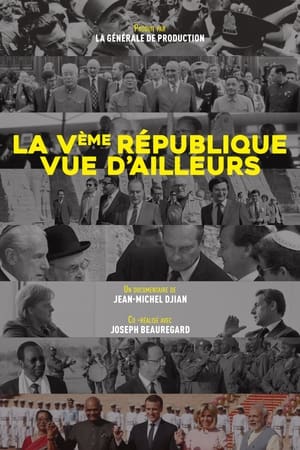
On October 4, 2018, France celebrated the 60th anniversary of the Fifth Republic. It is a republic born in the throes of the Algerian War and one which—from the day it was founded by General de Gaulle until the presidency of a very Jupiterian Emmanuel Macron—has been assailed as a “Republican monarchy” by partisans of a more assertive parliamentarian state. By revisiting the struggle of those who dared oppose the new regime — only to suffer a crushing defeat on September 28, 1958, when they were barely able to garner 20% of the vote against the constitutional text — this film shines a powerful new light on the origins of the Fifth Republic and its consequences for the next 60 years. It is a constitutional debate that planted the seeds for a complete upheaval of the French political landscape, on the left in particular, and set the country in motion toward what would be called the Union of the Left.
The film tells of the radical life-search by the Swiss writer Paul Nizon, born 1929 in Bern, Switzerland, who became what “he was meant to be” in Paris. Now 90-year-old, Paul Nizon grants insights into his life and work in a self-ironic, direct manner. The intimate portrait of a great literary outsider emerges, for whom the risk of life and the risk of writing merge into one and the same work of art.
Police à bout de souffle
Ernest Pignon Ernest is a French visual artist who is considered one of the pioneers of urban art in France. This film recounts the major stages of a considerable body of work that began in the 1960s on the Albion plateau and culminated in Les Extases at the Abbey Church of Bernay. The film gives him space to speak freely, generously, and with conviction. Ernest Pignon Ernest's hands are ancient, reaching back from Caravaggio to Titian, from Masaccio to El Greco. His works speak to us. They transform our streets into fictional spaces, reminiscences, rituals.
In 1974, a group of friends, inspired by what they had seen in Italy and driven by their common passion, organized a comic book fair in their Charente town of Angoulême. Half a century later, the event has become an internationally renowned festival, which is about to celebrate its 50th edition. This documentary tells the story of the creation of the Angoulême International Comics Festival in the context of the 1970s, and the evolution of the event since then, which has made the city a world reference in an exponentially growing bubble market.
Who has not dreamed of embracing the city of Paris from the sky? Fly and explore the exceptional places that have shaped and are shaping the history of Paris: Eiffel Tower, Notre Dame de Paris, the Louvre, the Bastille, Invalides, the Opera ... Far from the clichés of postcards out of marked routes by travel guides, this new film invites viewers to an exceptional private tour of the city of Paris. Travel through the centuries and be witnesses of the birth of the City Lights. This new production reveals one of the most influential capitals in the world as you've never seen.
何以为家
Bachar à la ZAD
Across two countries, France and Algeria, and five cities, Mohamed Gholam takes us south to tell us about the earthen and vernacular-inspired architecture of André Ravéreau. Passing through Lyon, Marseille, Algiers, and Djelfa, this adventure will take us to Ghardaïa, in the Algerian desert. The documentary presents the following buildings: L'Orangerie in Lyon, the Village Terre de l'Isle-d'Abeau in Villefontaine, the Unité d'Habitat or Cité Radieuse in Marseille, L'Aérohabitat in Algiers, the Palais des Raïs or Bastion 23 in Algiers, the Hôtel des Postes in Ghardaïa, and the low-cost housing of Sidi Abbaz de Bounoura.
Charles de Gaulle, the first president (1958-1969) of the Vth Republic, France’s current system of government, left his mark on the country . He was statesman of action and has been compared to a monarch. This film depicts the general’s personality through the great events of his presidential term, at a time when the world was undergoing considerable changes.
The Channel Tunnel linking Britain with France is one of the seven wonders of the modern world but what did it take to build the longest undersea tunnel ever constructed? We hear from the men and women, who built this engineering marvel. Massive tunnel boring machines gnawed their way through rock and chalk, digging not one tunnel but three; two rail tunnels and a service tunnel. This was a project that would be privately financed; not a penny of public money would be spent on the tunnel. Business would have to put up all the money and take all the risks. This was also a project that was blighted by flood, fire, tragic loss of life and financial bust ups. Today, it stands as an engineering triumph and a testament to what can be achieved when two nations, Britain and France put aside their historic differences and work together.
Pierre Carles questions the privatization of the leading French televisions channel : is it not scandalous that the TFI-Bouygues concession has been automatically renewed since 1987 ? Taking up the anti-television fight he initiated with "Pas vu Pas pris", his first film, he confronts the people responsible for the news who have always avoided tackling this taboo subject. But the investigation does not go as planned : the old dinosaurs and young guardians now how to handle this media critic. To find his "fighting spirit" again, Carles calls to arms his friends and changes methods : Henceforth, no more concessions !
At the close of Jacques Chirac's life, politician Jean-Louis Debré has wished to make a film to celebrate his friend, to tell the story of their friendship and professional understanding, and to make an intimate portrait of the former President of France through the accounts of a few very close friends. Thanks to Jean-Louis Debré's presence, Claude Chirac and some of Jacques Chirac's closest friends, famous or unknown, agreed to talk to the camera, sometimes for the first time, to evoke their untold-before memories and tell about the moments that bonded the two men for a lifetime.
Un peu, beaucoup, passionnément... Les Présidents et les Français
In the Douro, five winemakers get together with the aim of exporting Portuguese wine to the world.