Examines the intergenerational impact of addiction by chronicling the love, labor, loss, and uncertainty of one woman’s struggle to live a life of sobriety. Weaving together moments of glee, fulfillment, acceptance, sorrow, and disappointment, this documentary takes an intimate look at the bonds that hold one family together and a disease that threatens to tear them apart.
In the fifties, when the future Democratic Republic of Congo was still a Belgian colony, an entire generation of musicians fused traditional African tunes with Afro-Cuban music to create the electrifying Congolese rumba, a style that conquered the entire continent thanks to an infectious rhythm, captivating guitar sounds and smooth vocals.
Hanoise is a portrait of the little known, but very rich, experimental music scene from Hanoi, the capital of Vietnam. It showcases a diverse array of the city's musical mavericks and avant-garde explorers, merging the sounds of the city and the experimentations of a young community braving the local cultural prohibitions.
After concluding the now-legendary public access TV series, The Pain Factory, Michael Nine embarked on a new and more subversive public access endeavor: a collaboration with Scott Arford called Fuck TV. Whereas The Pain Factory predominantly revolved around experimental music performances, Fuck TV was a comprehensive and experiential audio-visual presentation. Aired to a passive and unsuspecting audience on San Francisco’s public access channel from 1997 to 1998, each episode of Fuck TV was dedicated to a specific topic, combining video collage and cut-up techniques set to a harsh electronic soundtrack. The resultant overload of processed imagery and visceral sound was unlike anything presented on television before or since. EPISODES: Yule Bible, Cults, Riots, Animals, Executions, Static, Media, Haterella (edited version), Self Annihilation Live, Electricity.
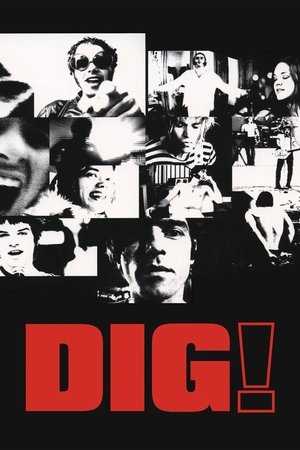
A documentary on the once promising American rock bands The Brian Jonestown Massacre and The Dandy Warhols. The friendship between respective founders, Anton Newcombe and Courtney Taylor, escalated into bitter rivalry as the Dandy Warhols garnered major international success while the Brian Jonestown Massacre imploded in a haze of drugs.
A journey through six different countries and characters into a world where chemistry is the ultimate response to human pursuits of well-being.
13 August 1961: the GDR closes the sector borders in Berlin. The city is divided overnight. Escape to the West becomes more dangerous every day. But on September 14, 1962, exactly one year, one month and one day after the Wall was built, a group of 29 people from the GDR managed to escape spectacularly through a 135-meter tunnel to the West. For more than 4 months, students from West Berlin, including 2 Italians, dug this tunnel. When the tunnel builders ran out of money after only a few meters of digging, they came up with the idea of marketing the escape tunnel. They sell the film rights to the story exclusively to NBC, an American television station.
A roller-coaster ride through the history of American exploitation films, ranging from Roger Corman's sci-fi and horror monster movies, 1960s beach movies, H.G. Lewis' gore-fests, William Castle's schlocky theatrical gimmicks, to 1970s blaxploitation, pre-"Deep Throat" sex tease films, Russ Meyer's bosom-heavy masterpieces, etc, etc. Over 25 interviews of the greatest purveyors of weird films of all kind from 1940 to 1975. Illustrated with dozens of films clips, trailers, extra footage, etc. This documentary as a shorter companion piece focusing on exploitation king David F. Friedman.
Learn the terrifying, true story about thirteen months that changed history! In November of 1966 a car full of kids encountered a creature unlike anything they'd ever seen before. In the weeks and months to follow, the monster – now known as The Mothman – was sighted again and again on country roads and around the state of West Virginia.
Tucumán, Argentina, 1965. Three years before George A. Romero's Night of the Living Dead was released, director Ofelio Linares Montt shot Zombies in the Sugar Cane Field, which turned out to be both a horror film and a political statement. It was a success in the US, but could not be shown in Argentina due to Juan Carlos Onganía's dictatorship, and was eventually lost. Writer and researcher Luciano Saracino embarks on the search for the origins of this cursed work.
A documentary that explores the myth behind the truth. Different people around the globe reinterpret the legend of Che Guevara at will: from the rebel living in Hong Kong fighting Chinese domination, to the German neonazi preaching revolution and the Castro-hating Cuban. Their testimonies prove that the Argentinian revolutionary's historical impact reverberates still. But like with all legends, each sees what he will, in often contradictory perspectives.
Pablo Escobar was the richest, most powerful drug kingpin in the world, ruling the Medellin Cartel with an iron fist. Andres Escobar was the biggest soccer star in Colombia. The two were not related, but their fates were inextricably-and fatally-intertwined. Pablo's drug money had turned Andres' national team into South American champions, favored to win the 1994 World Cup in Los Angeles. It was there, in a game against the U.S., that Andres committed one of the most shocking mistakes in soccer history, scoring an "own goal" that eliminated his team from the competition and ultimately cost him his life. The Two Escobars is a riveting examination of the intersection of sports, crime, and politics.
Chris Marker’s A Grin Without a Cat is an epic political essay tracing the rise and decline of the global left from the 1960s to the 1970s. Through archival footage and commentary, the film examines revolutionary movements in France, Latin America, and beyond, reflecting on the ideals, failures, and fading hopes of a generation.
After rigorous testing in 1961, a small group of skilled female pilots are asked to step aside when only men are selected for spaceflight.
A documentary account by award-winning filmmaker John Ferry of the events that led up to the 1969 Native American occupation of Alcatraz Island as told by principal organizer, Adam Fortunate Eagle. The story unfolds through Fortunate Eagle's remembrances, archival newsreel footage and photographs.
The film focuses on the exciting life journey of Swiss writer Katharina Zimmermann. She follows her husband on a mission to the jungle in Indonesia where she raises their four children and five foster children and lives through the military coup. Back in Switzerland Katharina discovers her voice and finds her path. Now, at eighty, she is writing her life story. Yet suddenly she faces another battle because her publisher is threatening to let her go.
In 1966 a group of determined young men defied the New Zealand government and launched a pirate radio station aboard a ship in the Hauraki Gulf.
This experimental 1970 color documentary film, ostensibly designed to provoke classroom discussion employs a boldly unconventional approach to addressing the issues of drug addiction, featuring the music of Canadian singer-songwriter Bruce Cockburn. The film eschews narration for montage effects and extended fly-on-the-wall scenes of various drug users in conversation.
The film looks at men and women of color in the U.S. Merchant Marine from 1938-1975. Through chronicling the lives of these men and women who, with a median age of 82, are beset with a host of life-threatening illnesses, the movie tells how they navigated issues of racism, disparities in the workplace, gender and familial relations.
Experimental movie, where a man comes home and experiences LSD. His kaleidoscopic visions follow, with readings inspired by the Tibethan Book of the Dead.