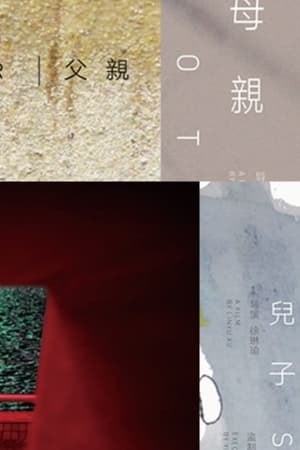
A day of Xiaoyang, the curator of a village church. Xiaoyang and her husband have just registered their marriage, but they cannot hold a wedding in the church for her husband is not a Christian. Before the wedding, she is waiting for her husband’s baptism.
A boy with horns gathers a group of Cosers, each armed with the same traditional woodworking tools, from the grocery store, the old cathedral, the gatehouse, the forest, the farmyard, the electric mahjong parlour, the old castle and so on. At midnight, with clumsy labor, they made a huge cross.
In the summer of 2007, Gan Xiaoer led an independent film projection team, using projectors and self-made screens, to tour villages in Henan province to show his feature film "Raised from dust" for 8 times, and recorded the process. The 81-minute version of Church Cinema records only one stop, the Qiliying Church, where "Raised from dust" was shot.
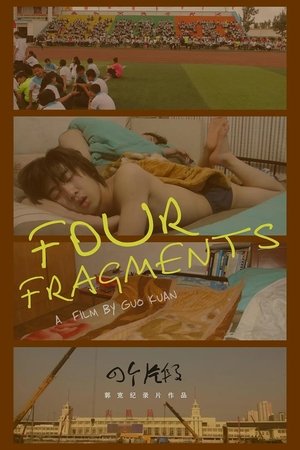
One boy, one girl. One close space, one silent night. What is the relation between them? The great works in art history structure, influence their relations, and show us something. At the same time, the boy and the girl convey their experience and taste on these works. Usually, a boy and a girl will make love to end a scene or a film, but it didn’t happen. It seems that they spend the night clearly, but the tomorrow is still unknown.
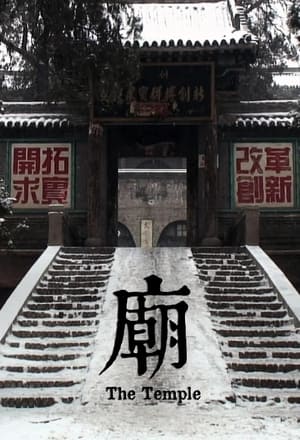
A small rural township called Red White was seriously devastated by the May 12th Earthquake in China 2008. A 62-year-old Taoist survived even though his temple was largely torn by the disaster. This documentary tells the story of how the Taoist practices the widely believed Chinese traditional religion and the local people’s daily life during the township’s post-quake reconstruction.
Andy is a novelist who works from home. One day, a girl mysteriously appears in his toilet. She claims to be from the future and needs his help. Her name is Pomegranate.
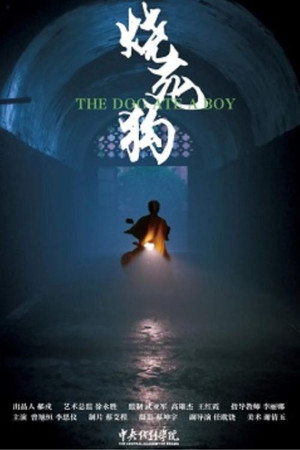
The day Xia Tong saw the flower burning, his father found his dream again. His little snore sounded like a baby crying.
His father was sick, and the boy Xia Tong was always surrounded by strange dreams about girls while he was taking care of him. Grandma's answer made him disagree. To find out the truth, when the flame rose from the bottom of the river, he stepped on the train from the clouds.
I used footage from the internet and a part of historical text, their interconnection and what produced are not "scary", but some coincidences that history provided.
This is a complete video that was downloaded from the Internet. I didn't make any changes, just added a title at the beginning and a line of text at the end. The time frame on the video appears to indicate an event in the future, but this is reality, not science fiction.
The story happened near the Shuangjing subway station in Beijing. The female stall owner was aggrieved by the selective enforcement of urban management and expressed that she would fight to the end for fairness. When the urban management team forced her to close, she burst into tears and complained of social injustice. Even in the urban management team, she had to ask for fairness. But in the face of institutional chaos, she finally chose to compromise and continue the cat and mouse game. The old man is a Christian, is he helpless in obedience to fate? How many people's melody played by the Huqin sounded in the smog of Beijing?
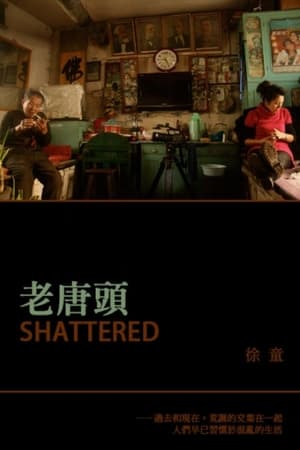
A microcosm of China past and present flows through Xu Tong’s intimate docu “Shattered,” in which the maverick indie filmmaker continues to refine his techniques and concerns shown in his previous “Wheat Harvest” and “Fortune Teller.”
Aoluguya, Aoluguya is the first film in Gu Tao’s Ewenki Trilogy. A tale that unfolds in the Aoluguya forest, featuring such unique characters as a mother who dulls her sadness over the absence of her son, Yuguo, with alcohol; her brother; and Maria, the tribal chieftain who watches over them.
Yuguo, from Mongolia, lost his father when he was very young. His mother Liuxia was not able to raise him as a heavy drinker. With social support, she sent Yuguo to Wuxi for free education. Liuxia is depressed all day long, and she finds sustenance of missing Yuguo in reindeer and wine. One winter holiday after many years, Yuguo returns to his hometown, the Evenki settlement deep in the Greater Khingan mountains. At that time, he is no longer the boy who just left home, but a thirteen-year-old teenager. Facing alcoholic mother, poetic uncle, pure people from the tribe, familiar yet strange forest, Yuguo, who grew up in the city, doesn’t know what to do. In the snow-laden mountains of Aoluguya, northeast of Inner Mongolia, the film chronicles their brief time together. Yuguo and His Mother is the second documentary of Gu Tao’s Evenki trilogy.
An old Beijing Opera performer who moves to the U.S. forgets his lines on the stage which causes him considerable distress. A female protege of his takes him for a walk on the beach along with her dog and her half-Chinese son. A string of dream-like memories of his old days are triggered by this walk, and he is gripped by a wave of nostalgia as the singing of Beijing Opera comes on in the background, making the boundary between reality and fantasy all the more blurry. The sea glitters in the setting sun and seabirds sing above the sea, the beautiful scene which awakes him from his trance...
Since 2007, the director of this film has initiated and participated in charity activities for the relief of the refugees in Tiananmen Square. The main line of the film is the director and Japanese friendly people who visited the refugees in Nanxiao Street, Beijing, where they lived in 2014, and tracked the scene of their livelihood on Tiananmen Square. The film was edited in combination with the old video materials shot by the director for eight years.
The player of Jia Zhangke's early film "Xiao Wu" and the famous independent film activist Wang Hongwei talked about Chinese independent films at the IFF Independent Film Forum.
‘Body’ is an object we are all familiar with. For British sculptor Anthony Gormley, it is a medium for expressing thoughts about space, while for young female artist Wang Ying, it is a potential vehicle for expressing emotions. This documentary uses a split-screen method to create a three-dimensional space like a "body". It not only explores the artistic concept and development of Wang Ying, a female artist born in the 1990s who studied in the UK but also completed it on this basis. The documentary creator (me) thinks about her and her body, from'meeting','seeing' to'existence'
In the dream I had one early morning in 2014, I was sitting in the backseat of a car. The driver suddenly turned to look at me and said: Why aren’t you filming? It was my second elder sister who had already passed away. After her death, I began to keep a diary and take pictures. When I got a video camera, I began to film the daily life of my family. I filmed out of the fear of death and loss. The idea was to capture everything on film before it disappeared. 2015 was the 20th anniversary of my sister’s death. That dream seemed to tell me to face her death. Death did not stop the passing of time, and the family members I was filming continued to avoid their grief which hadn’t subsided with time. Birth and death continue to alternate in our lives, and we are always getting ready for the day when we must say goodbye.
I just watch the news of war in a distant country on my mobile. My fingers go back day by day to the day the war broke out and pose to see comments posted on the Facebook News Feed that I follow. Outside, I have friends who participated in anti-war rallies.