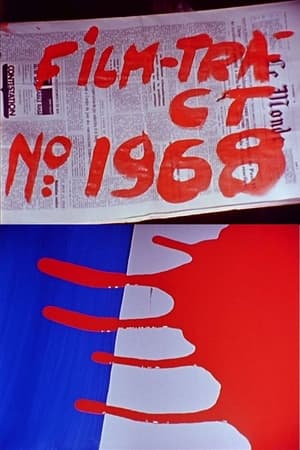
In the 1968 movement in Paris, Jean-Luc Godard made a 16mm, 3-minute long film, Film-tract No.1968, Le Rouge, in collaboration with French artist Gérard Fromanger. Starting with the shot identifying its title written in red paint on the Le Monde for 31 July 1968, the film shows the process of making Fromanger’s poster image, which is thick red paint flows over a tri-color French flag. —Hye Young Min
Clouds 1969 by the British filmmaker Peter Gidal is a film comprised of ten minutes of looped footage of the sky, shot with a handheld camera using a zoom to achieve close-up images. Aside from the amorphous shapes of the clouds, the only forms to appear in the film are an aeroplane flying overhead and the side of a building, and these only as fleeting glimpses. The formless image of the sky and the repetition of the footage on a loop prevent any clear narrative development within the film. The minimal soundtrack consists of a sustained oscillating sine wave, consistently audible throughout the film without progression or climax. The work is shown as a projection and was not produced in an edition. The subject of the film can be said to be the material qualities of film itself: the grain, the light, the shadow and inconsistencies in the print.
Warsaw's Central Railway Station. 'Someone has fallen asleep, someone's waiting for somebody else. Maybe they'll come, maybe they won't. The film is about people looking for something.
Mostly dark, rejecting images which are repeated. A stone wall, the chamber of a revolver which is, at first not recognizable, a close-up of a cactus. The duration of the takes emphasises the photographic character of the pictures, simultaneously with a crackling, brutal sound. (Hans Scheugl)
The subject is a group of women bathing in a public swimming pool. The camera was placed on the edge of the pool and the full extent of the film shows the women in the pool. Only the heads and shoulders of most of the women are visible but it is possible to see they are wearing rented bathing attire.
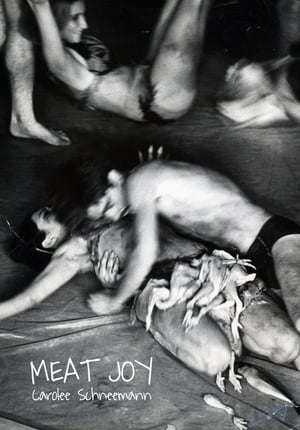
"Meat Joy is an erotic rite — excessive, indulgent, a celebration of flesh as material: raw fish, chicken, sausages, wet paint, transparent plastic, ropes, brushes, paper scrap. Its propulsion is towards the ecstatic — shifting and turning among tenderness, wildness, precision, abandon; qualities that could at any moment be sensual, comic, joyous, repellent. Physical equivalences are enacted as a psychic imagistic stream, in which the layered elements mesh and gain intensity by the energy complement of the audience. The original performances became notorious and introduced a vision of the 'sacred erotic.' This video was converted from original film footage of three 1964 performances of Meat Joy at its first staged performance at the Festival de la Libre Expression, Paris, Dennison Hall, London, and Judson Church, New York City."
A big-screen look into one of America's most successful entertainment industries, NASCAR racing.
12,000 feet down, life is erupting. Alvin, a deep-sea mechanized probe, makes a voyage some 12,000 feet underwater to explore the Azores, a constantly-erupting volcanic rift between Europe and North America.
Filmed in IMAX, a team of explorers led by Pasquale Scaturro and Gordon Brown face seemingly insurmountable challenges as they make their way along all 3,260 miles of the world's longest and deadliest river to become the first in history to complete a full descent of the Blue Nile from source to sea.
In 1966, John Harlin II died while attempting Europe's most difficult climb, the North Face of the Eiger in Switzerland. 40 years later, his son John Harlin III, an expert mountaineer and the editor of the American Alpine Journal, returns to attempt the same climb.
Originally shown in IMAX theaters, this film presents highly detailed and lavish views of the gorgeous scenery of the Pacific Northwest, both as they appeared before the top 1,300 feet of Mount St. Helens was blown into the sky and during the disaster's dramatic aftermath.
A breathtaking view of Zion National Park filmed originally in the IMAX format.
La niña más guapa de Aguilón
Alleged silent black-and-white short film shot at Apsley Gate, Hyde Park, London. It was claimed to be the first motion picture until pre-dating footage shot by Louis Le Prince was discovered. It was never publicly shown and is now considered a lost film with no known surviving prints or stills.
Journey across Morocco, Spain, Mexico, Argentina, Patagonia, Texas and British Columbia, to meet vaqueros, gauchos, baqueanos and cowboys - all part of a single global horse culture, an unbroken trail stretching back 1,500 years.
Het korps Mariniers is a documentary about the Royal Dutch Marine Corps, which Paul Verhoeven made while being assigned to the Marine Film Service as a documentary filmmaker.
Wild Ocean is in an uplifting, giant screen cinema experience capturing one of nature's greatest migration spectacles. Plunge into an underwater feeding frenzy, amidst the dolphins, sharks, whales, gannets, seals and billions of fish. Filmed off the Wild Coast of South Africa, Wild Ocean is a timely documentary that celebrates the animals that now depend on us to survive and the efforts by the local people to protect this invaluable ecological resource. Hope is alive on the Wild Coast, where Africa meets the sea.
A portrait of artist, actress, poet and occultist Marjorie Cameron, it shows images of her paintings and recitations of her poems. Preserved by the Academy Film Archive in 2006.
A short film warning the unaware housewife of the dangers of “dry cleaning” with gasoline at home.
"Africa Light" - as white local citizens call Namibia. The name suggests romance, the beauty of nature and promises a life without any problems in a country where the difference between rich and poor could hardly be greater. Namibia does not give that impression of it. If you look at its surface it seems like Africa in its most innocent and civilized form. It is a country that is so inviting to dream by its spectacular landscape, stunning scenery and fascinating wildlife. It has a very strong tourism structure and the government gets a lot of money with its magical attraction. But despite its grandiose splendor it is an endless gray zone as well. It oscillates between tradition and modernity, between the cattle in the country and the slums in the city. It shuttles from colonial times, land property reform to minimum wage for everyone. It fluctuates between socialism and cold calculated market economy.