With war and acts of violence in the background, Aida tells the story of a fascinating and tense love triangle between the Egyptian princess, Amneris, Ramades, an officer, and Aida, a Nubian princess, captured and reduced to slavery. The historical scenes and triumphal marches, which have contributed to the popularity of this opera, are followed by intimate but powerful duets and introspective moments of great intensity.
Having disposed of his enemies, Lucio Silla is now all-powerful. He wants to marry Giunia, but underestimates how much she hates him. After all, he has not only had her father murdered, but has also banished her beloved, Cecilio. At first, Giunia is misled into thinking that Cecilio is dead; with the help of Cinna, however, the lovers manage to meet up again. The power of love and Cinna’s machinations finally persuade Silla to relinquish his power.
During World War I, in an unnamed country, a soldier named Tamino is sent by the Queen of the Night to rescue her daughter Pamina from the clutches of the supposedly evil Sarastro. But all is not as it seems.
The film follows four families, with different nationalities (French, German, Russian and American) but with the same passion for music, from the 1930s to the 1960s. The various story lines cross each other time and again in different places and times, with their own theme scores that evolve as time passes. The main event in the film is the Second World War, which throws the stories of the four musical families together and mixes their fates. Although all characters are fictional, many of them are loosely based on historical musical icons (Édith Piaf, Josephine Baker, Herbert von Karajan, Glenn Miller, Rudolf Nureyev, etc.) The Boléro dance sequence at the end brings all the threads together.
Peaches - artist, feminist, rock star. She has been challenging gender stereotypes for over 20 years and is on par with the icons of the pop and rock world. With exclusive private archive material and current footage of preparations and concerts of her 2022 jubilee tour “20 Years of Teaches of Peaches”, we learn how the Canadian Merrill Nisker became the internationally celebrated musician and electro-clash icon Peaches.
A brilliant young fund manager leaves her unfulfilling job and long-term boyfriend to chase her lifelong dream of becoming an opera singer in the Scottish Highlands.
Recorded at the Musiektheater, Amsterdam on 21 & 25 January 2008. Performed by De Nederlandse Opera, composer Jean-Philippe Rameau's renowned tragedy "Castor et Pollux" tells the myth-based story of the selfless love between two brothers: Castor, who is mortal, and the immortal Pollux. When Castor dies trying to prevent the kidnapping of the woman he loves, Pollux decides to become mortal and replace his brother in the Underworld. Finnur Bjarnason, Henk Neven and Anna Maria Panzarella star.
Dyke Hard is a failed rock group travelling to a battle of the bands competition in the big city. The journey is further filled with bizarre, fierce and passionate encounters with cyborgs, ghosts, a thai boxer, roller derby gals, ninjas, motorcycle gangs and a mysterious billionaire all of whom will do everything to stop the band from making it in time to the battle.
The Christoph Marthaler production of Leoš Janáček's "Věc Makropulos", recorded live at the Salzburger Festspiele on 8 & 30 August 2011. Angela Denoke stars as Emilia Marty, with Raymond Very as Albert Gregor, Peter Hoare as Vitek, Jurgita Adamonyté as Krista, and Johan Reuter as Jaroslav Prus. Esa-Pekka Salonen conducts the Wiener Philharmoniker.
A devil is at work in the Ukrainian village of Sorochintsy, terrifying residents and travellers alike. Among them a farmer whose daughter is not allowed to marry her lover because her quarrelsome stepmother is against it.
A musical of one man's emotional journey through love, heartbreak, and healing.
Kanarie (Afrikaans for 'Canary') is a coming-of-age musical war drama. Drafted into the South African army during apartheid, a young soldier joins the military's traveling choir, and romance on the battlefield causes him to deal with his long-repressed sexual identity through hardship, camaraderie, first love, and the liberating freedom of music, the true self can be discovered.
A musical adaptation of Victor Hugo's novel "Notre Dame de Paris" which follows the gypsy dancer Esmeralda and the three men who vie for her love: the kind hunchback Quadimodo, the twisted priest Frollo, and the unfaithful soldier Phoebus.
TANNHÄUSER UND DER SÄNGERKRIEG AUF WARTBURG is a grand opera by Richard Wagner in three acts. After experiencing boundless sensuality and freedom with the fun-loving Venus (soprano), the singer Tannhäuser (Tenor) finds it impossible to conform to the cultured setting of his betrothed Elizabeth (soprano), who loves him. During a singing contest, Tannhäuser describes the affair with Venus as the ultimate love experience and because of that, he is cast out from the established society. Thanks to Elizabeth's intervention, he is allowed to undertake a pilgrimage to the Pope to ask for the Holy Father's pardon. If the Pope accepts to forgive him, he would be allowed to take back his place in society. Tannhäuser accepts. But fate will not allow him to meet with his beloved Elizabeth again in this life. This is a recording of the legendary staging by Götz Friedrich for the 1978 Bayreuth Festival conducted by Sir Colin Davis.
NORMA tells the tragic story of a supposedly chaste druidic priestess, who is driven to murderous jealousy by her lover's inconstancy. But she forgoes vengeance, protects innocence, and sees to it that the guilty atone for their crimes. Fiorenza Cedolins, Sonia Ganassi, Vincenzo La Scola, and Andrea Papi star in this 2007 Gran Theatre Del Liceu/Grand Theatre de Geneve co-production of the Bellini opera.
Javi comes to a sauna club looking for a job. But soon he'll find out a place full of secrets, the biggest of them being a strange man who will fall in love with him: the Phantom of the Sauna.
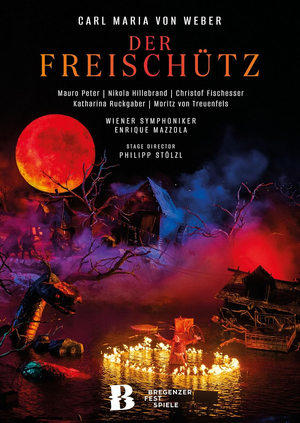
The legendary director Ruth Berghaus created this staging of Carl Maria von Weber’s Der Freischütz as a gripping theatrical experience for the Zurich Opera in 1993. Its revival in 1999 was a roaring success. With sets by Hartmut Meyer and costumes by Marie-Louise Strandt, Berghaus’ staging avoids the local peasant colour conventionally associated with Weber’s opera. Chorus and orchestra of the Zurich Opera House are conducted by Nikolaus Harnoncourt, universally celebrated for the structural transparency of his interpretations, his intellectual penetration and his emotional understanding of both music and opera plot. And last but not least an all-star cast made this production a highly memorable event: the dramatic soprano Inga Nielsen as Agathe, one of her best roles, the Swedish soprano Malin Hartelius as Ännchen, the sought-after Heldentenor Peter Seiffert, who gives a convincing passionate Max, and many others.
Every woman wants him, every man wants to be him: Mozart’s version of the irresistible rogue who brings excitement with him and leaves destruction it his wake has always attracted top singing actors, as in this performance brilliantly led by James Levine. Samuel Ramey is Don Giovanni, pursued by the incandescent Karita Mattila (Donna Elvira) in her Met debut season and role, and by the white-hot avenging fury of Carol Vaness (Donna Anna.) Ferruccio Furlanetto delivers a masterful comic turn as the Don’s servant, Leporello.
Dr. Hohner, theatre physician at the Vienna Royal Theatre, murders his mistress, the star soprano when his jealousy drives him to the point of mad obsession. Ten years later, another young singer reminds Hohner of the late diva and his old mania kicks in. Hohner wants to prevent her from singing for anyone but him, even if it means silencing her forever.
Opera Australia's 1976 production of Lakmé, an opera in three acts by Léo Delibes, with a French libretto by Edmond Gondinet and Philippe Gille. Set in India during the British Raj, the story focuses on Lakmé, the daughter of a Hindu priest. Lakmé's life is troubled by her infatuation with a British officer.