Kitten of vluchteling?
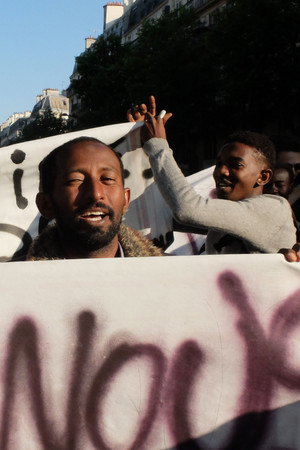
Djibi and Ange, two teenagers living on the streets, arrive at the Archipel, an emergency shelter in the heart of Paris. This documentary is a look at the Archipel, a shelter offering an innovative way to welcome families living on the streets.
Recounted mostly through animation to protect his identity, Amin looks back over his past as a child refugee from Afghanistan as he grapples with a secret he’s kept hidden for 20 years.
A look at the refugee crisis, with testimony from the refugees themselves.
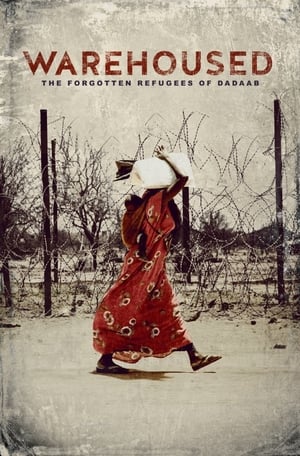
An estimated 12 million people live in refugee camps worldwide and only 0.1% are resettled, repatriated, or integrated into normal society each year. The feature-length documentary.
The inhabitants of the canyon of river Kupa, located on the border between Croatia and Slovenia, have historically been united due to their harsh living conditions, but this peaceful cohabitation between members of different cultures is threatened by the construction of iron fences to prevent the transit of refugees from Bosnia.
A family with five children flees the war raging in their home village on the Russian border. They end up in Mshanets, a farming village on the other side of the country, remote and unknown. Here the family starts building a new home. At the same time, two documentary makers come to the village, looking for a story. In the Lymar family they find the ideal characters for their film. But one day, when the renovation of their house is almost finished, the family disappears. The filmmakers go in search of their characters and along the way they try to find an answer to the question: what does a person need to feel at home?
In the Briançonnais mountains, in France, men and women on the roads of exile find the courage to cross the passes on foot, risking their lives. Arrived at the end of a long journey, exhausted, they do not know if they could settle down somewhere to start their life over. It is this transitional time that "The Adventure" tells. Ossoul, the Sudanese poet, Mamadou, survivor of an icy night at the Col de l'Échelle, Charlotte, Mother Courage and others are gradually getting back on their feet and settling to embark on a new life. Filmed over three years, "L'Aventure" is a story of resilience, friendships and revealed emotions. The portraits are drawn and deepened until everyone can recognize themselves in the other, put themselves in their place and understand them.
In 1963, Rosans, a village in the Hautes-Alpes region depopulated by the rural exodus, welcomed Harkis (military soldiers) forced to leave Algeria for supporting France during the Algerian War. Around thirty families settled in a camp below Rosans. Nearly half a century after their arrival, first- and second-generation Harkis and native Rosanais recount their experiences of this culture clash, often painful, sometimes happy. Language barriers, religious differences, living in barracks for 14 years, and unemployment were all obstacles to overcome in order to be accepted and then achieve mutual enrichment. Enriched with archive footage to explain the historical context of the time, the film seeks above all to express feelings and unspoken words.
In the Gaza refugee camp of Jerash, Palestinians face the critical issue of lacking identification documents. This situation undermines their rights and hinders access to essential services and opportunities.
Eighteen-year-old Shahnura is about to graduate from high school. Her mother spends hours at the dining table while Shahnura is at school, wondering if her mother, sister, and brother are still alive. Living in Germany without a passport or nationality, she listens to the harrowing stories of her mother and two friends who have experienced imprisonment and re-education camps in China. These accounts reveal the suffering, human rights abuses, forced adoptions, and the grim reality of the camps where the predominantly Muslim Turkic Uyghurs are tortured and mistreated.
‘The Great Wall has been completed at its most southerly point.’ So begins Kafka’s short story ‘At the Building of the Great Wall of China’, and so, at Europe’s heavily militarised south-eastern frontier, begins this film. In the shadow of its own narratives of freedom, Europe has been quietly building its own great wall. Like its famous Chinese precursor, this wall has been piecemeal in construction, diverse in form and dubious in utility. Gradually cohering across the continent, this system of enclosure and exclusion is urged upon a populace seemingly willing to accept its necessity and to contribute to its building.
Belfast-born actor Stephen Rea explores the impact of Brexit and the uncertainty of the future of the Irish border in a short film written by Clare Dwyer Hogg.
Produced by the U.S. Office of War Information, this short dramatizes the uneasy but ultimately hopeful integration of European war refugees into the small town of Cummington, Massachusetts. Narrated over silent images with a score by Aaron Copland, it blends documentary style and propaganda, underscoring both cultural tension and community acceptance.
Longe de Cabul
Refuge(e) traces the incredible journey of two refugees, Alpha and Zeferino. Each fled violent threats to their lives in their home countries and presented themselves at the US border asking for political asylum, only to be incarcerated in a for-profit prison for months on end without having committed any crime. Thousands more like them can't tell their stories.
The Syrian Civil War has created one of the greatest humanitarian crises in the last 60 years. REFUGEES: ENEMIES OR VICTIMS? investigates the very important question of whether the United States is doing enough to uphold its long tradition of helping those in need.
After twenty years, Wiam Al Zabari starts a conversation with his father. Why did they flee from Iraq? Why was that never discussed? Will he be able to let go of the past and embrace a Dutch future?
After crossing 11 countries irregularly to seek asylum in Canada, Peggy, Simon and their three children are waiting for the hearing that will determine whether they get refugee status or not. Having fled political repression in the Democratic Republic of the Congo, the family tries to rebuild a peaceful life in Montreal, in spite of the constant threat of deportation. Between ghosts from the past, hopes for the future, a complex legal maze and seemingly endless trial, the film delves into the struggle of the Nkunga Mbala family to remain in Canada. Offering unprecedented access to their hearing before the Immigration and Refugee Board, the film unveils the opaque process of claiming asylum in Canada.
The Stella Maris Berria is a tuna vessel destined for scrapping. However, Iñigo Mijangos and Iñigo Gutierrez, two members of the NGO Salvamento Marítimo Humanitario, have an unusual idea: to transform the fishing boat into a rescue boat to save refugees drowning in the Mediterranean Sea. That is how Aita Mari was born.